
Multisensory processing

The brain is truly clever: not only does it associate and transfer information, crossmodally, from one sense to another. And adapt, through crossmodal plasticity, to sensory impairments. (See our blog for the crossmodal correspondences between the senses and Crossmodal brain plasticity and empowering of sensory abilities.) It integrates and processes information from multiple senses too.


I have invited Dr Monica Gori, Head of the Unit for Visually Impaired People at the Italian Institute of Technology, to write this post on multisensory processing. Monica Gori has published over 130 scientific articles and book chapters as well as numerous conference abstracts. She has been the Principal Investigator on several research projects funded by the European Research Council, including the ERC StG MySpace project, she has developed early intervention systems like ABBI and iReach (some of which have been patented), and she has been awarded numerous prizes for her work (e.g., in the SmartCup and the TR35 Italian Innovation Award).
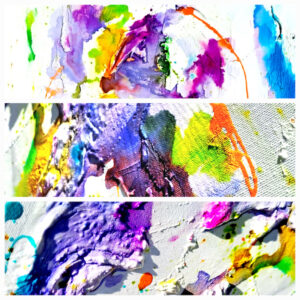
Image of one of Monica's highly textured paintings.

Monica also creates multisensory art.


Multisensory painting by Monica Gori. (Choline and enamel on canvas.)


An organism’s ability to relate to the external world depends on its ability to correctly process and interpret information from the environment. Our senses are our window to the world. They are the means by which we interact with the external world.


For example, when we are on the street, sight helps us understand where to go or where objects of interest are located, but hearing also helps us understand things, like whether a car is approaching or if there are people around us. Tactile information helps us understand how firmly we need to grip a handle to open a shop door or to shake hands with someone we haven’t seen in a long time. Smell allows us to detect if there is a restaurant nearby. These simple operations result from complex processes of sensory information processing. When a signal from the external world contacts our sensory receptors, our brain constructs a perception of the event and produces a response suitable for the situation.


However, even though we have many sensory modalities, we only have one brain that must integrate these sensory signals. Multisensory integration is a fundamental process that makes perception more than the sum of its parts, improving reaction time, precision, and response accuracy. Imagine if these senses were uncoordinated. Have you ever experienced a delay on television, where the voice is out of sync with the audio? It’s pretty annoying. In that case, the brain fails to synchronize the two signals because they are too far apart in time. The same happens during a thunderstorm when lightning is seen before the thunder is heard. Since light travels faster than sound, the two signals are perceived as separate. Typically, this doesn’t happen. Have you ever wondered why?


Each sensory system has its own timing in signal analysis. Visual and auditory signals, for instance, follow different pathways: vision through receptors in the eye and hearing through receptors in the ear. Our brain has learned to synchronize these two signals in space and time. Scientific results show that two signals from different modalities can be perceived as synchronous when their timing is within approximately 100 milliseconds. They are perceived as separate when the interval is longer, like on TV or with thunder and lightning. Fortunately, visual and auditory events are usually associated, and their delays fall within this window, allowing them to be perceived as a single event. Otherwise, imagine the confusion!


Our brain has also learned to integrate spatially discordant information within a limited window. If this spatial limit is exceeded, anomalies are perceived, much like in the ventriloquist effect, where the sound appears to come from the puppet’s mouth because the spatial distance is large, and vision strongly attracts the sound.


All these fascinating phenomena are explained by mathematical models developed and studied by researchers to understand better how our brains work. Over the past 20 years, I have studied the complexity of analyzing these signals, which allows for a great perceptual richness and their multisensory integration, and how it develops in children.


Our research has led to understanding how children and adults learn to integrate information from different sensory modalities in space and time and what happens when one sensory modality is missing. There are about 300 million visually impaired people worldwide, with approximately 15 million being children under the age of 15. Visual impairment in children hinders the development of many skills, such as movement, environmental perception, and play. Studying perceptual abilities and early intervention can make a difference, and it is a rapidly expanding field.


Monica has also very kindly suggested nine activities (WeDraw) for us. See our blog for more Activities; especially 34-36.


Some suggestions for further listening and watching:

Multi-Modal Perception – The basics

Multi Sensory Perception

Multisensory development and technology for children and adults

The Blind Kitchen Eating in the Dark

Try this bizarre illusion

Your sensory health matters. Here’s why

Crossmodal brain plasticity and empowering of sensory abilities

Research on crossmodal brain plasticity has not only found that the brain compensates for sensory impairments. For example, so that people who are born blind process auditory information in both the auditory and the visual areas – not just the auditory like the fully sighted. (See our blog for the scientific approach.) It has also shown that the brain adapts to artificial input restoring the impaired senses and computer algorithms translating information from one sense to another. However, while people automatically recognise information processed through their natural crossmodal correspondences (see our blog for the crossmodal correspondences between the senses), they have to learn to interpret the sensations from both brain implants for hearing and sensory substitution devices from vision to hearing (see our blog for A Feel for Art.)


I have invited Carina Sabourin, Dr Yaser Merrikhi, and Professor Stephen G. Lomber, Cerebral Systems Laboratory, McGill University to write this blog post about crossmodal brain plasticity and empowering of sensory abilities. Carina Sabourin, Yaser Merrikhi, and Stephen G. Lomber investigate cortical plasticity in the auditory and visual cortices following hearing loss and the initiation of hearing with cochlear prosthetics. And, recently, in a comprehensive review study, they addressed the question “Do the blind hear better?”.


The idea that blind people can compensate for their lack of vision with enhanced hearing or other abilities, has been around for millennia. Many of the most acclaimed artists from the 8th century BC Greek poet, Homer, to the great jazz musician, Stevie Wonder, lost their vision. Recently, researchers have investigated these anecdotes and confirmed that there is now over-whelming evidence the blind have specific super hearing abilities compared to the sighted1. More excitingly, the brains of blind individuals recruit neural areas that typically handle vision to process auditory information along with hearing brain areas. The ability of typically visual areas to adapt to auditory input is called crossmodal plasticity. The extra brain power crossmodal plasticity provides gives blind individuals their superhuman hearing abilities.


Crossmodal plasticity can occur for other senses beyond hearing too. Deaf individuals recruit hearing brain areas to improve their vision2. Beyond other senses taking advantage of the freed-up brain power, brain plasticity can help the brain adapt to artificial input from brain implants restoring the lost sense. One example is cochlear implants which bypass the inner ear and directly stimulate the auditory nerve giving people with certain types of hearing loss access to sounds. Crossmodal plasticity is thought to help visual and hearing brain areas work together to better process speech. The more teamwork between visual and hearing brain areas, the better cochlear implant users can understand speech3. Similarly, researchers and engineers developing tools for blind people can leverage brain plasticity as well as the specific super hearing abilities of the blind.


One such attempt is sensory substitution devices (SSD) which translate information from one sensory modality into another. Audio-to-visual SSDs convert visual scenes captured by a camera into soundscapes. These devices exploit the improved pitch discrimination4-5 and sound localization abilities6-8 of blind people to convey information about visual environments as the frequency and movement of sounds. SSDs can even use the available brain space in the visual cortex. The part of the visual cortex that recognizes human bodies and tracks their movement was recruited to localize body movement conveyed by an SSD9. The visual reading brain area was even activated by SSDs to enable blind individuals to read with sounds10. Even years after getting their vision back, the visual cortex of individuals who sight was restored through gene therapy was still helping hearing brain areas process sounds11. Some concern exists that crossmodal plasticity may hinder sight restoration from visual brain implants. However, brain plasticity may help the visual and hearing brain areas work together to improve vision outcomes for visual brain implant users, just like it improved the ability of cochlear implant users to understand speech3.


The additional brain power provided by crossmodal plasticity empowers blind individuals with their extraordinary hearing abilities. Researchers and engineers creating tools for the blind can leverage both brain plasticity and their remarkable auditory skills to improve how blind individuals navigate and interact with the world around them.


See our blog for Activities; especially 22-24.


Some suggestions for further listening and watching:

Healing the brain via multisensory technologies and using these to better understand the brain

Losing and recovering sight

Neuroplasticity Animation

The Brain

What Does Blindness or Deafness Tell Us About Brain Development?

What is the function of auditory cortex when it develops in the absence of acoustic input?


_______________

1Sabourin, C. J., Merrikhi, Y., & Lomber, S. G. (2022). Do blind people hear better? Trends in Cognitive Sciences, 26(11), 999-1012. https://doi.org/10.1016/j.tics.2022.08.016

2Bavelier, D., Dye, M. W. G., & Hauser, P. C. (2006). Do deaf individuals see better? Trends in Cognitive Sciences, 10(11), 512-518. https://doi.org/10.1016/j.tics.2006.09.006

3Anderson, C. A., Wiggins, I. M., Kitterick, P. T., & Hartley, D. E. H. (2017). Adaptive benefit of cross-modal plasticity following cochlear implantation in deaf adults. Proceedings of the National Academy of Sciences of the United States of America, 114(38), 10256-10261. https://doi.org/10.1073/pnas.1704785114

4Collignon, O., Dormal, G., Albouy, G., Vandewalle, G., Voss, P., Phillips, C., & Lepore, F. (2013). Impact of blindness onset on the functional organization and the connectivity of the occipital cortex. Brain, 136(9), 2769-2783. https://doi.org/10.1093/brain/awt176

5Rokem, A., & Ahissar, M. (2009). Interactions of cognitive and auditory abilities in congenitally blind individuals. Neuropsychologia, 47(3), 843-848. https://doi.org/10.1016/j.neuropsychologia.2008.12.017

6Chen, Q., Zhang, M., & Zhou, X. (2006). Spatial and nonspatial peripheral auditory processing in congenitally blind people. NeuroReport, 17(13), 1449-1452. https://doi.org/10.1097/01.wnr.0000233103.51149.52

7Lewald, J. (2013). Exceptional ability of blind humans to hear sound motion: Implications for the emergence of auditory space. Neuropsychologia, 51(1), 181-186.

https://doi.org/10.1016/j.neuropsychologia.2012.11.017

8Röder, B., Teder-Salejarvi, W., Sterr, A., Rosler, F., Hillyard, S. A., & Neville, H. J. (1999). Improved auditory spatial tuning in blind humans. Nature, 400(6740), 163-166.

9Striem-Amit, E., & Amedi, A. (2014). Visual Cortex Extrastriate Body-Selective Area Activation in Congenitally Blind People “Seeing” by Using Sounds. Current Biology, 24(6), 687-692. https://doi.org/10.1016/j.cub.2014.02.010

10Striem-Amit, E., Cohen, L., Dehaene, S., & Amedi, A. (2012). Reading with Sounds: Sensory Substitution Selectively Activates the Visual Word Form Area in the Blind. Neuron, 76(3), 640-652. https://doi.org/10.1016/j.neuron.2012.08.026

11Mowad, T. G., Willett, A. E., Mahmoudian, M., Lipin, M., Heinecke, A., Maguire, A. M., Bennett, J., & Ashtari, M. (2020). Compensatory Cross-Modal Plasticity Persists After Sight Restoration. Frontiers in Neuroscience, 14(12 May). https://doi.org/10.3389/fnins.2020.00291