


Plants and People, Past and Present
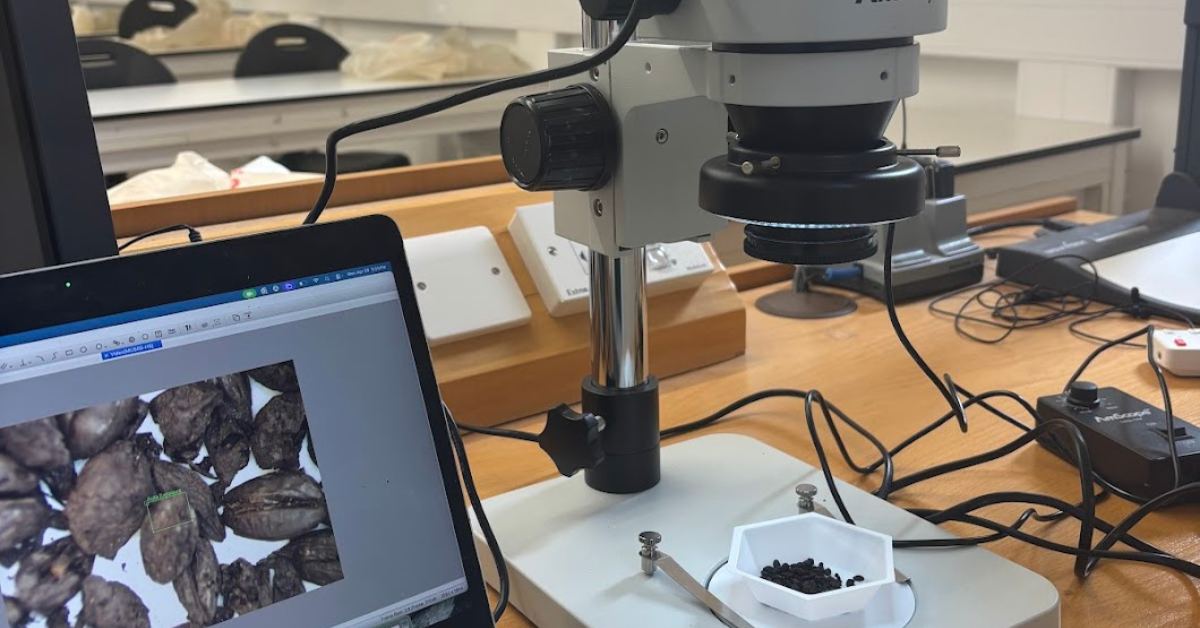
It’s not just trowels and trenches in Archaeology at the University of Edinburgh …

Dr Alice Wolff, IASH-HCA Postdoctoral Fellow, October 2025 – July 2026
Hello! My name is Dr Alice Wolff and I am the IASH-HCA Postdoctoral Fellow for the 2025-2026 academic year. My focus within archaeology is archaeobotany, the study of plant remains in archaeological contexts. In April 2026, I ran a workshop for postgraduate students and staff at the University of Edinburgh on basic archaeobotanical practice and identification.
The theory
The two-hour workshop started with a lot of talking! In my lecture, I started from the very beginning: how plant remains end up preserved in the archaeological record in the first place. This is through four main mechanisms.
- Waterlogging: Plants are preserved in an anaerobic environment created by water saturation. Places like wetlands and peat bogs are common locations for waterlogged plant remains to be found. Waterlogging preserves a huge range of plant remains beyond the sturdier seeds and wood, such as leaves.
- Carbonisation: Plants are preserved by exposure to heat in a low-oxygen environment such as an oven or a hearth. Essentially, the organic structure of a plant part such as a seed is replaced by a carbon skeleton that is impervious to the microorganisms that cause decay in organic materials in most contexts. Fragile items such as leaves or flowers do not generally survive this process, so we mostly find hardier pieces of plants like seeds or wood charcoal!
- Mineralisation: Plants are preserved through mineral replacement of the organic material. This is fairly rare and tends to occur in phosphate-rich environments (think latrines!).
- Desiccation: Plants are preserved by the lack of moisture in their environment. Like with waterlogging, these assemblages preserve a wide range of plant materials so samples are very rich in plant remains! This occurs in arid environments like deserts or even occasionally in high altitude caves – which means we do not find desiccated remains in the UK.
We then talked about strategies for taking samples for these different preservation types and how to process those samples.
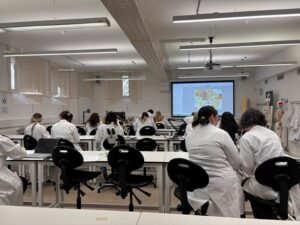
Participants in the workshop. White coats are essential in the archaeology lab.
After talking about how we get plant remains from archaeological sites, we talked about what kind of information we can learn from those plant remains. While the obvious answer is of course that we can learn about food plants people were eating, like different types of cereals and fruits, archaeobotany can teach us about many other aspects of human-plant relationships in the past! Finding plants like flax (Linum usitatissimum L.) can tell us about fibres people were using in daily life, for example as clothing. Dye plants like woad (Isatis tinctoria L.) or madder (Rubia tinctorum L.) can tell us about the textile colours available to people in the past. Medical plants like the opium poppy (Papaver somniferum L.) tell us about healing, while plants that don’t grow in the local area – like grape pips (Vitis vinifera L.) in ancient northern England – tell us about long-distance trade. Beyond the cultivated plants, wild and weedy plants can tell us about local environments or agricultural practices.
The practice
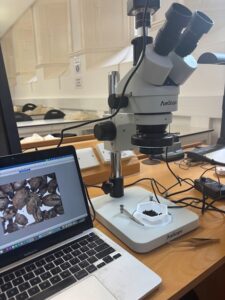
Comparing a sample under the microscope against an example on a laptop.
After the lecture, we moved on to the practical portion of the workshop. Each pair of participants sat at a microscope and was given a vial of modern seeds, including cereals like wheat (Triticum sp.) and barley (Hordeum sp.) and a wide range of weedy plants found in Scotland, and asked to identify them using a photo guide.
We then looked at charred modern seeds. These were seeds of the same modern species the participants had been looking at previously, but they had been deliberately charred meaning they were all black, so students couldn’t use colour to identify them! They had to rely instead on morphology, meaning the shape of the seed.
Participants were then given the chance to work with archaeological materials in two stages. First, they were given vials of archaeological cereals and asked to identify wheat, barley, and oat in the samples. This is something that can be very tricky, especially when just starting out, but they did an amazing job! Finally, each pair was given an unsorted archaeological sample. I asked them to sort through their sample and look for any seeds they could find.
Moving forward
I hope this workshop was useful and interesting for the archaeologists and non-archaeologists in the room! Archaeobotany is a highly specialised discipline, but I think it’s important to de-mystify how it works to encourage cooperation between archaeologists of different specialties and to make our work accessible to non-archaeologists.
Find out more about Archaeology at the University of Edinburgh
- Undergraduate archaeology degrees
- Postgraduate archaeology degrees – MSc, MScR, PhD

Share