The Chernobyl accident, which occurred on 26th April 1986, was one of the most catastrophic nuclear disasters in history. A sudden failure during a safety test at the Chernobyl Nuclear Power Plant in Ukraine released a massive amount of radioactive material into the atmosphere. The disaster resulted in immediate fatalities, long-term health consequences, widespread environmental contamination, and the evacuation of thousands of people. In this blog post, marking the 40th anniversary of the Chernobyl disaster, I have pulled together just a small selection of our digital library resources that will help you explore the accident, the events leading up to it and the aftermath.
What did the papers say?
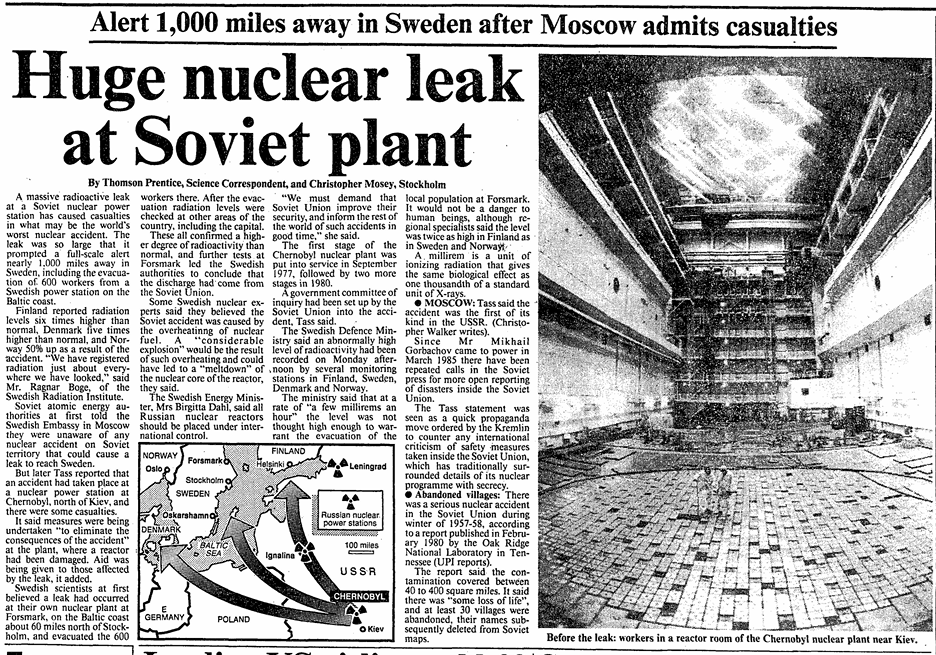
While the Chernobyl accident occurred in the early hours of 26th April, it only began to be reported on 2 or 3 days after the event. The Soviet regime had wanted to keep news of the accident as contained as possible but when the alarms at a nuclear power plant in Sweden were set off by radiation levels, it was quickly worked out the radiation was coming from outwith Sweden and the Soviet government were forced to confirm the accident had occurred.
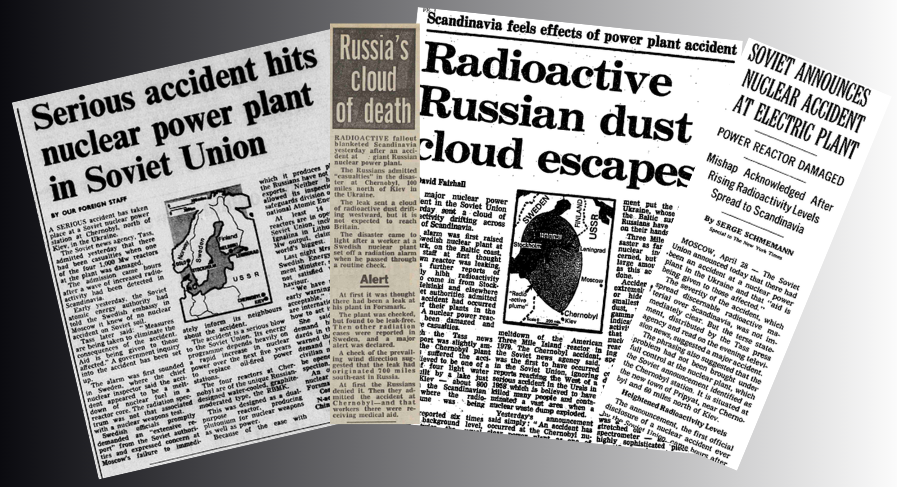
The Library subscribes to a large number of digitised newspaper archives that will allow you to see what events were being reported on at the time and how they were being reported. Read full text articles, compare how different newspapers were covering the same issues and stories and track coverage of the Chernobyl accident from the first reports onwards.
You can search individual titles, such as The Times, The Scotsman, The Guardian and The Observer, The Daily Mail, The New York Times, The Washington Post, Le Monde, The Irish Times, The Times of India, Japan Times, etc. Or you can cross-search a range of titles, through databases such as British Library Newspapers (includes national and regional newspaper titles), Irish Newspaper Archive (the largest online database of Irish newspapers in the world), Chinese Newspaper Collection (includes around a dozen English language newspapers published in China), etc.
Pravda and Izvestiia
The Library also has access to two digital archives of major Russian newspapers, Pravda (Правда, Truth) and Izvestiia (Известия, News). Pravda was the official voice of Soviet communism and the Central Committee of the Communist Party between 1918 and 1991. While Izvestiia, during the Soviet era, became the mouthpiece of the Kremlin, informing the public of government policies through its pages, though it was less ideologically vocal than official party newspapers.
If you can read Russian, then these two newspaper archives will offer insight into what was being reported on related to the Chernobyl accident to the people of the Soviet Union.
Unfortunately, these archives do not offer translations. BBC Monitoring: Summary of World Broadcasts, 1939-2001 and the Current Digest of the Russian Press do offer English transcriptions and/or translations of select broadcasts, speeches, press materials, and more. Though these are not without biases of the translators, reporters and writers themselves.
All digitised newspaper and periodicals/magazines archives available via the Library can be accessed from the Newspapers, Magazines and Other News Sources guide.
What do the archives tell us?
The Library has access to a large range of primary source databases that allow you to search for and view digitised primary source material from libraries, archives and museums across the world.
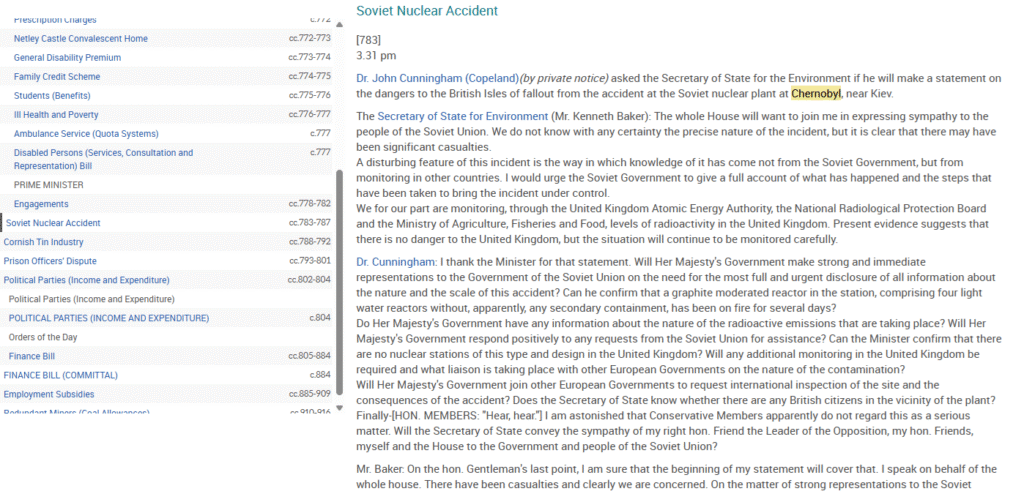
You can see the public record of what British MPs and peers said in the House of Commons or House of Lords about the Chernobyl accident, at the time and the months and years leading on from this in U.K. Parliamentary Papers.
For official documents, responses, briefings, etc., from the USA, why not take a look at U.S. Declassified Documents Online, or the Digital National Security Archive (DNSA) collections: Soviet-U.S. Relations, 1985-1991 and Nuclear Nonproliferation.
If you are looking to go beyond official government documents then Archives of the Campaign for Nuclear Disarmament: Pamphlets and Serials, 1985–1990 and Bruce Kent's Speeches and Articles, 1981–1989 and Power to the People: Counterculture, Social Movements, and the Alternative Press, Nineteenth to Twenty-First Century (only available until June 2026) would be worth a look to see how the Chernobyl accident was used to help strengthen the nuclear disarmament campaigns. While Mass Observation Project, 1981-2009 allows you to see the reactions, thoughts and opinions of ordinary UK people at the time of the Chernobyl accident, along with other events happening at that time at an international, national, local and individual level. Mass Observation Project is one of the most important sources available for qualitative social data in the UK.
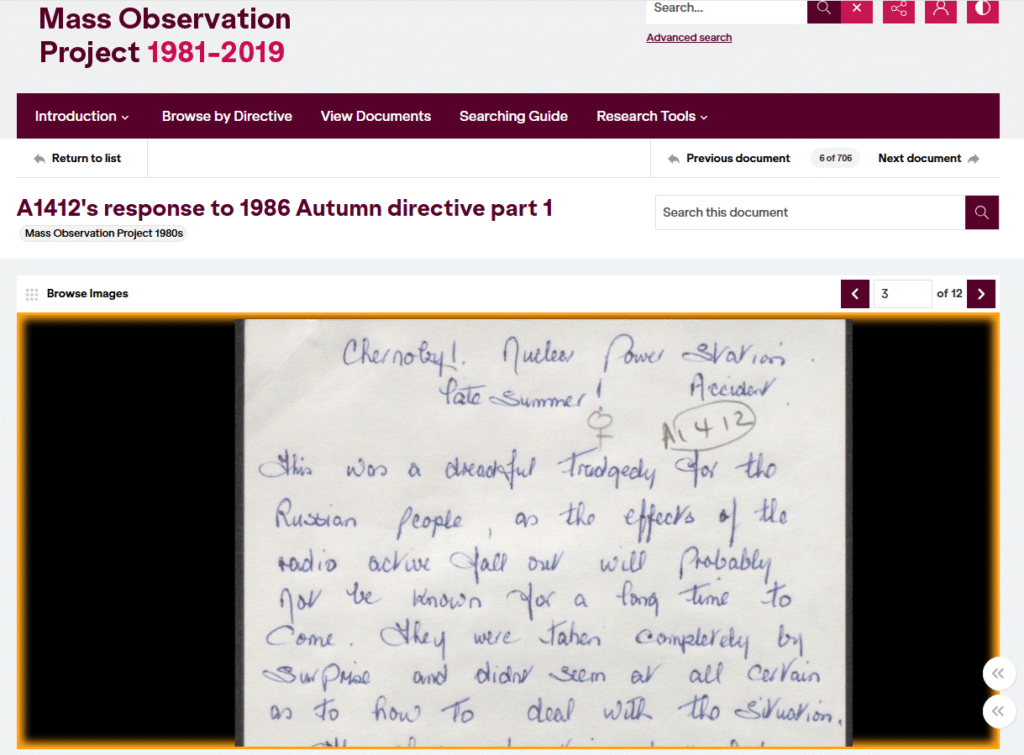
You can access these and a large range of other primary source resources from the Digital Primary Source and Archive Collections guide.
What research has been done already?
You can use bibliographic (abstracting and indexing) databases to search for journal articles, book chapters, book reviews, conference reports, theses, etc. This enables you to find scholarly research on the Chernobyl accident, events surrounding it and the repercussions over the years following.
The Arts & Humanities Citation Index (part of the larger Web of Science Core Collection) contains over 5 million records giving comprehensive coverage across 25 arts and humanities disciplines. This allows you to quickly and easily find the latest research and pinpoint relevant papers published in arts and humanities journals.
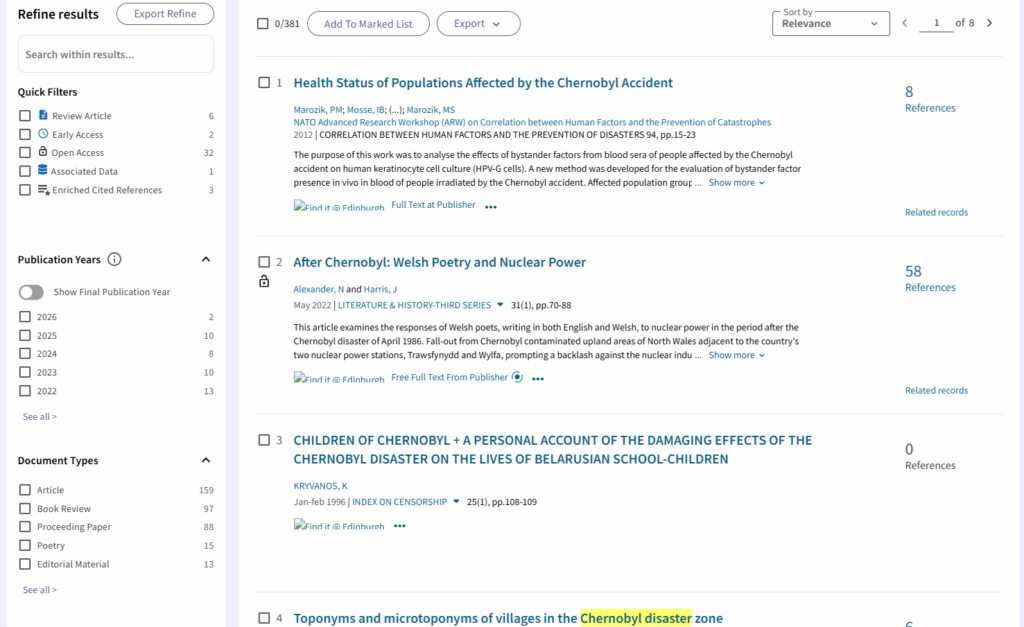
Historical Abstracts with Full Text is the definitive full-text database covering world history (excluding the United States and Canada) from ancient times to the present. It includes hundreds of history journals and books, plus useful features such as the ability to search by time period.
Take a look at the History subject guide to find and access other relevant databases. You may also want to look at other relevant subject guides for this topic to see if there are additional databases that could be useful for your research. And why not search DiscoverEd to see what books, articles, and other material you can find in the Library related to the Chernobyl accident.
What to watch?
You can use some of the Library’s film and TV streaming databases to search for and view films, documentaries, interviews, plays, TV programmes, etc., on the Chernobyl accident. And as you can imagine there is a lot out there.
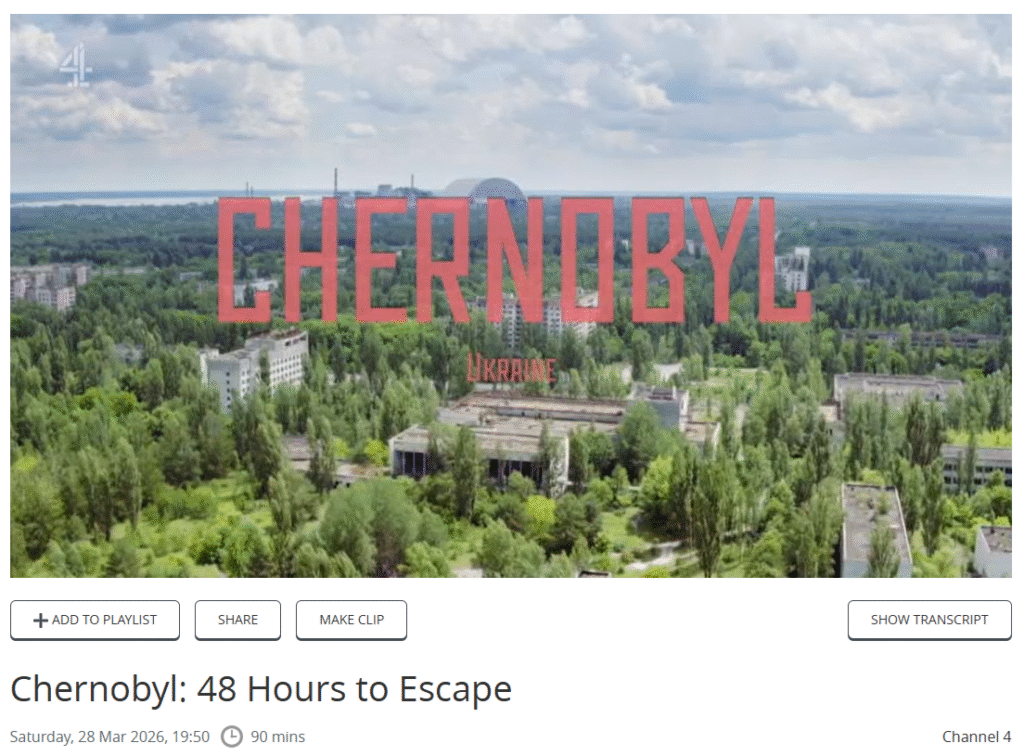
Box of Broadcasts (BoB) is an on-demand TV and radio service for education. It allows you to record programmes (and create playlists, clips, etc.,) from over 75 free-to-air channels. And its extensive archives, giving you access to over 2 million broadcasts recorded by other students and staff across the UK, give you access to rare and hard to find films, obscure documentaries, and TV shows from the last 20 years or so. Do a search on BoB for, Chernobyl, and see what you can find.
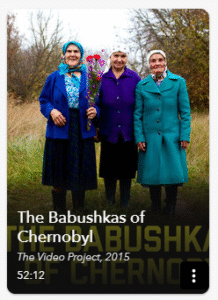
Academic Video Online is a multidisciplinary collection of videos that allows you to analyse unique and valuable content from over 500 producers and distributors around the world. With 1000s of videos already available on the site, around 400 new titles are added to the site every month.
You can access BoB, Academic Video Online and other video streaming and moving image databases from Video resources.
If you have not had a chance to watch the award-winning miniseries Chernobyl (2019), you can borrow the DVD from ECA Library. And if you don't have a DVD player, our libraries have a small number of portable DVD players that can be borrowed.
These are just suggestions of some of the resources you may wish to use. You can explore more of the library's resources, online and physical, through DiscoverEd and the Subject Guides.
Access to the majority of the library's online resources is only available to current students and members of staff at the University of Edinburgh.
Caroline Stirling – Academic Support Librarian for History, Classics and Archaeology