


Studying for a Master’s by Research (MScR) – Charlie
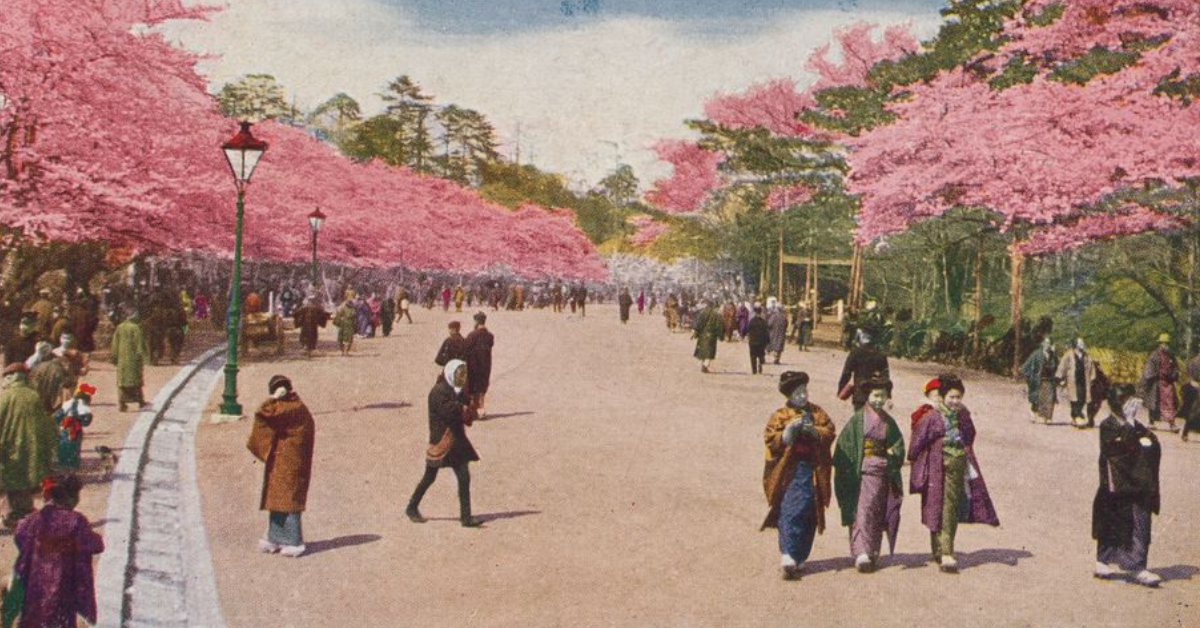
Hello! I’m Charlie, I have recently completed my Master’s by Research (MScR) in History, researching modern Japanese and British history. My thesis focused on Tokyo’s urban redevelopment and everyday life in the late 19th and early 20th centuries, with influences from Victorian London. This blog post aims to share my experience during the MScR program, and how I got the idea of studying and researching modern Japanese and British history at the University of Edinburgh.
The spark of idea
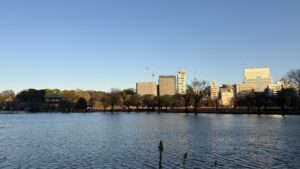
Ueno Park, Tokyo modern day.
The idea of studying Tokyo’s urban redevelopment and everyday life during the Meiji and Taishō periods, through borrowed ideas from Victorian London, draws from both personal and educational factors. My earliest memory of Japan was coming home from school and making a beeline to watch historical fiction television series on Japan. Simultaneously, Japan was the first overseas country I visited and within the arrivals area at Narita Airport near Tokyo, featured traditional Japanese artwork and visiting museums in Tokyo, as I hope to learn more about Japanese history in an academic setting.
During my taught master’s course, I took a module on modern Japanese history, which ignited my desire to learn and research more about Japan’s history. The key aspect from that module gave me a deeper insight into Japan’s transition into a modern nation-state, starting with the Meiji Restoration in 1868 and the lead-up to Tokyo’s urban redevelopment from the 1870s.
Similarly, in my last year of undergraduate studies, where I was on a European urban history module, aligning my interest on how urban spaces and everyday lives began to evolve in Victorian Britain. These factors included the formation of garden cities in England, and the use of public spaces, such as museum exhibitions and public parks, were being promoted as ‘spaces of gathering and learning.’
Learning about Japan’s transition into a modern state and Victorian Britain’s urban and social histories from previous studies, became the spark of idea and interest to conduct my research, particularly on how Tokyo and London’s urban landscape evolved into both countries’ social and economic hubs in the late nineteenth and early twentieth centuries.
Researching my topic
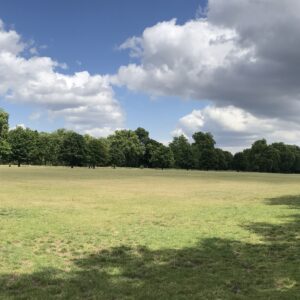
Hyde Park, London, modern day.
Unlike the taught master’s program with regular class schedules and midterm assessments, the MScR program has a lot of flexibility with research time and self-study, allowing me to start researching on my topic soon after Welcome Week in September. Between September and December, I mostly spent time taking a deeper dive into the reading articles and books from other researchers’ work on Tokyo and London’s social and urban histories.
Alongside previous work in the subject, I delved into diary accounts such as Richard Brunton noted his experience of advising the Meiji government, with urban redevelopment in Tokyo and Yokohama between 1868 and 1871, as Japan began to start its nation-building efforts. At the same time, the Japanese sent a delegation led by Iwakura Tomomi to Europe and the U.S. between 1871 and 1873, to learn from these places on how Japan could develop into a modern state as part of their ‘fact-finding’ mission, including urban planning and industrialisation.
As my thesis was focused on the British section of the mission, I explored archival documents written by those on the mission to gather their impressions of Britain and London, such as the British Museum and Hyde Park as ‘places of gathering and learning.’ Following these observations in London, urban planners in Tokyo used this inspiration from London to transform places like Ueno Park in 1873, into a Western-inspired public park and the establishment of Tokyo Museum in the area.
I also discovered that later travellers’ accounts in Japan saw the uniqueness of Western and traditional Japanese architecture, blending into Tokyo’s urban redevelopment, which aligned with the Meiji government’s aims of maintaining Japan’s identity, while embracing Westernisation in the late nineteenth and early twentieth centuries.
These sources paved the way for crafting my chapter ideas during and after the winter break, which started my writing stages for my thesis into the summer.
A day in a life on the MScR program
On a normal day as an MScR student, I normally base myself in the history building or the library, where I plan my research after reading diary accounts and articles I have explored through a spreadsheet tracker. Using the spreadsheet tracker allowed me to visualise my next steps on which chapters I should start to write, from the articles and sources I had read before and during the Christmas holidays. With the history building having a postgraduate common room, this became a hub for my friends and me to catch up over lunch, chat about our research progress and any research trips we may take during the year.
Meetings with my supervisors were ‘by-appointment’, which allowed me to request a meeting when I would like to ask for feedback or directions on my draft chapters. Usually, a week in advance before a meeting, I will send a draft chapter and questions to my supervisors and discuss comments during the meeting. These meetings became incredibly valuable and became a motivation booster, because their comments and discussions we had gave me confidence that I was on the right track and brought new ideas to my thesis, easing my sense of self-doubt and imposter syndrome as I worked on my chapters.
Additionally, my supervisors were always an email away which I am extremely grateful for, particularly when I had questions about my research directions or concerns, before and after the meetings.
Networking and making friends
As I was studying modern Japanese and British history, I joined the school’s Centre for Global Histories and the Asian History graduate networks, where I attended research seminars and listened to ongoing research in their subject areas. By attending these events, I was able to broaden and explore different avenues for my research through the advice given by students who have graduated, those doing their PhDs and the speakers, which became a great way to network and hear about future conferences or academic seminars.
These networking opportunities became the key cornerstone for my positive experience during the program, as I have made amazing supportive friends both in the MScR and PhD programs, which allowed me to get involved and present my research in seminars. Plus, we certainly ended up at the pub doing a round of pub quizzes, and chats at the end of the long week of work!
Looking back on the past year when I started the MScR program, I am grateful to the connections I have made from the graduate networks, in challenging myself both academically and personally. Joining these networks and establishing friendships at the pub, has truly made the year went by quickly, and I wouldn’t trade the past year for anything else!
Acknowledgements
I would like to acknowledge my supervisors, my tutors at undergraduate and postgraduate studies for giving me the tools I need to complete five years of studies. Thank you for giving insightful and engaging classes that has shaped my academic journey and listening to my concerns throughout my time in higher education. With thanks goes to the School of History, Classics and Archaeology for giving me the opportunity to write this blog post and providing me with travel funds for my archival trips. Lastly, thanks are due to my parents for taking me to Japan at a young age, and my cohort for discussing my research over the past year and the connections we have made.

Share