Lately, I’ve been having dreams about research methodology. Instead of a peaceful night’s sleep, interpretivism and positivsm, poststructuralism and critical realism, hermeneutics of suspicion and hermeneutics of empathy wrestle in my subconscious. I used to think – as students commonly do – that the methodology chapter is the chapter you want skip, unless you’re having to write your own methodology chapter and need a template. But I am coming to realise, that a deep-dive into methodology is your chance if you, like me, sometimes find yourself second-guessing, not having pursued a philosophy degree; the methodology chapter is where you can contemplate the nature of reality, being, and knowledge within which you ground your inquiry.
It is thanks to my supervisor that I now see beyond my dismissal of methods as “dull”. Talking through my research design, and I say that I plan to use critical discourse analysis (CDA). She asks why. To tease out changes in language and conceptions of t education in European education policy. Since I am interested in the recent turn to ‘preparedness education’ brought about by heightened security alertness, CDA could help me see how circulating security discourses are paving the way towards a risk-averse approach to education. CDA might also reveal the extent to which these discourses overpower previous endeavours to foster democratic values, innovation, and international cooperation, as promoted by projects such as the European Education Area and the European Higher Education Area.
For instance, the Council of Europe (CoE), traditionally focused on democratic citizenship education and human rights education (CoE, 2010; 2018), recently published the ‘Resilience toolkit to ensure the right to education in times of emergencies and crises’ (EDURES). The toolkit involves 270 indicators to render education systems robust against shocks. A “disaster management cycle” (CoE, 2025, p.17) would help protect the right to education if the world around were to fall apart. Democracy – featuring 4x in the document – and human rights – featuring 24x – seem to play little role in the disaster management cycle while resilience – featuring 437x – appears key. In the Council’s defence, ‘community’ is the second-most used word with 290 mentionings, stressing the importance of society’s self-sufficiency. Moreover, alongside EDURES, the Council continues to support democratic citizenship and human rights education. Hence, I don’t expect Europe’s education policy evolution to make for a straightforward story. This is why, more broadly, I hope to contribute to literature trying to reconcile the language of security on the one hand and human rights, freedom, and democracy on the other hand (Lazarus & Goold, 2007; Ahmed, 2017; Ashri, 2019).
To honour tensions and paradoxes, I require an analytical framework and dedicate many hours to coding. Tedious work, my supervisor remarks. But she also suggests that I could create my own analytical framework. That sounds exciting actually; it has never occurred to me that this is an option. If methodology involves “craft” and “bricolage” (Braun & Clarke, 2023), could research design even become somewhat of a recreational activity? No, it will be tedious, my supervisor says.
She further points out that CDA alone would not be sufficient; first, I should look for larger themes in the data; then, I could unpack the more implicit underlying discourses with CDA. In addition, I am considering sentiment analysis to pull out emotive messages conveyed by selected documents, especially more public-facing ones such as websites. Here, not only written text but also images will be significant. During my very first Education Futures seminar, the lecturer drew attention to Kate Rousmaniere’s study of the history of education as conveyed by images (Rousmaniere, 2001). This work poses a crucial but much overlooked question: how has education policy affected the ways in which generations of children have experienced schooling? Or, drawing on Barbara H. Rosenwein (2006): what is the power of education to build ‘emotional communities’?
Letting images speak:
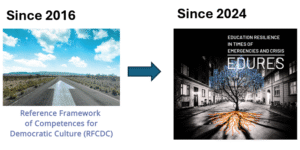
Education used to take us to blue skies; now, dark clouds are rolling over. What might be the felt experience of each policy approach on the ground?
Presenting my preliminary analysis at last week’s student symposium ‘Future Voices’, one of my peers challenged me to see face to my position as a white researcher. For students from minority groups, the anticipation of the worst and the need to be prepared are nothing new. In a world built on racism, exposure to macro- and micro-aggressions form a daily reality to many People of Colour. So, my peer proposed, what could we learn from minority groups in designing preparedness education?
Arguably, positionality is the most important post-positivist concern. If reality cannot be objectively known – indeed, if there is no objective reality out there at all – personal biases inform how we come to know the world. This can be understood less as a limitation and more as a window into the deeper truth of things, revealing how our interpretations shape knowledge, social relationships, identities, and so on.
Constructivism is particularly relevant when thinking about issues of crisis and security. Crises can be invented and inflated or ignored and downplayed. Often, as Sara Ahmed (2014:93) explains, “to announce a crisis is to produce the moral and political justification for maintaining ‘what is’ […] in the name of future survival”. And further, “the language of fear involves the intensification of threats, which works to create a distinction between those who are ‘under threat’ and those who threaten” (ibid:87-88). Fear being tied up with crisis, I worry about the implications of preparedness and risk-aversion for educational culture: “vulnerability involves a particular kind of bodily relation to the world, in which openness itself is read as a site of potential danger. […] the openness of the body to the world involves a sense of danger, which is anticipated as a future pain or injury” (ibid:84). Dwindling openness, more tightly-knit, allegedly resilient communities, the anticipation of future injury caused by an Other; Europe is erecting protective walls, which I deem – from my anti-appeasement point of view – necessary, however the reinforcement of a distinct European space creating insiders and outsiders sits uneasily.
The Council of Europe’s mantra for human rights education proclaims “education about, for, and through human rights” (CoE, 2023:cf.16); can preparedness education achieve preparedness by the same mantra, but replacing “human rights” with “preparedness”? What if we recognised human rights as the prerequisite for preparedness rather than a dispensable luxury? In the same vein, what if futures literacy – the capacity to conceive futures rather than merely handle predicted futures –formed an essential “preparedness skill” parallel to conditioning body and mind for emergencies? Probably, we need to meet halfway: have an honest conversation with learners about possible threats and, as the EU emphasises, equip them with “life protection skills” (European Commission et al., 2026:10); and, at the same time, foster “human rights protection skills” and ability to affect change, allowing learners to question and alter the systems that have led to dire predictions in the first place.
Thinking about methodology has opened my eyes to what Karen Barad (2007) terms ‘onto-epistemology’ – the entanglement of being and knowing. Whatever my findings, they will be entangled in my perspective. Consequently, any policy recommendations concluding my dissertation will not represent the needs of all who would be affected by such recommendations if they were implemented. Hence why the picture will remain incomplete, even potentially harmful if taken as THE solution. To mitigate this risk (because risk-aversion is not all bad), further qualitative research into preparedness education is vital for developing apt interventions that respond to everyone to whom preparedness policy will trickle down.
Now there’s the actual methodology chapter to write – I fear that, after all, it will be a tedious process. You must take a holiday, my supervisor insists. Gratefully, I receive her advice.
References
Ahmed, I. (2017). Migration and security: in search of reconciliation. Migration Letters, 14(3), 371–383. https://doi.org/10.59670/ml.v14i3.350
Ahmed, S. (2014). The Cultural Politics of Emotion (2nd. ed.). Edinburgh University Press. https://ebookcentral.proquest.com/lib/ed/detail.action?docID=1767554
Ashri, M. (2019). Reconciliation of Humanitarian Law and Human Rights Law in Armed Conflict. Hasnuddin Law Review, 5(2), 209. https://doi.org/10.20956/halrev.v5i2.1348
Barad, K. M. (2007). Meeting the universe halfway : quantum physics and the entanglement of matter and meaning. Duke University Press. https://doi-org.eux.idm.oclc.org/10.1215/9780822388128
Braun, V., & Clarke, V. (2023). Thematic Analysis: A practical guide. SAGE. https://bookshelf.vitalsource.com/reader/books/9781526417299
Council of Europe (CoE). (2010). Charter on Education for Democratic Citizenship and Human Rights Education. Committee of Ministers of the CoE.
CoE (2018). Reference Framework of Competences for Democratic Culture (RFCDC), Volume 1: Context, concepts and model. CoE. https://rm.coe.int/prems-008318-gbr-2508-reference-framework-of-competences-vol-1-8573-co/16807bc66c
Council of Europe (2023). COMPASS: Manual for Human Rights Education with Young People (2nd ed.). Council of Europe. rm.coe.int/compass-2023-eng-final-web/1680af992c
CoE (2025). EDURES: Resilience toolkit to ensure the right to education in times of emergencies and crises. Council of Europe. https://rm.coe.int/prems-036925-gbr-2515-toolkit-edures-9643-web-a4/488028fb84
European Commission et al. (2026). Preparedness education in Europe 2025 – Eurydice report. EU. https://eurydice.eacea.ec.europa.eu/publications/preparedness-education-europe-2025
Lazarus, L., & Goold, B. J. (2007). Security and Human Rights. Hart Publishing. http://commons.allard.ubc.ca/fac_pubs/146
Rosenwein, B.H. (2006). Emotional Communities in the Early Middle Ages. Cornell University Press.
Rousmaniere, K. (2001). Questioning the visual in the history of education. History of Education (Tavistock), 30(2), 109–116. https://doi.org/10.1080/00467600010012391