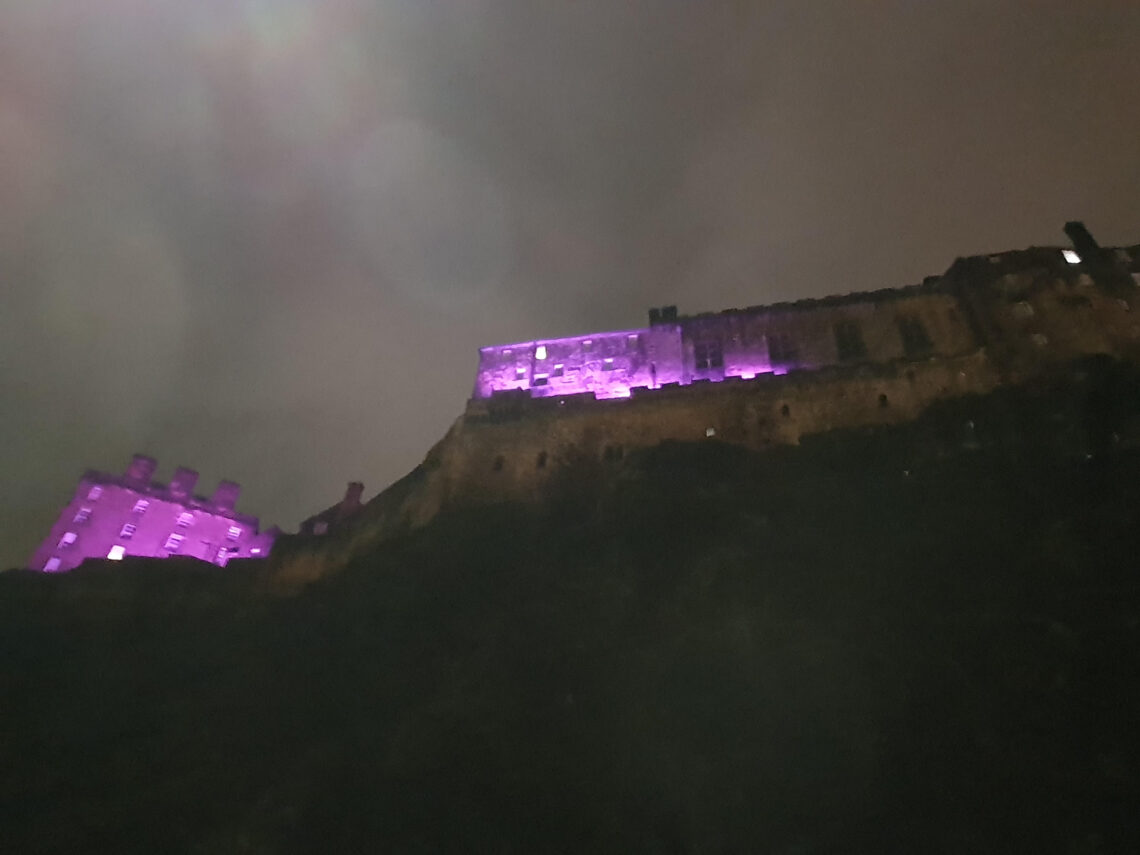
From below, Edinburgh castle appears like a purple flame this evening, resembling the symbol of the UK’s Holocaust Memorial Day Trust. On 27th January 1945, Auschwitz-Birkenau, the largest Nazi concentration camp, was liberated.
these years, these months and days they won’t wash out
This verse is taken from The Voices of Babyn Yar (Бабин Яр. голосами), a mesmerising poetry collection by Ukrainian poet Marianna Kiyanovska. Babyn Yar (“Old Woman’s Ravine”), located at the outskirts of Kyiv, saw the execution of more than 100.000 victims during the Nazi occupation from 1941-1943 (The Holocaust Memorial Day Trust, 2021). On 29 and 30 September 1941 alone, the Nazis shot 33,771 Jews at the site (IHRA, 2025).
Kiyanovska finds fault with numbers dominating remembrance discourses: “these are the dead who forfeited the dignity of death” (Slavinska, 2018). Through a pluralistic first-person narrator, Kiyanovska seeks to pay tribute to the persons killed, honouring their uniqueness and legacies. Most of the poems imagine the last hours, minutes, or seconds before the massacre.
The author’s projection of victims’ voices raises multiple ethical concerns. These range from speaking for dead to issues of translation. For instance, the murdered Jews of Kyiv formed a multilingual group who would not have spoken the pure Ukrainian of Kiyanovska’s narrators (Barskova, 2022). Ultimately, questions of ethics leading to questions of truth-telling. However, rather than critiquing the author for writing these poems, I wish to focus on the ethics of reading her work.
I described the collection as “mesmerising”. If all poetry has an aesthetic dimension, I must ask myself: is opening The Voices of Babyn Yar an inherently unethical act?
In search for a compass, I dived into the field of trauma studies. ‘Trauma’, understood since Freud (2015), as a “wound to the mind” is defined in the literature as a disruption to memory which “refuses to be represented as past, but as perpetually reexperienced in a painful, dissociated […] present” (Leys, 2000). Due to trauma’s disruptive nature, survivors’ testimonies have tended to be viewed either as distorting the facts about the traumatic event or as simply inaccessible to the victim, who is thought incapable neither of integrating the event into their normal consciousness nor of constructing a linguistic representation of the event. Hence, trauma accounts have a history of doubting the survivor’s recollection of the event.
In their book Testimony: Crises of Witnessing in Literature, Psychoanalysis, and History, Felman and Laub (1992) seem to take a step further even, defending the provocative claim that “during its historical occurrence, the [Holocaust] produced no witnesses” (p.80, original emphasis); the perverse logics and atrocious practices of the Nazi regime, undermining victims’ subjectivity, meant that the boundaries between a “You” and “I” collapsed, so that concentration camp inmates could not bear witness for each other. Further, victims were deprived of an “internal witness” (p.81), a “sober” and humanising point of reference against the dehumanisation experienced. Based on this theory, Felman and Laub (1992) place major value on listening, suggesting that the encounter between primary witness (the survivor) and secondary witness (the listener) is the only way to restore a humanising reference point. Undergirding this idea is the assumption that the traumatic event exists as an objective event, inaccessible to survivors until they come to repossess it through testimony. Therefore, testimony is never a direct representation of the event, but, rather, a new historical moment characterised by identity-formation, action, and change.
writing “Holocaust” after the Holocaust I
only now can I speak of this
[…]
only now can I speak of this
bearing witness
An issue that emerges from Felman and Laub’s theory is that it puts the listener into the role of saviour, helping the victim to access the event and continue the process of survival. Davies (2017) sharply critiques Felman and Laub for positioning the secondary witness as participants in the creation of testimony. In his view, the only ethical form of listening is to keep a critical distance when receiving insights into the event.
memory is a miracle; all I have, all I have not
is my family: all of them shot
Considering the tensions around receiving testimony, tapping into the ethics of fictional testimony seemed too much. Still, I wanted to know, what does literature do that historical sources don’t and vice versa?
In the foreword of The Voices of Babyn Yar, Barskova (2022) writes that, in contrast to the historian, the “poet aims at synthesis, at association, and at reconstruction of the affect” (p.17). I can’t help but read myself into Kiyanovska’s verses – to become synthesised, associated until a moment of horror springs out of the text, pulling me back outside. Reader-response theory says that reader and text co-construct meaning (Probst, 1994). The Voices of Babyn Yar makes co-construction into struggle. I simultaneously can and cannot project the lines onto my own life, for they reveal something about the human condition (e.g., the presence of the past enabled by our capacity to remember and the grief and comfort that this brings); however, the atrocious event itself lies beyond my grasp.
The act of reading renders me acutely self-reflexive, demanding that I scrutinise my position and response_ability. I felt that I could resume some responsibility by researching first-hand testimonies of survivors of Babyn Yar. I also came across the Names project of the Babyn Yar Holocaust Memorial Center, which is building a database of biographies of those killed at the ravine. Still, epistemic and empathetic limitations hold fast also when dealing with non-fictional first-hand accounts. I find both relief and guilt in these limitations. Relief because I do not share in the Holocaust trauma, and guilt because I get to comfortably educate myself about it from a distance. Ilya Kaminsky offers a more straightforward way of capturing this double-sensation, like Kiyanovska, in lyrical form: we (forgive us) / lived happily during the war.
Bestowing names onto numbers: I only go out to Nadia, look into her face; Raika whose kid doesn’t walk; there’s Edik the fiddler in the crowd; Murka the cat; where they bury all they will bury Tsylia and us
Historical sources of the Holocaust are free from the question of who gets to speak for whom. Meanwhile, questions of representation and comprehension remain. Hence, the paradox that literary and non-literary Holocaust accounts have in common, might be “a language that defies, even as it claims, our understanding” (Caruth, 1996, p.5). The answer to my question about the difference between Holocaust literature and historical sources reveals itself as another set of questions: might literature fill the gap between the impossibility to listen and the imperative to listen? Might literary narratives lift some of the burden off survivors giving testimony to an ever-distant audience? Might imagined accounts support the truth of the event on an affective level?
time’s losing its future tense […]
but I know
those things in the attic are our footsteps into the future
At the start of the full-scale invasion of Ukraine, Russia damaged the Babyn Yar memorial site in a missile attack (Wertheimer, 2022). Thus, the Holocaust denialism that runs through Soviet history continues into the future. The Soviet state, in order to claim an anti-fascist and anti-capitalist stance, framed communists the main victim group of the Nazis; Putin, in order to justify the war on Ukraine, casts Ukrainian’s state leaders as neo-Nazis from whom to the Ukrainian people (whom Putin claims as being part of the Russian people) must be saved. A Holocaust memorial set up by the Ukrainian state interferes with Putin’s version of history. So he tries to erase it.
Clearly, Kiyanovska’s fictional take is not the same as Putin’s propagandistic disinformation, fabricated to twist the facts, feed hatred, cause confusion, and secure authoritarian control. Kiyanovska uses freedom of the imagination to convey an affective dimension of the truth; Putin produces blatant lies. While Kiyanovska does not give account of the factual truth, her poems do help preserve the truthful narrative of what happened at Babyn Yar. Memory, as we are witnessing time and time again, offers not just an insight into the past but actively makes the world of today and tomorrow. Which footsteps we choose to follow will determine what future we are walking into.
References
Barskova (2022). Introduction. In M. Kiyanovska The Voices of Babyn Yar (P. Maksymchuk & M. Rosochinsky, Trans.). Harvard Library of Ukrainian Literature.
Caruth, C. (1996). Unclaimed Experience: Trauma, Narrative and History. Johns Hopkins University Press.
Davies, C. (2017). Traces of War: Interpreting Ethics and Trauma in Twentieth-Century French Writing. Liverpool University Press.
Felman, S., & Laub, D. (1992). Testimony: Crises of Witnessing in Literature, Psychoanalysis, and History. Routledge. https://doi.org/10.4324/9780203700327
Freud, S. (2015). Beyond the Pleasure Principle (J. Miller, Ed.). Dover Publications. https://ebookcentral.proquest.com/lib/ed/detail.action?docID=6802400
International Holocaust Remembrance Alliance (IHRA). (2025, April 5). Behind every name is a person: piecing together the stories of Babyn Yar. IHRA. https://holocaustremembrance.com/news/babyn-yar-names-project
Holocaust Memorial Day Trust. (2021. The Babi Yar massacre. Holocaust Memorial Day Trust. https://hmd.org.uk/wp-content/uploads/2021/08/The-Babi-Yar-massacre-life-story.pdf
Leys, R. (2000). Trauma: A Genealogy. University of Chicago Press. https://ebookcentral.proquest.com/lib/ed/detail.action?docID=648142
Probst, R. E. (1994). Reader-Response Theory and the English Curriculum. English Journal, 83(3), 37–44. https://doi.org/10.2307/820925
Slavinska, I. (2018, July 1). The Holocaust has become part of Ukraine’s history: Marianna Kiyanovska talks about “Babyn Yar. In Voices” (Marta D. Olynyk, Trans.) UJE – Ukrainian Jewish Encounter. https://ukrainianjewishencounter.org/en/the-holocaust-has-become-part-of-ukraines-history-marianna-kiyanovska-talks-about-the-voices-of-babyn-yar/
Wertheimer, T. (2022, March 3). Babyn Yar: Anger as Kyiv’s Holocaust memorial is damaged. BBC News. https://www.bbc.co.uk/news/world-europe-60588885







Jamie Zeigler Laurens
29 January 2026 — 23:55
Beautiful rendering of both the problem and the opportunity presented in this reading. Helena. A profound and enriching reflection. Thank you!
s2903873
30 January 2026 — 14:08
Thank you, Jamie, for having talked the ideas through with me. Most of all, thank you for building my courage to write about Holocaust testimony.