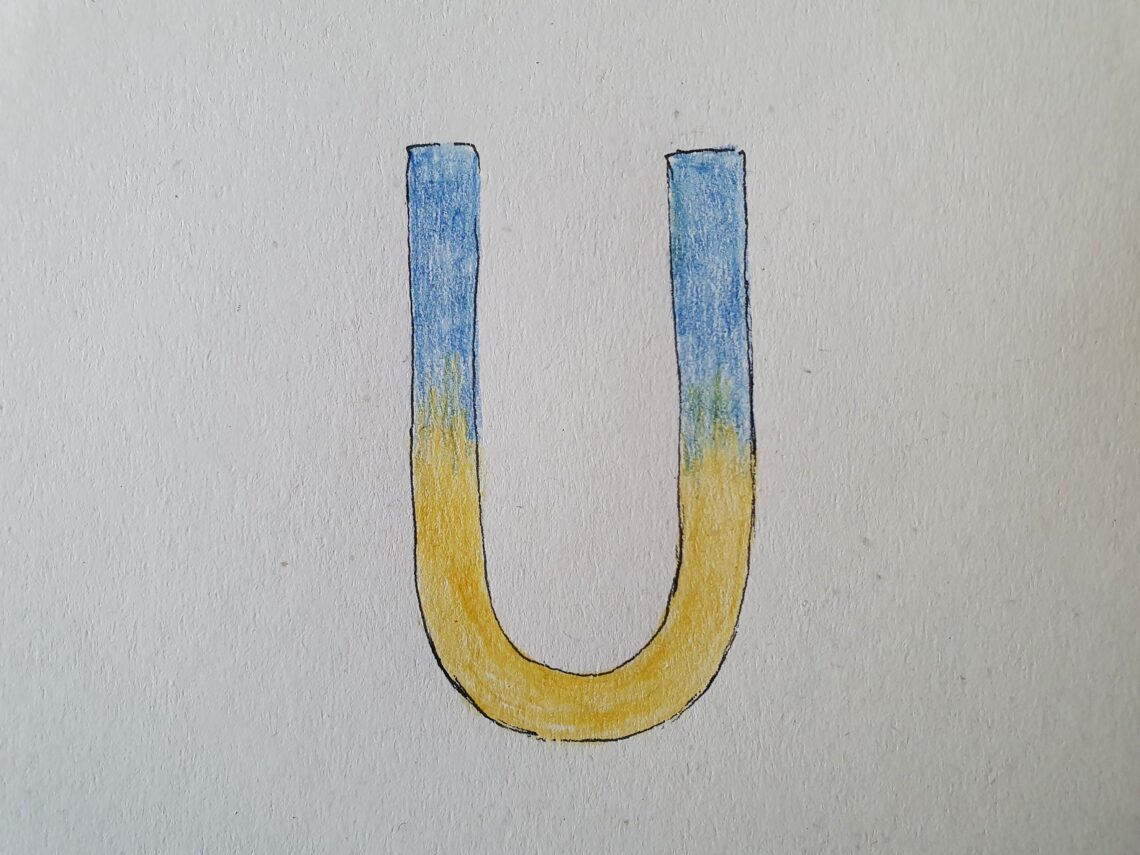
My time in Edinburgh began with a somewhat unexpected activity: I enrolled in a Ukrainian language course. Since September, I would rehearse basic conversations in our weekly classes, grapple with the language’s many, beautiful inflections, revise vocabulary over dinner, and, more recently, join events of the Edinburgh University Ukrainian Society and the Association of Ukrainians in GB to connect with Ukrainians and practice speaking.
People ask me why.
An article in the new issue of the student-led Dïaspora journal articulates what I have been sensing since developing keen interest in Ukraine. Diana Shypovych (2026) investigates the reasons for why non-Ukrainian students decide to pick up the language. She found that “[in] many students’ stories, Ukrainian emerges as a language of the future – useful in diplomacy, research, security, and cultural work. Through learning it, people fall in love with the country, its history, and its resilience, and many begin imagining futures that lead back to Ukraine itself” (p.98).
Since the full-scale invasion, Ukraine has moved from being Europe’s periphery to being Europe’s future – indeed, I have learned that Europe should have woken up to this long before 2022. Ukraine as the future not merely forms an abstract wakeup call and ideal but also manifests in concrete ways in the lives of individuals. This includes myself when I look at my emerging career aspirations: contributing to Ukraine’s European integration through and beyond education would be a dream. To place one’s dreams into Ukraine asserts the country’s survival, recovery, and re-centring on a European stage.
Ukraine’s fertile grounds have been embattled for centuries, viewed by foreign forces – Russia, Poland, Lithuania, Austria, Germany, Romania – as a desirable place for colonisation (Snyder, 2014). Given the wavering support for Ukraine from Western allies today, lately playing out in Trump’s easing of Russian oil sanctions and the readmission of Russian athletes in the Paralympics, Ukraine’s civil society appears to be on its own, preserving the nation’s territory and cultural heritage and defending freedom and democracy on behalf of everyone else.
Cut from the branch. Leaves in the flames. Nothing is safe.
On 12 March, I attended the conference “Hybrid Warefare and Ukraine’s Resilience” organised by the university’s Ukrainian Society and The Ukrainian Politics Network. High-level panelists highlighted that, one way to help share the burden of Ukraine’s fight, is to promote Ukrainian studies and research collaborations with Ukraine. The idea is not to turn Ukraine into another exotic field of eastern European study, but to include Ukraine in a larger transnational story. I feel driven to partake in this mission, and to orient my master’s towards this mission.
My core motivation to do so has been nurtured at an interpersonal level. Thanks to my fellow Ukrainian learners, our excellent teacher, and the Ukrainian friends I’ve made across the past few years, I found community here in Edinburgh at a time when I struggled to connect to peers around me. Thus, persons connected to Ukraine have made me feel more at home abroad. This experience demonstrates that social integration is not simply down to the good will of the host society towards newcomers and newcomers’ willingness to blend in; integration is the encounter of open hearts, mutual support, and cultural exchange. Integration asks, as I argued in a previous blog, why are we here if not for each other?
In Edinburgh, вивчення української мови has brought me more delight even than swimming and dancing. They say that hobbies and work are best kept separate so as not to suck the joy and recreational qualities. Meanwhile, we are told that our master’s project should be a passion project. With Ukraine taking up a good 70% of my thinking these days, and with most of my blog posts reflecting on Ukraine to some extent, I might as well lean into my inclination and see where it leads.
The problem with this pivot in topic: I have got seven days to work out the details of a new project before a first consultation with my supervisor. At least, I am not starting from scratch. In February, I completed the open online course “Ukraine: European Frontier” delivered by the University of Tartu, covering Ukraine’s history, political system, foreign policy, EU integration, and digital transformation. One of the many facts I’ve learned in the course: ‘Ukraine’ assumes a variety of disputed meanings: “Our land”, “Borderland”, “Frontier”, “Region/Principality/Territory”. Brocken up into its literal components, it translates as “u-land”. This land, its language, culture, songs, struggle, and people encourage me to dare a u-turn (not the best pun, I apologise). Juggling an overwhelming amount of deadlines, I am with little sleep and a chronic headache; choosing a research focus that compels me will carry me through the odds.
Trust in the change.
I put on Leléka and start redrafting.
References
Shypovych, D. (2026). Where the right door leads: Learning Ukrainian in Cambridge, Dïaspora, Issue 2, 96-103.
Snyder, T. 2014, April 16). “Europe and Ukraine: Past and future”. Eurozine. https://www.eurozine.com/europe-and-ukraine-past-and-future/