

Curatorial Pitch–Under the Witch Moon


[The final project differs significantly from the version presented in this curatorial pitch. The reasons for these changes are discussed in the later blog posts and critical reflection.]
My exhibition Under the Witch Moon centers on the theme of “witches,” using the iconic Triple Goddess symbol from Wicca and feminist mysticism as its narrative framework. I aim to weave together a female narrative that transcends time and space.
Triple Goddess: From left to right are the three phases of the moon: waxing, full, and waning. They also represent the three stages of womanhood: Maiden, Mother, and Crone. This symbolizes the past, present, and future

Triple Goddess symbol
This art exhibition begins with the imagery of the Triple Goddess, offering a retrospective on the historical fate of witches. It explores how Scotland’s historical witch trials and persecution of women have permeated contemporary society, and how contemporary female artists respond to this legacy.
Moon worship is deeply ingrained among witches. To my mind, the moon’s waxing and waning cycles symbolize the perpetual renewal of the female cycle and the enduring energy of life. This exhibition centers on linking the temporal and spatial symbolism of the Triple Goddess to the witch’s destiny. Each lunar phase corresponds to a temporal and spatial slice in the witch’s journey, mirroring the persecution and resistance women have endured at different stages of their lives.
The narrative begins with the waxing moon, symbolizing the Maiden. The featured artwork is Petra Collins’ 24 HOUR PSYCHO. This piece captures the sorrow and emotional turmoil experienced by young women. The author of The Madwoman in the Attic observes that within patriarchal narratives, women who fail to conform to the ‘angelic’ ideal are often confined to the attic, becoming ‘madwomen’. This piece visualizes the sorrow and breakdown of a young girl, aligning with the theme of my exhibition space. It responds to the emotional predicament and counter-resistance of young women.
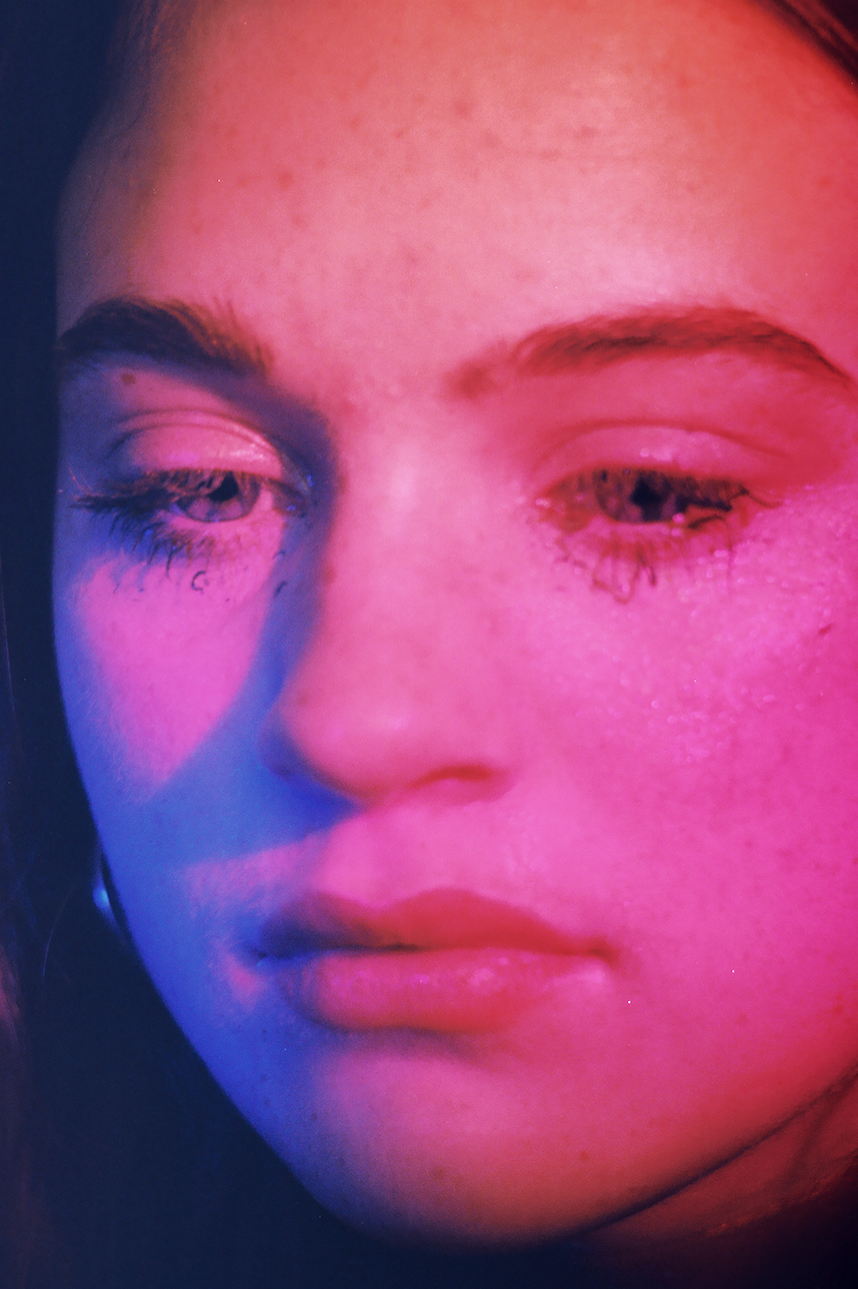
Petra Collins, Untitled #19 (24 Hour Psycho) Digital C-print. 65 x 43 inches. Edition of 2.
The full moon symbolizes the mother archetype. The featured work here is Jesse Jones’ Tremble Tremble. This piece not only revisits the historical witch hunts but also addresses contemporary challenges faced by women, such as the denial of abortion rights, the undervaluing of domestic labor, and the lack of bodily autonomy. It reflects the real-life circumstances of women in motherhood and extends the power of “motherhood” from the individual to the collective.
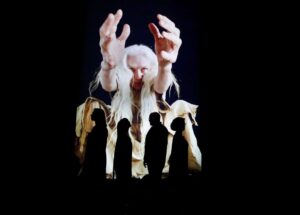
Jesse Jones, Tremble Tremble, 2018, Project Arts Centre, L-R Susan Stenger (Sound Design and Composition), Jesse jones (Artist), Cian O’Brien (Artistic Director, Project Arts Centre) and Tessa Giblin (Commissioner and Curator), photo by Photocall Ireland
The waning moon corresponds to The Crone. I selected Sarah Lucas’s WINTER SONG, an artist I discovered through the Big Women exhibition. This showcase of midlife and older female artists resonates deeply with my curatorial vision. I aim to present women navigating the passage of time,bearing the traces of past oppression yet possessing an undeniable resilience.
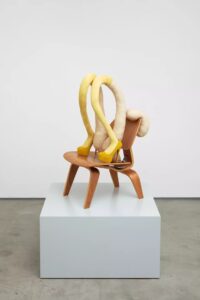
Sarah Lucas, WINTER SONG, 2020, tights, wire, wool, spring clamps, shoes, acrylic paint, wooden chair, image courtesy of Sadie Coles HQ, London, © the artist, photograph: Robert Glowacki.
Bibliography:
Federici, S., 2004. Caliban and the Witch. Autonomedia.
Gilbert, S. and Gubar, S., 2004. The madwoman in the attic. na.
Jones, P., 2005. A Goddess Arrives: Nineteenth Century Sources of the New Age Triple Moon Goddess. A Journal of the History of Astrology and Cultural Astronomy, 9(1).
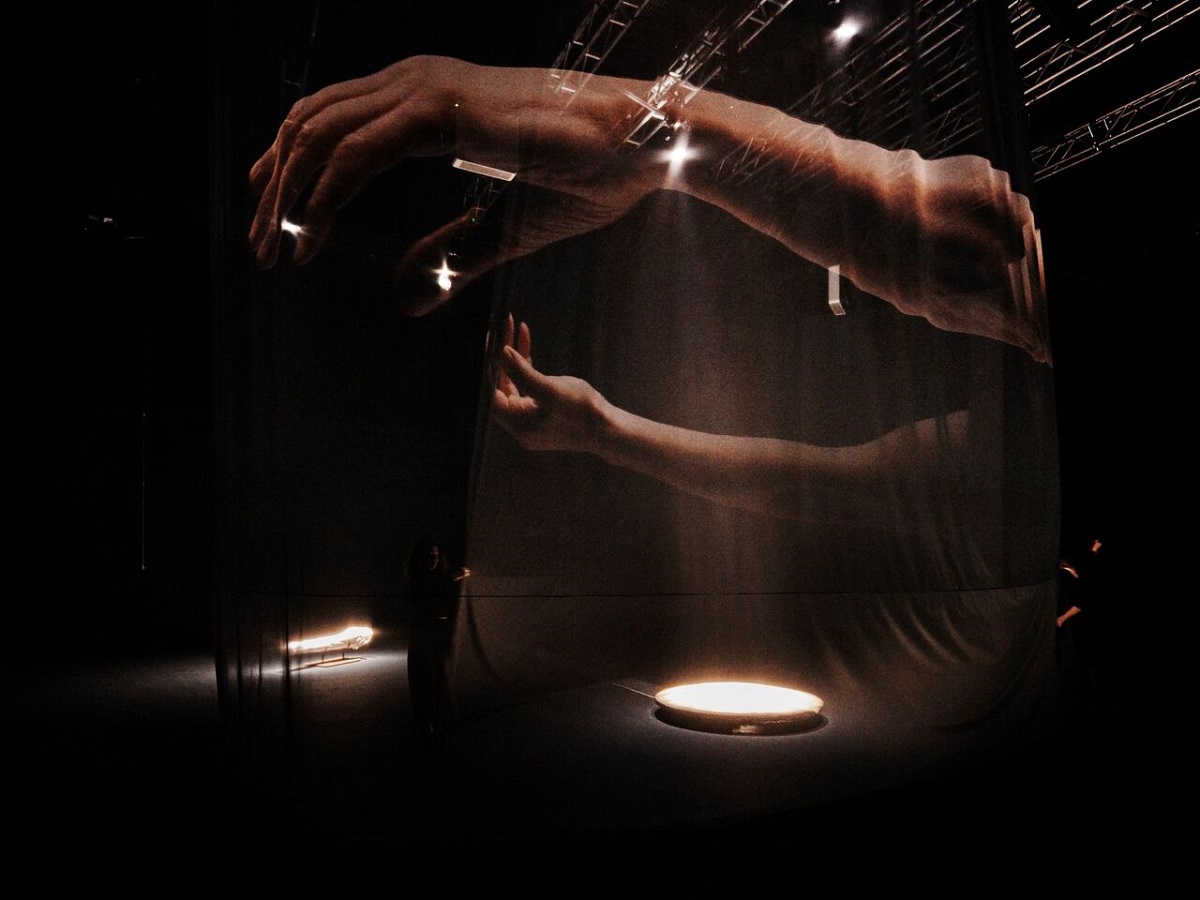
(Jesse Jones, Tremble Tremble, 2018, Installation view, Project Arts Centre, photo by Ros Kavanagh)
(Jesse Jones, Tremble Tremble, 2018, Installation view, Project Arts Centre, photo by Ros Kavanagh)




It is great to see that you have taken on board the previous feedback and have been engaging in extensive independent research. This is great to see. It would be good to contextualise the disciplinary and professional context of those that you are referring to. This will help to ground the arguments and points that they are making as well as yourself.
We discussed the need to reflect on your position as an emerging curator, the significance of the format that you have chosen and how you could use the triple goddess concept as a narrative framework and also connect this with the curatorial format, and the role of group exhibitions, et cetera by engaging with source material to contextualise your approach. It would be good to also provide context for the triple goddess system. Where did this originate? Can you supply a source to contextualise this? How has it been dealt with in contemporary art? Have other contemporary artists dealt with this three stage concept again? Where is the maiden, mother, crone concept from? What is the role of witchcraft as an analytical tool in the arts? What contemporary artists have responded directly to histories of witches within their work and practice? Are you focusing specifically on the history of witch trials and persecution in Scotland? You need more synthesis here. What contemporary Scottish artists having engaged with the notion of witches and feminist context in their work? Similarly, we also discussed that you need to reflect on your role as an emerging artist for example. It is not feasible that you would be able to include a work by Sarah Lucas, as she is a very established and high profile artist. Can you now demonstrate how you have engaged with feedback from the pitch and revised aspects of your speculative project in response? In addition, you also need to reflect on the format of your group exhibition, budget, ethical considerations, audience engagement and programming, transport of artwork, insurance, Artist pay, how you might engage with feminist advocacy groups or charities that support women, perhaps in a Scottish context, if this is your focus. There are many aspects that can be considered. Spend some time reading around the course on learn as this will help you to further develop the content of your blogs in accordance to the expectations of the course and the learning objectives and rubric. It is great to see that you are including references in text and in the form of a bibliography, as well as figure references. You also have made some really interesting points and practice based examples such as a visit to an exhibition. You could perhaps engage more with Artist research and artwork research, as well as other practical examples such as curatorial approaches in relation to particular exhibitions et cetera I mentioned previously that you might want to look at the exhibition called ‘The Viking Sorceress’ that is currently on display at the National Museum of Denmark in Copenhagen, which is showing until 2027. https://nationalmuseet.dk/en/exhibitions/the-viking-sorceress Whilst this is not a contemporary art exhibition, they use interesting forms of audience engagement and different rooms serve different purposes which could link with the way that you are approaching your exhibition design. I encourage you to research this and to identify the curator and information about the curatorial approach. Then it would be good to look at contemporary female artists and artwork that focus on the persecution of women in the context of notions of witchcraft. What contemporary art exhibitions have been done on witchcraft and witches? Who were the curators and what was their approach? Which artists/artworks were included? What was the format of the exhibition? This might include looking at female artists focusing on different geopolitical and cultural context. This would then tie into a reflection about intersectional feminism and feminist curating. Look at writing by curator Elke Krasny about feminist curating. There is also the book – Curating as Feminist Organizing. Edited by Elke Krasny and Lara Perry, 2023.
It is good to see that you are comparing and contrasting viewpoints and tying this into the development of your individual speculative project. Perhaps some of these arguments require a little more synthesis which may be helped by grounding these perspectives in particular professional and disciplinary context. In addition, I think it would be interesting to interrogate the notion of the witch in the context of witches actually just being women. To perhaps interrogate the complexity of referring to the persecution of witches rather than the persecution of women. You touch on this a bit in your week five blog when you refer to Sylvia Bovenschen and her point about entertainment value and discursive power. However, her perspectives are in need of further interrogation, as is the way that you have framed her perspectives. Greater clarity is needed, for instance, what do you mean by the return of witches? What is it that she is specifically referring to? In addition, are women no longer fearing the stigma imposed by a patriarchal society? I don’t think that this is the case. We also discussed how you might engage with the notion of intersectional feminism and to research around this, as well as to research intersectional feminist curating and feminist curating practices and discourse.
Four week six, you need to include both the blog for your curatorial pitch, and an additional blog for that week. In your curatorial pitch blog, it would be good to demonstrate the development of these aspects of your project within the other blogs to demonstrate how you have been developing your project over the previous weeks.
It would also be good to incorporate course themes and tie this into your speculative project development, as well as group work, and use of the project space at Summerhall.