

Week 11 – Collective Display, Material Decisions, and Curatorial Responsibility
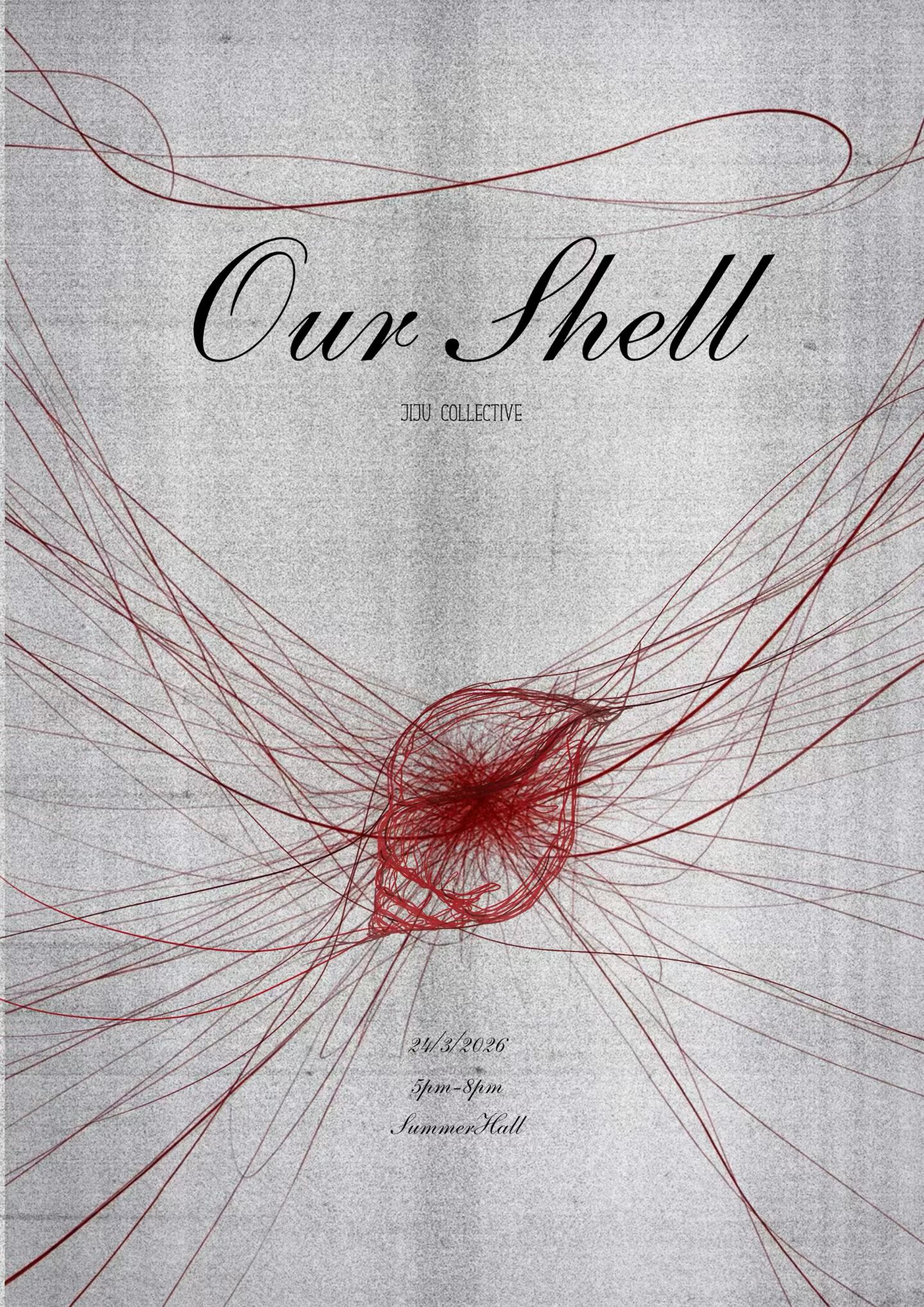


This week, through reflecting on and reviewing our collective curatorial practice, I gained many valuable practical experiences. These experiences also led me to reconsider the relationship between exhibition concept and production. Through the process of installing works at Summerhall, I became more aware that exhibition-making is not simply about choosing a theme or placing works in a room. It also involves gradually transforming ideas into a real and workable spatial display through exhibition planning, material selection, and practical installation. In our collective work, this transformation was never smooth. It developed step by step through continuous adjustment, as we encountered problems and tried to solve them.
During the installation process, we faced a difficult problem: how could we create visual coherence between works that were very different in style, size, form, and medium? Because the differences between the works were so large, we had to think carefully about the rhythm of viewing and about how audiences might move through the space. We developed more than three possible display arrangements and rejected them one by one. Through these discussions, I started to understand that the display itself is part of the curatorial argument. The position of each work can shape the viewer’s pace and also affect how they understand the relationship between individual works and the overall theme.
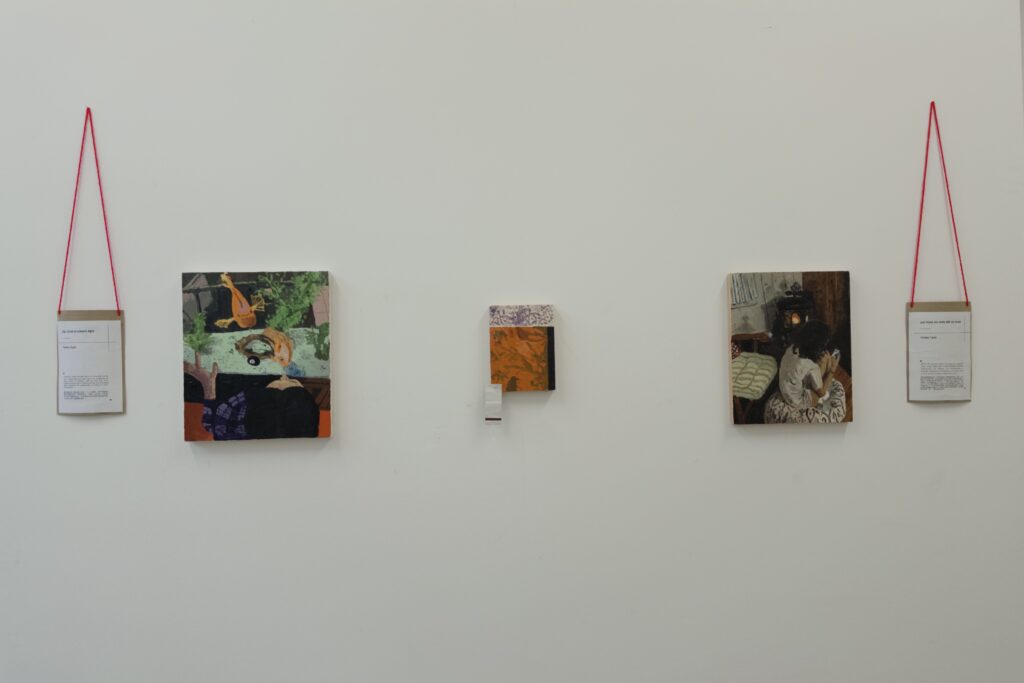
Installation view of Our Shell, showing painting display with suspended labels, Summerhall, Edinburgh, 2026. Photograph by Hazel Ren.
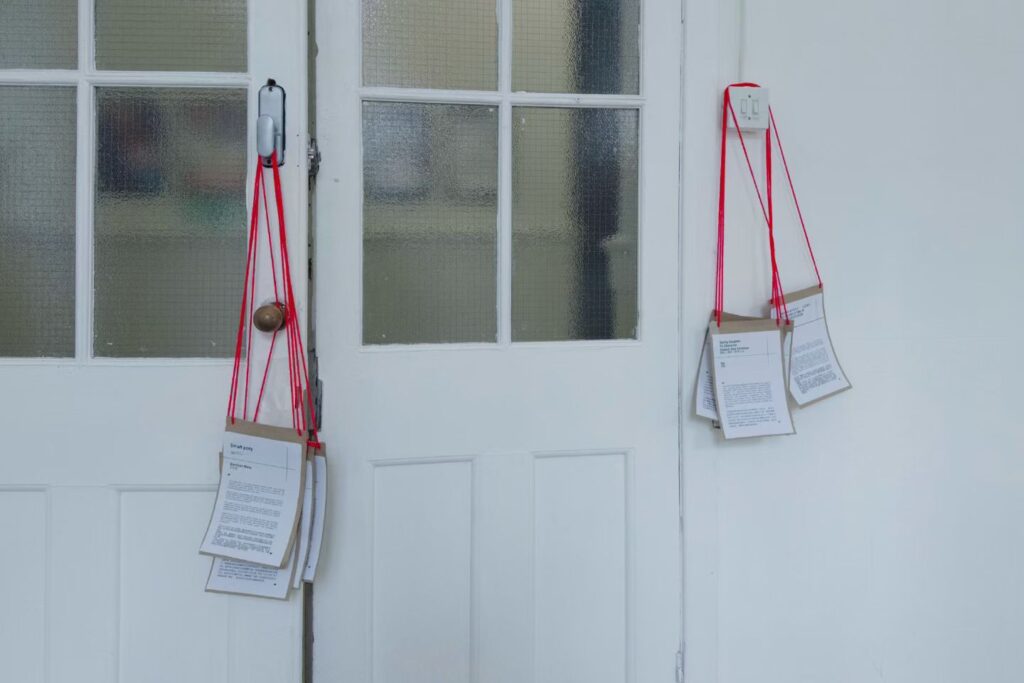
Installation view of Our Shell, showing hanging label design in relation to the gallery doorway, Summerhall, Edinburgh, 2026. Photograph by Luosijie Ding.
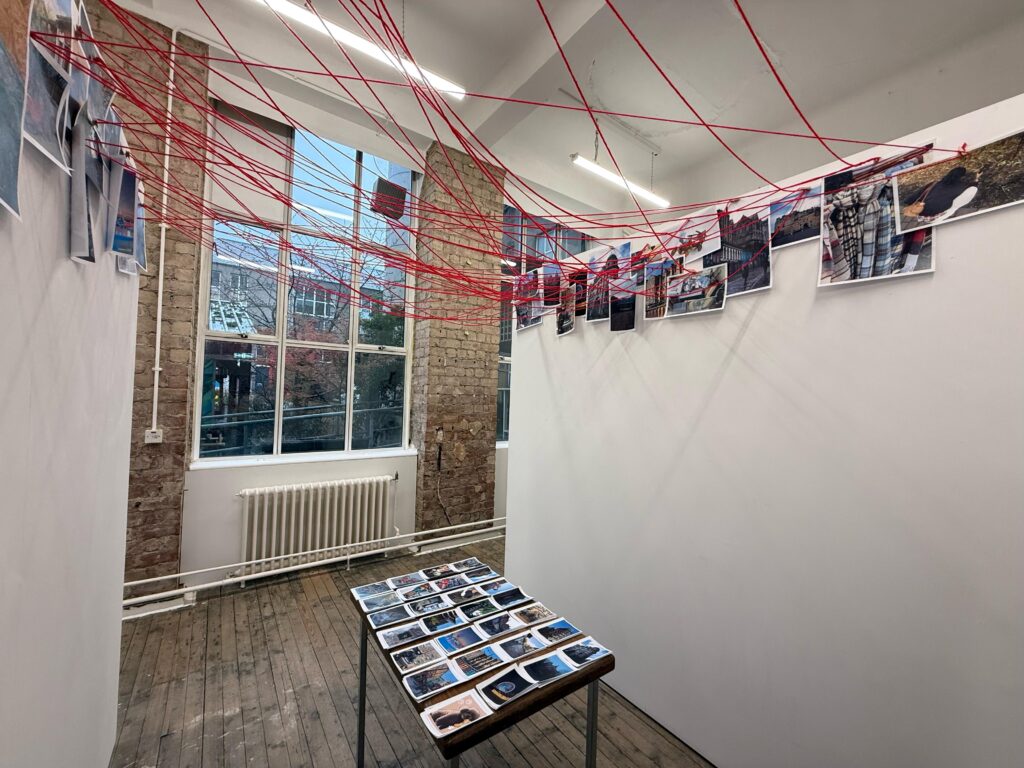
Installation view of Our Shell, showing suspended photographic display with red thread intervention, Summerhall, Edinburgh, 2026. Photograph by Hazel Ren.
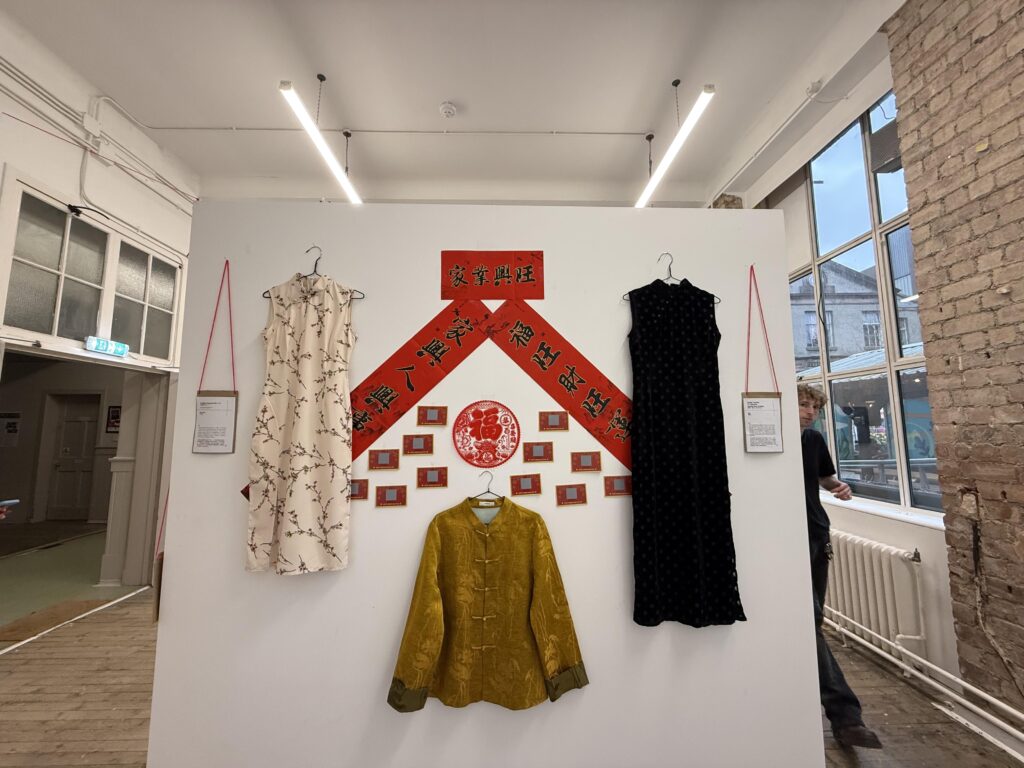
Installation view of Our Shell, showing garment installation and wall arrangement, Summerhall, Edinburgh, 2026. Photograph by Hazel Ren.
This experience also made me reflect more critically on my own curatorial project. In my exhibition, I have chosen public space as the exhibition site, with different points located across the city. After earlier adjustments, I have already changed the bus route into an optional way of connecting the sites rather than a fixed viewing path. Because of this, the relationship between the sites now needs to work in two ways at the same time. On the one hand, they need to exist as part of one overall curatorial structure. On the other hand, each site also needs to have viewing value when encountered on its own. Even if audiences meet these sites in a different order, the overall experience should still feel reasonable rather than abrupt. This means I need to pay more attention to designing a structure that can still function even when it is experienced unevenly. Here, the role of curatorial mediation becomes especially important. If audiences may encounter the sites in different sequences, coherence cannot depend only on order. It needs to be supported in other ways. For this reason, the map, on-site texts, and visual prompts within the AR elements will need to be more carefully designed so that viewers can recognize the connections between different sites.
At the same time, I became more aware of what curatorial responsibility means. During transportation, the frames of two works were damaged. This incident reminded me that curating does not only happen inside the exhibition space. It also includes risks that exist outside what the audience can directly see. This is especially important for my own curatorial project, because it is a fully outdoor exhibition. Questions of maintenance, permissions, risk, and responsibility to the public must be treated as seriously as concept and aesthetics. In terms of budget preparation, these unpredictable factors need to be considered much more carefully than in an indoor exhibition.
references
Kwon, Miwon. One Place after Another: Site-Specific Art and Locational Identity. Cambridge, MA: MIT Press, 2002.
O’Neill, Paul. The Culture of Curating and the Curating of Culture(s). Cambridge, MA: MIT Press, 2012.
University of Edinburgh. “IMPORTANT 2026 Toolkit BLOGs and Speculative Individual Curatorial Projects.” Course document.
“Walking as a Form of Critical Curating.” OnCurating, no. 8. Accessed April 13, 2026.
Figure 1. Installation view of Our Shell, showing painting display with suspended labels, Summerhall, Edinburgh, 2026. Photograph by Hazel Ren.
Figure 2. Installation view of Our Shell, showing hanging label design in relation to the gallery doorway, Summerhall, Edinburgh, 2026. Photograph by Hazel Ren.
Figure 3. Installation view of Our Shell, showing suspended photographic display with red thread intervention, Summerhall, Edinburgh, 2026. Photograph by Hazel Ren.
Figure 4. Installation view of Our Shell, showing garment installation and wall arrangement, Summerhall, Edinburgh, 2026. Photograph by Hazel Ren.
( Installation view of Our Shell, showing suspended photographic display with red thread intervention, Summerhall, Edinburgh, 2026. Photograph by Hazel Ren.)