

Curatorial Pitch
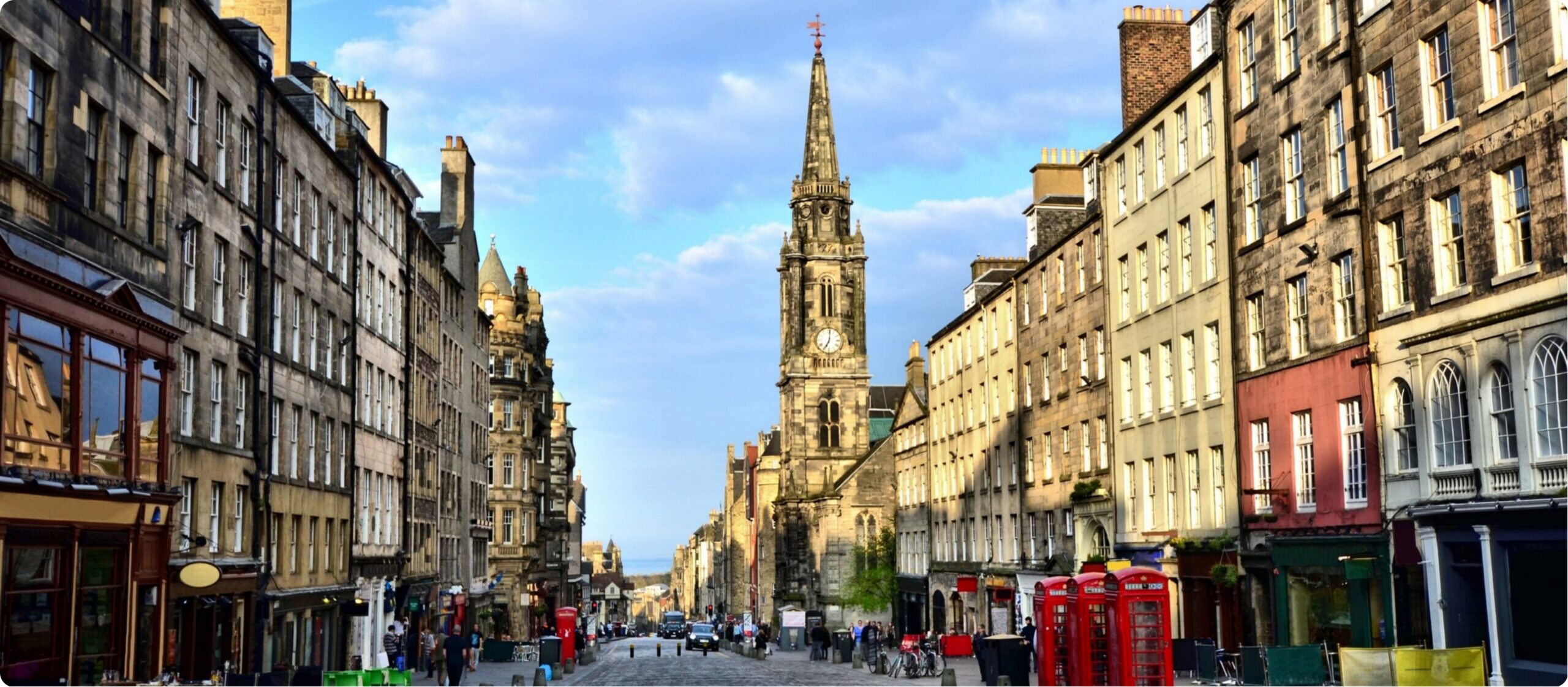


While strolling along the streets of Edinburgh, you might be able to sense those unspoken boundaries – they quietly delineate who belongs here, who can stay, and who feels like an outsider. My curatorial project “The Intangible Boundaries of Edinburgh” presents these hidden dividing lines through a self-guided outdoor “wanderlust exhibition” based on the city’s public transportation.
There is no need for expensive gallery tickets – just a Lothian Bus Day Pass (adult £6, family £13). The 35 bus is not just a means of transportation; it is also a “commute link” that connects various exhibition sites. Their seats themselves are deeply involved in the issues of public space: every moment of passengers’ sitting, staying, or observing is an unspoken dialogue with the urban public space. The linear movement of the bus serves as a natural transition between exhibition sites, making “commuting” no longer just a simple movement, but also a part of the exhibition.
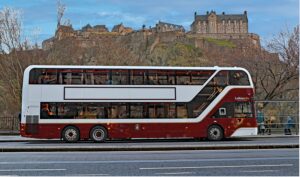
Lothian Bus Route 35
AR technology will be the core element throughout the exhibition. It will not only be embedded in each exhibition site, but also embedded in a series of mini augmented reality landscapes along with the street scenes during the bus journey. Visitors can interact with them through simple mobile phone operations, making the commuting process full of artistic perception.
This bus will take you through 6 stops, and each of the 6 exhibition sites corresponds to a unique invisible boundary. Based on critical space theory, drawing on the viewpoints of Doreen Massey and Henri Lefebvre, public space is regarded as a place of power struggle. The focus is on three key themes: tourist gentrification, invisible space rules, and space production.
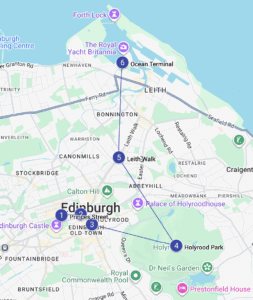
Exhibition Site Overview Map
My collaboration concept with the target artist is as follows:
Firstly, it is Chris Johanson. The emotional color and organic quality in his works can evoke the audience’s perception of the surrounding space and guide them to re-examine the theme of “harmony between ideals and environment”. I plan to invite him to create a work for Princes Street (Tourism Capital Boundary Station), drawing on the creation form of his work “Impermanence #9” (2025, acrylic and house paint on recycled canvas, 57.2×76.5×2 cm). By presenting the daily colors and textures, I aim to show the collision between the tourist consumption scene of Princes Street and the local daily life, allowing the audience to have an intuitive experience of the erosion of tourism capital on the daily space.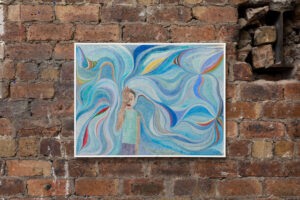
The second one is Toby Paterson, a local Scottish artist who is skilled at responding to specific spatial structures with abstract visual language. He constructed a city perception landscape between reality and concept through the overlapping of shapes and layers. I plan to collaborate with him to create a work for Waverley Bridge (Transportation Power Node Station), producing a distinctive geometric floor sticker. Through the direction of lines and the overlapping of layers, I will visualize the “guiding pedestrian flow lines” of this station. At the same time, I will also use AR technology to construct a similar visual layering effect, allowing participants to intuitively perceive the implicit control of infrastructure on space flow.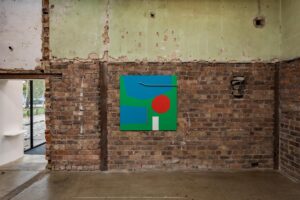
The third one is Clara Ursitti. Her works use smell as the medium to stimulate the audience’s experience of the spatial environment. I plan to invite her to create an olfactory intervention installation for Holyrood Park (a natural/city boundary site). The initial concept is to set up two sets of contrasting smells – the commercial atmosphere of the tourist area (coffee aroma, spice smell in the souvenir store) and the daily atmosphere of the residential area (bread aroma, grass and plant aroma), allowing the audience to intuitively experience the spatial differences through the smell, in line with the core theme of the exhibition “Invisible Spatial Boundaries”.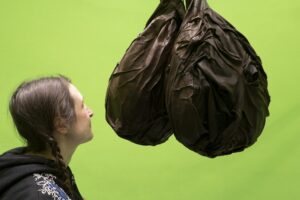
In addition, students from the Theater and Performance Practice department of the University of Glasgow will perform slow-paced shows on the Royal Mile, thereby visually depicting the normal local life that has been infinitely accelerated due to the tourism economy.
At Leith Walk and Ocean Terminal, interactive environmental protection activities that do not harm the environment are set up for the audience to participate in. Using local materials, collage artworks for ideal public spaces are created on-site. At the same time, a sand painting creation session for the future public spaces is organized on the sand, allowing the public to participate in the imagination and construction of public spaces.
All the sites are wheelchair-accessible. The artistic interventions are all temporary. Documentations are recorded through low-cost methods such as photography and visitor feedback. Meanwhile, as an outdoor exhibition, I have conducted risk assessments for multiple potential exhibition sites and AR devices in buses to ensure the safety of the artworks and interactive installations.
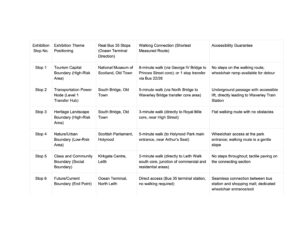
Edinburgh Bus 35 Exhibition Interchange Map