

Week 6|Site Testing: Site Visit as a Research Method


1.Ji Ju Collective: Physical Mapping at Summerhall
This week, the Ji Ju Collective conducted site testing at the Summerhall exhibition space. At this time, we have not yet determined the final curatorial theme, but focus on understanding the physical limitations of the venue. We used tape to mark the potential audience movement on the ground, and measured the height of the wall and the projection angle of natural light. This preliminary physical contact is essential because it forces us to think from an abstract perspective, but from the relationship between the body and the building. Measuring together also revealed something important about group work: curating is not only about authorship, but negotiation between people, and between artworks and architecture.
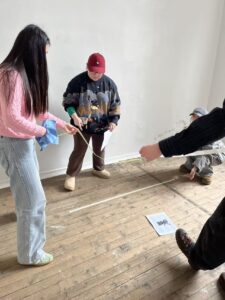
Figure 1. Measuring together: the group used a tape measure to check proportions and circulation, turning a floor plan idea into a physical, walkable scale test.
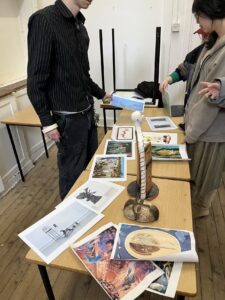
Figure 2. Jiju group curatorial workshop: we laid out printed images and discussed scale, sequencing, and material relationships before moving into the gallery space.
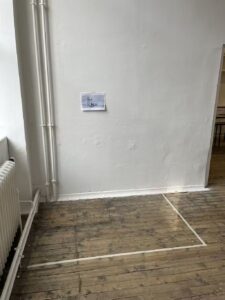
Figure 3. Testing placement in the room: a taped rectangle on the floor and a small image on the wall helped us visualise footprint, height, and viewing distance.
2.Theoretical Framework: The Curatorial as Potentiality
This state of indecision aligns with contemporary curatorial theories regarding potentiality. Curating should not be viewed as a finished conclusion but as an event in a constant state of becoming.
As Irit Rogoff argues:
So here is the beginning of my argument: I am not interested in understanding the expanded field of art as a multiplicity, as a proliferation of coexistent practices, as a widening of what might have previously been seen as a somewhat narrow arena defined by fine art practice. In addition to art I would designate the terms: ‘practice’, ‘audience’, ‘curator’, ‘space’, ‘exhibition’, ‘performance’, ‘intervention’, ‘education’ and many other terms as subjected to this same disorientation – a historically determined meaning which has been pushed at the edges to expand and contain a greater variety of activity – but never actually allowed to back up on itself and flip over into something entirely different. The hallmarks of an epistemological crisis in the way in which it interests me here are not the trading of one knowledge or one definition for another more apt or relevant one, but rather the question of what happens when practices such as thought or production are pushed to their very limits.
This view supports our current open and even somewhat confused discussion. At present, this uncertainty is not missing, but a research field waiting to be activated.
3.Extensions for the Individual Project (SICP)
The spatial experiments at Summerhall directly informed my individual project (SICP) planning at Custom Lane. By observing the movement of the collective members in different corners, I learned how to control the rhythm of the audience through the spacing of the work. For my future SICP, I plan to use similar physical marking techniques to position Guo Puyi’s works within the non-traditional space of Custom Lane. This method ensures that curatorial decision-making is based on honest perception of the venue, rather than blind visual aesthetics.
Notes:
1.Martinon, Jean-Paul. The Curatorial : A Philosophy of Curating. London: Bloomsbury, 2013,43.


1 replies to “Week 6|Site Testing: Site Visit as a Research Method”
Leave a reply


Hi Siqi, overall I can see you are really engaging with curatorial practice and art, good, there is a need to embed research more (independent and connections with course materials).
Week 4: share context wherever you can, eg “Parkview Green in Beijing” what is this, when was it built, a link in references art the end? You refer to Halperin and Hessler, but there are no references: who are they, what, and why do they appear. Also, grammatically the sentence does not have a main point (clause).
In Week 5, more substance is needed in the comments on the collective, eg you mention ethics, add research from course/elsewhere (LO1), link this to greater reflection (LO3) (same for ideas of home). Put curating in a commercial space in critical context of practice (LO2). You can do this, just not produce an event for profit.
In Week 5, how does your approach link to any course materials discussed (eg in relation to accessibility, audience engagement, ethics of openness, the way you frame curation through short texts?). What examples of exhibitions/projects is it aligned with (add LO1 research). Any value-loaded terms, arguments, statements need to be properly explained, eg what is “art jargon”. Your idea is not entirely clear from this very general note on your plan “to make the link between life and making visible”. Great to see your depth of connection to Puyi’s practice (but do not duplicate content, you use Reading week content in the Pitch post): sustain this in your final artist choice. I understand what you mean about not-overtheorising, but again but this in the context of curatorial practice and research on this (eg, going back to Week 1 and 2, do the texts discuss this?). There is no link to Mono-ha: create flow, why are you referencing this? Contextualise curating across materialities and mediums?
You have an extra post titled Curatorial Proposal: this should not be in the final portfolio. I have reviewed it anyway: awareness…do you need this very general idea, by contrast the 3-part thematic is interesting, thoughtful, perhaps a little convolute…hard to tell…more artworks are perhaps needed. Be careful not to tie art to thinking that is too defined. For eg. understand one person’s friction is another person’s companionship? Some very good practical thinking in the production plan, well done. Week 6 post: aim for shorter, clear subheadings in posts, use consistent language in Collective Post, eg Ji Ju in Collective Space, Meeting 1. Summarise the structure, goals and outcomes of the workship more clearly. To be clear, it is not that you are not allowed to have a solo ehxibition, it is the fact that without an extensive programme around this, you cannot attain the breadth of practice/research for the assessment criteria (Los). Make clear y our method of sourcing artists. Your summary of artists’ “shared commitment to material as a way of thinking” is a strong line for your final curatorial text, well done. Some images are still very small: make sure they are formatted in a way that communicated with clarity and impact.
Remember you are looking to summarise, format and elaborate on content in the clearest, most dynamic and consistent way to create strong impact.
we are not allowed to stage a solo exhibition
Include all references at end.
Give all key info where you can, to give context, say who writers are, the Polish curator X in their exhibition text for Y, highlights…
Avoid using formulations such as “this week I learned that curation is xyz) it is like a diary, writing to yourself. Think how can I demonstrate the depth and application of what I have learned?