

Week 7 | Site Survey and Initial Collective Negotiation


1. Objects as Narrators
This week, the Ji Ju collective transitioned into a substantive material phase. We are not in a hurry to determine a grand curatoral theme, but choose to start with the objects brought by individuals. Some people brought amulets, and some people shared old photos. These objects are not just souvenirs, they are shells that carry the memory of migration. At this stage, we do not pursue consensus, but allow each voice to maintain its uniqueness in the collective space. This approach makes us realize that the first task of the curatorial exhibition is not to force a title, but to provide a field for these fragmented narratives to collide with each other.
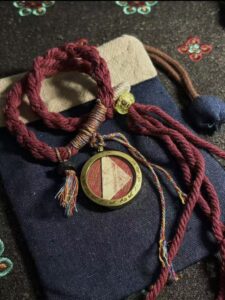
Figure 1. Daoist amulet from Taiqing Palace, Qingdao. Shared during Ji Ju Collective’s discussion at Summerhall as an object connecting hometown culture, everyday belief and curatorial thinking.
2.Curating as Connection
Although we have not yet identified the final name of the exhibition, our activity itself is a kind of curatorial practice. We are establishing some kind of nonlinear connection between the backgrounds of different members. This gathering process responds to Hans Ulrich Obrist’s discourse on the function of curating.In his work, he suggests that curating is about building bridges rather than mere preservation. He writes:
Ever since, this has been a central theme of all my exhibitions. I don’t believe in the creativity of the curator. I don’t think that the exhibition-maker has brilliant ideas around which the works of artists must fit. Instead, the process always starts with a conversation, in which I ask the artists what their unrealized projects are, and then the task is to find the means to realize them. At our first meeting, Boetti said curating could be about making impossible things possible.
3.Negotiating the Unknown
The current stage of discussion is full of friction and fragmentation. We visited Summerhall multiple times to understand how the site could accommodate our unformed ideas. The lack of a preset theme brings us a kind of freedom, allowing us to adjust the curatorial strategy according to the physical restrictions of the venue and the improvised feedback of the members. This is a kind of pragmatic consultation: how to extract publicly significant curatorial logic from the private experience of a group of nomiders, driven by respecting the labor of each artist. We are learning to accept this uncertain state and regard it as a necessary tension in collective creation.
Notes:
1. Obrist, Hans Ulrich, and Asad Raza. Ways of Curating. UK: Penguin Books, 2016, 11.