

Curatorial Pitch


Title: Awareness Through Materiality
Venue: Custom Lane, Edinburgh
1. Curatorial Narrative
This group exhibition will take awareness as a specific viewing practice, not an abstract psychotherapy. In urban life that pursues speed and efficiency, materials are often simplified into tools. This exhibition regards daily materials as weighted existences, explores how we treat objects, and then reflects on how we treat ourselves and others.
Through the works of three artists, the exhibition guides the audience through three stages of bodily and visual pacing: companionship, friction, and decentring. Jiang Miao carved acrylic paint on the aluminum plate. These traces on the hard surface acted as a quiet companion, making the audience slow down. Suyon Huh uses pulp, Korean paper and ropes to transform invisible anxiety into visible spatial pulling force, and break the daily comfort through the resistance of the material. Guo Puyi, on the other hand, uses modular structures such as fallen leaves and steel to divert the audience’s attention from the human-centered sense of urgency, prompting us to reposition ourselves in a broader material network.
2. Space and Location
Custom Lane link:exhibition-space
The exhibition will be held in the Custom Lane exhibition space in Edinburgh. Custom Lane is an independent creative workspace in Leith, with a flexible ground-floor exhibition room suited to installation, wall-based, and floor-based works. Unlike the traditional White Cube gallery, Custom Lane has a strong atmosphere of life and community, which is very suitable for displaying works that explore everyday materials.
The move away from a white-cube gallery reflects the curatorial logic of the project: materials should accompany audiences in their daily lives, not be isolated behind institutional distance. Custom Lane’s existing circulation, the movement of workers, visitors, and the community, creates the conditions for natural encounter.
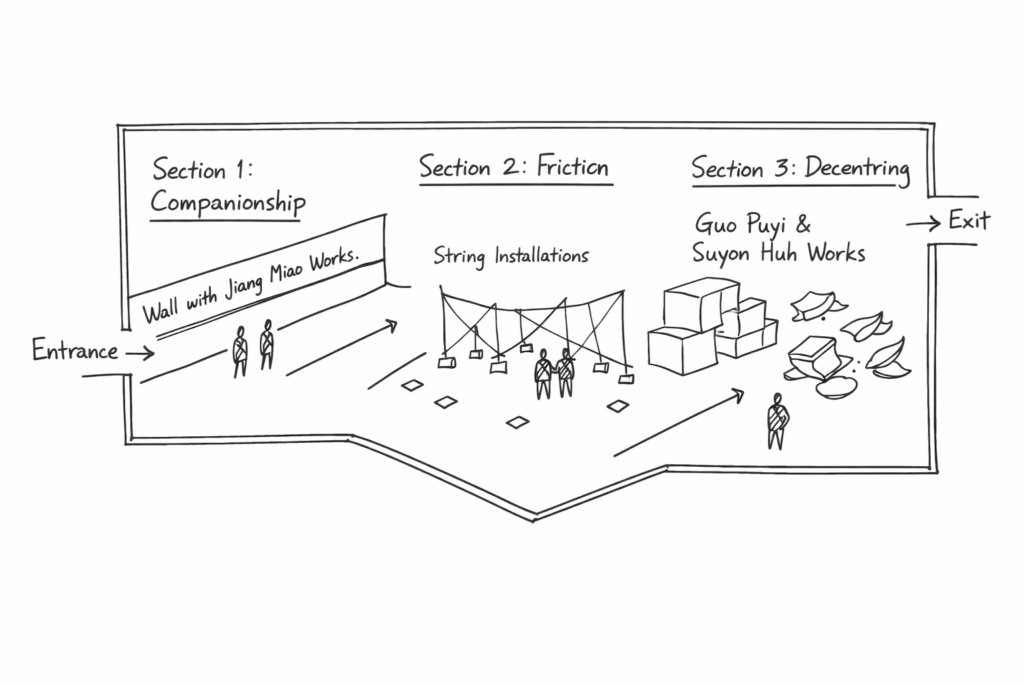
Layout overview:
• Section 1 (Jiang Miao): Works mounted on the main wall. Visitors begin at distance, then approach to read carved surfaces. Soft, even lighting to reveal shadow in the carving.
• Section 2 (Suyon Huh): String-based works require clear floor distance and subtle cue markers. Structure is visible first; tension draws the eye inward.
• Section 3 (Suyon Huh Fig.6 and Guo Puyi): Modular and leaf-based works near the exit, functioning as a return point, transforming earlier tension into a proposal for reformed connection.
3. Curatorial Rationale
The curatorial method of this exhibition is based on the theme, participation and venue. The three-part structure derives from the curatorial practice lesson I drew from Mono-ha: treat material, weight, scale, and placement as carriers of meaning, and let viewers understand through bodily experience rather than explanation.
Choosing Custom Lane instead of the traditional White Cube Gallery is carefully considered: it embodies this concept. If the awareness of consciousness lies in relearning attention in daily situations, then the exhibition itself must resist the closed and authoritative institutional exhibition model. Venue here means choosing a space where art can coexist with daily life.
The artist selection prioritises material as a way of thinking, not illustration. Jiang Miao’s carving practice is a form of long-term polishing. Suyon Huh’s tension-based works make anxiety and absence physical. Guo Puyi’s modular logic turns connection into a tactile argument. Together, these three practices build a sequence from quiet companionship through rupture to reorientation.
Accessibility and ethics are structural, not decorative. Clear labels avoid exoticising the cultural backgrounds of the artists. Artist fees, transport, and insurance are treated as non-negotiable. Audience participation in the walk-through is optional, and the online layer ensures that those who cannot visit in person can still access the work.
4. Artists and selected works
A) Jiang Miao
Jiang Miao’s three works all point to the first level of awareness: not a didactic spiritual therapy, but rather, through carving and the hardness of metal/wood, she brings attention back to the rhythm of touch and breath. Her paintings are like a state of repeated polishing, reminding the viewer that awareness is not a sudden flash of inspiration, but rather a long-term training.
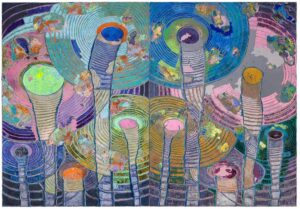
Figure 1. Mindfulness 20241205, JIANG MIAO, 2024. Acrylic on aluminium panel, carving. 250.0 × 400.0 cm.
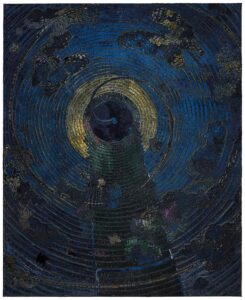
Figure 2. Mindfulness 2024.5.5, JIANG MIAO, 2024. Acrylic on aluminium panel, carving. 160.0 × 130.0 cm.
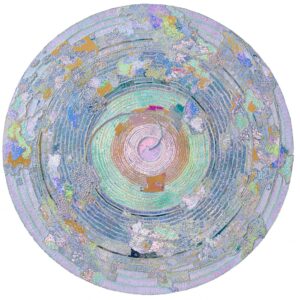
Figure 3.Taoist Trinity and the Self 2023.10.22, JIANG MIAO, 2023. Acrylic on wooden board, carving. Diameter 217 cm.
B) Suyon Huh
Her works materialize everyday fears, absences, and fictitious orders into tangible material systems: papier-mâché, string, thread, Korean paper, watercolor, and oil painting overlays. They look light, but actually form a pulled structure in the space, causing the audience to experience physical tension and self-projection. She is responsible for the transition between the second and third sections of the exhibition: from being soothed to being pulled back to reality.

Figure 4. Garden in Reality, Suyon Huh, 2023. Watercolour, oil paint, and paper pulp on hanji. 200 × 180 cm.

Figure 5. The Perfect Society in Absence, Suyon Huh, 2023. Paper pulp, hanji, rope, ribbon. Dimensions variable.

Figure 6. Phone Phobia, Suyon Huh, 2023. Wooden frame, telephone, paper pulp, string, sand. 69 × 69 × 116 cm.
C) Guo Puyi
Guo Puyi is responsible for pushing the exhibition to the third level of awareness: the material not only accompanies it, but also organizes the space in turn, forcing us to adjust the way we see. In particular, he turned the text, structure and splicing system into a scalable installation logic, making the audience realize that the relationship between people and the real materials of the world is not a slogan, but a kind of repeated construction and maintenance.
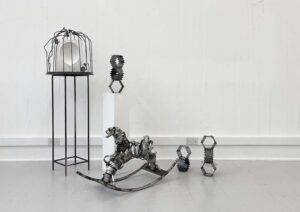
Figure 7. Guo Puyi, installation view. A small family of objects shares the same room but holds different degrees of freedom. A balloon-like void is kept inside a metal cage, while a rocking-horse body lies on the floor like a toy that has grown heavier than play. Nearby, modular steel figures stand upright, as if play has been reorganised into structure. In this scene, comfort, control, and companionship are negotiated through material weight and spatial distance.
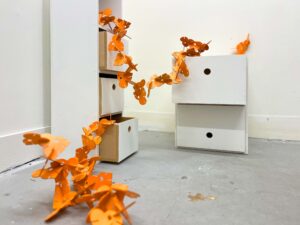
Figure 8. Guo Puyi, installation view. Placed among drawers and corners, the work behaves like something that escaped storage and began to travel. It turns the domestic into a site of agency, not just comfort.
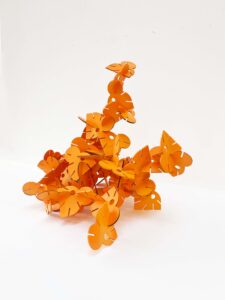
Figure 9. Guo Puyi, sculptural detail. A cluster that looks like a soft plant but is built from rigid modules. It suggests how connection grows: not as one perfect form, but as many small contacts holding each other up.
5.Public Programme
The programme is low-cost and designed to reduce barriers without over-explaining the works.
-
Sensory Walk-through(free, twice per week): A 30-minute guided session. Rather than providing art historical context, the guide prompts sensory observation by asking questions about material weight and texture.
-
Material Workshop (free, one session): A 45-minute practical session. Participants build temporary structures using only paper and string to test physical tension and spatial resistance.
6. Budget (Total: £10,000)
Item |
Estimate (GBP) |
Rationale |
Venue hire — Custom Lane |
£1,932 |
£276 × 7 days |
Venue tech / staffing contingency |
£600 |
Basic ops, cleaning, equipment add-ons |
Artist fees / loan fees (3 artists) |
£3,000 |
£1,000 each, respecting labour and permissions |
Transport and packing |
£1,600 |
Local courier + lightweight international packing |
Insurance (artworks + public liability) |
£700 |
Conservative placeholder pending quotes |
Installation and materials |
£900 |
Plinth tweaks, fixings, labels, minor lighting |
Graphics and print |
£450 |
A2 poster set + in-space print |
Documentation (photo/video) |
£550 |
One on-site documentation session |
Accessibility and translation |
£300 |
Bilingual text, alt text, text guide |
Contingency (~10%) |
£968 |
Buffer |
TOTAL |
£10,000 |
Balanced |
7. Funding Sources
The following foundations have been identified as realistic candidates based on their eligibility criteria, funding ranges, and the nature of this project.
Amount available: £500–£50,000 (rolling deadline, no fixed closing date). This project would apply for approximately £10,000.
website:https://www.creativescotland.com/funding/funding-programmes/open-funding/open-fund-for-individuals
8. Project Timeline
Phase |
Tasks |
Notes |
Weeks 1–2 |
Confirm artist loans, artwork information, permissions, and crediting agreements. Draft contract and fee structure. |
Apply to Creative Scotland (rolling). Confirm Custom Lane booking. |
Week 3 |
Lock transport and insurance. Finalise bilingual wall texts and accessibility materials. |
Commission documentation photographer. Finalise layout and floor plan. |
Week 4 |
Technical coordination: plinths, fixings, lighting rig, floor cue markers for Huh’s string works. |
Print graphics. Brief walk-through guide for workshop facilitators. |
Install (2 days) |
Install Jiang Miao panels first (heaviest and wall-fixed). Then Huh’s tension works. Guo Puyi last , modular works adjusted in situ. |
Private view on final install evening (optional, low-cost). |
Open (7 days) |
Public opening. Two walk-throughs per week (Day 2 and Day 5). One workshop session (Day 4). |
Online layer live from Day 1. Invigilator schedule confirmed with Custom Lane. |
Deinstall (1 day) |
Careful deinstall and packing. Artworks returned or held for collection. |
Document condition of works on departure. |
Archive (1 day) |
Edit documentation. Compile report: visitor numbers, programme feedback, financial summary. |
Share archive with artists and funders. |