
Reading Week | Awareness: Reshaping the Curatorial Gaze Through Materiality


1.The Evolution of a Curatorial Pitch
During Reading Week, I grounded my individual curatorial project in the theme of Awareness. This is not an abstract spiritual slogan, but a concrete effort to detect how inertial gaze shapes our relationship with objects and ourselves. I chose to cooperate with the artist Guo Puyi and had an in-depth discussion with him. Because his works give life and dynamism to seemingly inanimate materials, challenging the utilitarian efficiency logic that dominates modern life. This reflection stems from the background of my growing up in Shandong, where social norms composed of etiquette and rules sometimes make people feel heavy, which prompts me to find another way of existence through art.
2.Material Strategy: Companionship and Resistance
I divided Guo’s works into three groups: the first is wooden and ceramic works, showing the warmth of matter as a daily partner; the second is iron and hard materials, which challenge the audience’s comfort and stimulate critical thinking by transforming familiar soft forms (such as balloons or rocking horses) into cold and hard metal; finally, based on leaf The works of children and paper lead attention to the vast world outside nature and self. This curatorial logic aims to let the audience understand the work through physical experience rather than complex terms.
I do not want to force this exhibition into Mono-ha, but Mono-ha gives me a clear curatorial lesson: treat material, weight, scale, and placement as part of meaning, and let viewers understand through bodily experience rather than over-explanation. Mono-ha, emerging in postwar Japan, foregrounded direct encounters with materials and the relationships between things and site. That approach helps me keep awareness grounded in how people look and move, not only in what they read.
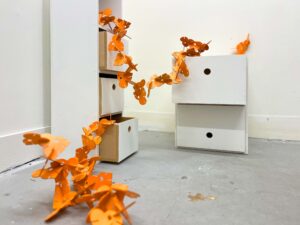
Figure 1. Guo Puyi, installation view featuring modular leaf-like structures interacting with a domestic drawer unit.
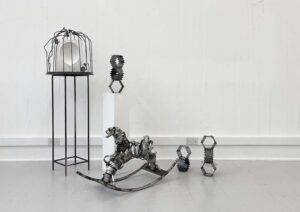
Figure 2. Guo Puyi, installation view of the metal sculpture series, featuring forms of a cage, a rocking horse, and modular figures.
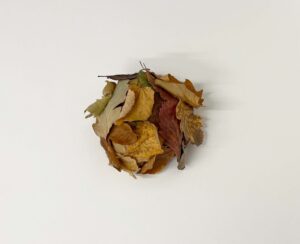
Figure 3. Guo Puyi, sculptural object constructed from compacted fallen leaves.
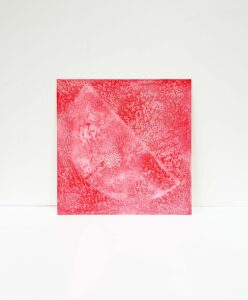
Figure 4. Guo Puyi, surface-based artwork exploring the visual tension of a frozen spill or stain.
3. Ji Ju Collective: Ethics of the Transitive Site
This week, the Ji Ju Collective discussions focused on the ethics of nomadic identity and curatorial labor. As a mobile network composed of foreigners, we lack a fixed physical structure, and our exhibition space is essentially instantaneous. However, this requires us to have a deeper curatory responsibility. As Miwon Kwon warns in her examination of site-specificity, without a relational sensibility, our migratory trajectories might become genericized sequences. Instead, she argues:
Thus, it is not a matter of choosing sides—between models of nomadism and sedentariness, between space and place, between digital interfaces and the handshake. Rather, we need to be able to think the range of the seeming contradic-tions and our contradictory desires for them together; to understand, in other words, seeming oppositions as sustaining relations.
Notes:
1.All photographs of the artworks featured in this post are provided courtesy of the artist, Guo Puyi.
2.Kwon, Miwon. One Place after Another : Site-Specific Art and Locational Identity. Cambridge, Mass. ; MIT Press, 2002, 166.
3.”Mono-ha,” Art Terms, Tate, accessed April 19, 2026, https://www.tate.org.uk/art/art-terms/m/mono-ha.