

Week 5 |Turning Lived Experience into Curatorial Material


1.CAP Workshop: From Jargon to Memory
After observing Contemporary Art Practice (CAP) classmates present their work, I recognized that artistic vitality stems from personal background, cultural memory, and lived experience rather than abstract jargon. This discovery makes my project goal clearer: I hope to plan an exhibition to help the audience understand the work through a simple entry point, explore the source of the creator and how these experiences can be transformed into forms, materials and postures. This narrative style makes the curation no longer just a display of works, but makes the relationship between life and creation clearly visible.
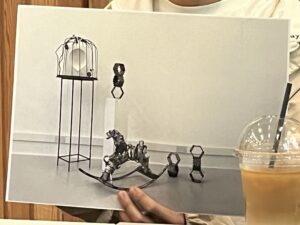
Figure 1. CAP classmate (name withheld), documentation image of a metal sculpture installation shared during an in-class session, ECA Main Building, Thursday, 12 February 2026. Photograph by the author.
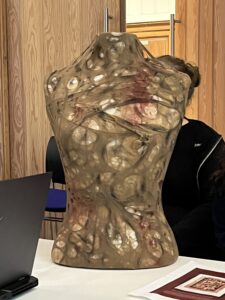
Figure 2. CAP classmate (name withheld), torso-shaped sculpture brought for an in-class sharing session, ECA Main Building, Thursday, 12 February 2026. Photograph by the author.
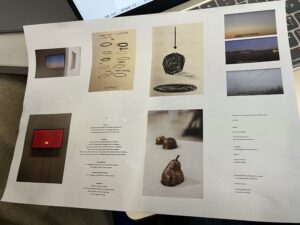
Figure 3. CAP classmate (name withheld), printed presentation board combining artwork images, sketches, and short texts, shared during an in-class session, ECA Main Building, Thursday, 12 February 2026. Photograph by the author.
2. SICP: Material, Home, and Translation
My personal project (SICP) will revolve around three daily clues: material (emotional carrier in reality), household goods (from daily life) and translation (changes in experience in cross-regional and language migration). The purpose is not to explain identity, but to make the connection between life and creation visible. In her work, she explores how backgrounds shape how we inhabit space:
Familiarity is what is, as it were, given, and which in being given “gives” the body the capacity to be orientated in this way or in that. The question of orientation becomes, then, a question not only about how we “find our way ”but how we come to “feel at home.”
3. Ji Ju Collective: The Ethics of Representation
Within the Ji Ju collective, our discussions focused on a cautious approach to the concept of cultural background. We agreed that artistic backgrounds should not be treated as fixed labels or transformed into exotic commodities for audience consumption. Our collective manifesto emphasizes that curators must be aware of their speaking position, ensure financial transparency, and maintain profound respect for artist labor.This requires me to think carefully about who gets to speak and how the effort behind each piece is properly acknowledged through transparent processes.
Notes:
1. All photographs were taken by the author. The artworks shown were brought and presented by MA Contemporary Art Practice (CAP) classmates during an in-class sharing session, and are used here as documentary material for curatorial reflection.
2. Ahmed, Sara. Queer Phenomenology Orientations, Objects, Others. Durham: Duke University Press, 2008,7, https://login.eux.idm.oclc.org/login?url=http://dx.doi.org/10.1215/9780822388074.