Below are several questions and concerns that remain central to the current stage of my KIPP research and have linger in my head. I would be deeply grateful for my supervisor’s invaluable advice and guidance as I navigate these evolving tensions. This post also serves as a reflexive sketch of where the project currently stands, where it may go, and what conceptual resources might guide its next iterations.
- Epistemological entanglements of Darwinian ontology
My proposed project has so far clearly articulated the ontological critique of Darwinian evolutionary models that underpin certain algorithmic design paradigms, particularly the reductive logics of optimisation, competition, and seperability. However, what remains underdeveloped is the epistemological dimensions it underwrites—particularly its role in shaping the dominant frameworks of knowledge production. This is a critical area that must be taken up in the next stage of research. Following Rashné’s insightful advice during our KIPP feedback meetings, I now see the critique of epistemological knowledge production as a crucial anchor for the next phase, as epistemology has always had a deep entanglement with ontology, which is my main takeaway from the course Coloniality of Data.
Specifically, I am drawn to interrogate how Darwinian-inspired algorithmic ontologies produce regimes of intelligibility—what forms of knowledge are made legible or illegible, which questions are allowed to be asked, and which forms of relationality are deemed irrelevant or non-datafied. This line of inquiry finds resonance with Donna Haraway’s situated knowledges and Karen Barad’s onto-epistemology, as well as Robin Wall Kimmerer’s Indigenous critique of scientific objectivity’s framing of “legitimate” questions. I aim to explore how algorithmic regimes inspired by Darwinian epistemology reinforce the logic of separation, distilling relational phenomena into isolated, inter-competitive units—thereby erasing entanglement, reciprocity, and symbiosis—another kind of possibility of relationship in evolutionary theories and evolutionary algorithms.
- Methodological Refashioning: Letting Go of the Three-Phase Prototype
During my personal KIPP meeting with Rashné’s, we have addressed the concern that my original proposal (proposed in December) was overly ambitious in the Mater scale. I have since let go of the proposed three-phase digital humanities methodology that envisioned building a prototype algorithm inspired by symbiogenetic evolution. While this model allowed me to speculate on what a “feminist and posthuman evolutionary algorithm” might look like, it also demanded a level of technical development that would exceed the scope of a master’s dissertation.
At the same time, my critical stance towards digital humanities has sharpened. Participating in the university’s digital humanities workshop prompted me to interrogate the field’s epistemic assumptions and historical complicities. As I reflected in an earlier blog post, “Whose Words Will Live Forever? A Call for Critical Digital Humanities,” I am increasingly unwilling to uncritically apply computational tools that have not undergone rigorous critique. These reflections have prompted me to suspend the uncritical application of DH tools and instead begin developing methodological frameworks aligned with my ethical and political commitments. My position is not one of rejection, but of strategic suspension: I would only be willing to use digital humanities methods once they evolve into a form of critical digital humanities—capable of engaging with power, coloniality, and epistemic exclusion.
- Turning Towards Utopia as Method
Given this methodological pivot, I now face the urgent task of crafting alternative approaches that are epistemologically coherent with my theoretical framework and my political-ethical stance. As I search for a new methodological framework, I find Ruth Levitas’s Utopia as Method, which I encountered in the course Utopia and the Future, particularly generative. Rather than treating utopia as a fixed ideal, Levitas positions it as a methodological tool composed of three modes: excavation (of underlying assumptions, also called as “Archaeology” in Levitas’ terms), critique (of taken-for-granted present conditions, also called as “Ontology” in Levitas’ term), and construction (of alternative futures, also called as “Architecture” in Levitas’ term). This triadic structure maps remarkably well onto the structure of my current project.
Levitas’s method serves as a speculative tool for constructing my alternative algorithmic imaginaries through a series of practical and necessary acts. It helps to avoid a potential pitfall of this project—namely, becoming too lofty and cruelly optimistic—especially as the project has shifted its goal from building an actual prototype to engaging in speculative imagination in ontology and epistemology, following Rashné’s advice. A symbiogenetic AI model, while not currently realisable in full, can function as a methodological fiction that opens up space for new imaginaries. In this sense, the critical and speculative dimensions of my project become co-constitutive: critique makes space for construction, and construction sharpens the stakes of critique.
- Supplementing the Theoretical Framework and Artefactual Inspiration: Data Coloniality and Feminist Tech / Data Activism
In addition to methodological realignments, I am also revisiting the theoretical framework through insights gained from other courses. The Coloniality of Data course has equipped me with a vocabulary to critique how Darwinian evolutionary logics are embedded in algorithmic systems, and how they naturalise techno-evolutionary trajectories that privilege competition and optimisation over entangled or symbiotic modes of becoming. The works of Karen Barad, Robin Wall Kimmerer, Nelson Maldonado-Torres, Sylvia Wynter, and Denise Ferreira da Silva form an essential part of my evolving theoretical repository and warrant further close reading in the future.
Also, if I eventually decide to include an artefactual or applied component in future research, the Inclusive Society course offers practical models. Projects on feminist data activism and community-led audit tools demonstrate how alternative knowledge infrastructures can be enacted. These may inform my thinking on what a symbiogenetic algorithm would require.
- Ongoing Lexical and Conceptual Dilemmas
There are still unresolved semantic and conceptual tensions that I hope to clarify:
- Should I describe the recursive entanglement between anthropocentrism and patriarchal logic as a “loop” or a “chain”? While “loop” evokes closed cycles, “chain” connotes linear bondage. I am still deliberating on which metaphor more accurately reflects the recursive violence of these logics influenced by Darwinian evolutionary theories.
- In imagining a symbiogenesis-inspired AI, what term best describes its participating agents—“agents,” “actors,” or “subjects”? Each term carries its own philosophical baggage, and I am inclined towards “actors” for its STS connotation, though “subjects” may better capture the project’s political stakes.
- Lastly, in describing the genealogical arc of algorithmic life, should I refer to a “bios-technological genealogy” or a “zoē-technological genealogy”? While I am aware of the distinction—bios as qualified, regulated life and zoē as raw, immanent life— I need to reflect more on the affective and political valences of each. At present, I am inclined toward “bios,” given that my critique targets the recursive loop by which plural, entangled, symbiotic life (zoē) is reduced to regulated, optimised, and exclusionary algorithmic life (bios). Thus, my object is not zoē itself, but the logic that attempts to capture and format all life into bios.
- Cosmic Objectivity: From Darwinian Evolutionary Theory and Evolutionary Algorithms to Epistemological Applications in Astronomy and the Universe
Now, I would like to seek advice for what I consider the most pivotal and generative question in my current research trajectory. While my updated KIPP proposal—outlined in Structured Blog Post 9: Recursive Ancestors: On Darwinian Shadows and my Symbiogenetic Dreams in AI (18 June) [1]—focused on tracing Darwinian epistemologies within evolutionary algorithms and their extensions into AI, this post takes a decisive step further. Here, for the first time, I attempt to critically trace the technogenetic inheritance of Darwinian thought into domains that lie far beyond traditional algorithmic systems: specifically, the application of evolutionary algorithm logics within astronomy and cosmology. This move opens a new interdisciplinary branch of inquiry that engages not only with AI and algorithmic cultures, but also with the knowledge-making practices of astrophysics and the philosophy of the universe.
In the proposal of Structured Blog Post 9, although I had already made significant optimisations and theoretical refinements, I had always harboured a subtle unease and a certain dissatisfaction with the integrity of the research. This dissatisfaction did not stem from technical aspects, but from my pursuit of critical depth—I had always vaguely felt that my critical lineage tracing had not yet truly reached its proper endpoint. Inspired by Crawford and Paglen’s paper, “Excavating AI: The Politics of Images in Machine Learning Training Sets,” particularly their excavation of the “roots” of bias in computer vision, I began to treat lineage tracing as a kind of excavation: not merely analysing how contemporary systems operate, but digging into their distorted and corrupted roots, and further questioning whether these roots continue to sprout similarly distorted and corrupted branches—branches that manifest as their contemporary applications across various scientific fields.
Therefore, I attempt to string together a critical chain: beginning with the ontological and epistemological assumptions of Darwinian evolutionary theory → leading to its inspired evolutionary algorithms (EA) → then analysing how EA implant Darwinian-like features and structures into many non-EA systems (such as AutoML or other black-box models) → ultimately, I hope to point out that this deep infiltration manifests in a specific applied domain (a section not yet determined at the time of Structured Blog Post 9), producing a seemingly neutral (pseudo-neutral), seemingly objective (pseudo-objective), but in fact fundamentally skewed, new scientific knowledge production and practice.
Yet precisely in the “last segment” of this chain—that is, the concrete application consequences ultimately caused by EA and their latent Darwinian ontological assumptions—I have long felt something was missing. If this “applied instance” cannot be effectively identified, then the entire critical lineage, though seemingly coherent, lacks a grounded, tangible, reality-pointing critical fulcrum, rendering the overall theoretical elaboration slightly lofty.
This persistent “dissatisfaction” has thus pushed me to extend my reading antenna, to investigate how evolutionary algorithms (and their philosophical assumptions) have actually influenced knowledge production processes and practices in a broader range of scientific disciplines. It was not until a eureka moment during my MSc in Edinburgh—specifically, the Coloniality of Data course’s fieldtrip to the Dynamic Earth in Edinburgh, where we watched the planetarium show “What’s Up”—that this became clear. The show, about the universe as seen through the Hubble telescope, was an astonishing experience that ignited my interest in astronomy and cosmology. I began reading books like “The Science of Interstellar” by Nobel Prize-winning physicist Kip Thorne to understand the rigour and speculation within cosmology.
During this exploration, I discovered the applications of EA within astronomy and cosmology, and for the first time, the critical lineage looped back to closure—becoming a hybridised genealogical critique that starts from ontological roots, realises through technical forms, and ultimately shapes the epistemic order of cosmic knowledge.
In the past few weeks of reading and reflection, I have further attempted to sort through the ontological-technical context of evolutionary algorithms (EA), and how they, as a digitised delivery format inspired by Darwinian evolution, have entered data modelling and prediction systems across various non-biological fields.
Initially (as of the proposal in Structured Blog Post 9), my attention was limited to EA as a type of computational strategy within AI systems, critiquing the ontological assumptions of Darwinian-style competition-selection-optimisation it internalised. But more recently, I realised EA do not merely exist within the “closed systems” of biological simulation or technical optimisation; they are influencing a wider array of knowledge production domains and even shaping our understanding of the universe. And, I’ve started to believe that perhaps the application of AI algorithms as tools for detection, measurement, simulation, and prediction in astronomy and cosmology is precisely the “missing chain” I had been seeking in my critical lineage tracing.
Accordingly, the argument I aim to substantiate is: traversing from biological evolutionary theory to AI/ML to cosmological sciences, the paradigms of ontology and epistemology—specifically the Darwinian paradigm—are continually traversing scientific disciplinary boundaries and infiltrating one another. The so-called pseudo-objective, pseudo-value-neutral knowledge is continually being produced, delivered, and reproduced across different eras and scientific fields, generating successive waves of similarly pseudo-objective, pseudo-value-neutral knowledge production.
Specifically, in my exploration of AI applications within astronomy and cosmology, I discovered that EA family methods have already been deployed in tasks such as morphological classification of galaxies, feature selection across UV-optical-infrared spectra, telescope array parameter optimisation, and anomaly detection in new celestial objects.
These scientific applications appear neutral, yet their technical substrate embeds the distinctive logic of evolutionary algorithms: selection, competition, fitness, adaptation. For example, in classifying galaxy morphologies, researchers might optimise classification models using EA and EA-generated non-EA to quickly converge on categories pre-assumed to be “representative,” such as spiral or elliptical galaxies, while excluding irregular forms of galaxies as “noise” or “outliers.” [2]
Similarly, in anomaly detection tasks, EA are often used to optimise the “sensitivity” and “specificity” of perceptual models. But behind such optimisation often lies the assumption that only certain signals (e.g., Earth-like planetary trajectories or specific spectra) are valuable cosmic phenomena, while others that do not meet the standard of “biological habitability” are deemed redundant or uninterpretable and thus discarded.
These technical choices, in effect, shape the “map of our visible cosmic knowledge” today—which data are retained, annotated, named, and incorporated into knowledge graphs, and which are excluded as useless signals, statistical noise, or anomalous data. In other words, although EA’s selective pressure is not biological, it performs a similar filtering role in knowledge construction, further shaping the epistemological boundaries of cosmology. EA, then, are not merely methodological choices, but adjudicators of knowledge classification and value ordering. The seemingly neutral cosmic understanding and knowledge we acquire is already permeated by specific technical genealogies.
This observation led me to ponder: is there a genealogical (or archaeological) critical path to be excavated? That is: Darwinian biological evolution → EA as technical realisation → EA infiltration of non-EA algorithms and AutoML pipelines → EA deployed in astronomy → Evolutionary ontology in computational form infiltrating “cosmic epistemology” → Constructing new, seemingly neutral cosmic imagery and knowledge order.
My aim is not to devalue the scientific contributions of astronomy, but rather to point out: whether these AI/EA-constructed “knowledge pipelines” might, through their embedded Darwinian evolutionary assumptions, restructure our epistemic vision of the universe—from “what constitutes noteworthy celestial structures” to “which features qualify as meaningful signals.” In such cases, the so-called ‘observation of the universe’ is no longer merely a neutral act of data collection, but rather a deep epistemic practice into which technological ontology has infiltrated.
This reasoning also resonates with Lorraine Daston and Peter Galison’s Objectivity, Karen Barad’s theory of intra-actionin measurement, and Denise Ferreira da Silva’s critique of how modern systems of knowledge—including race, geography, and temporality—are structured by the logics of coloniality. While da Silva does not explicitly address “outer space,” her analysis of how raciality and colonial power saturate global epistemic and spatial formations provides a compelling lens through which to question the presumed neutrality of the cosmos. In other words, if terrestrial modes of seeing and knowing are entangled with colonial infrastructures, why would celestial domains be exempt? The universe, then, is not merely something that is seen, but is constituted through historically specific epistemic apparatuses—a process that may already bear the shadow of technological colonisation.
Hence, I would like to raise a concrete research question for discussion: If we treat evolutionary algorithms as delivery tools for ontological assumptions and excavate how they technically infiltrate astronomy and cosmology through AI, does such a critical epistemological-ontological lens possess scholarly potential within the fields of History of Science, STS, or HPS?
To sum up, I intend to examine evolutionary algorithms as an “ontological-epistemological delivery mechanism” and observe how those somewhat unpure have already been implanted even into fields traditionally considered the most pure hard-science scientific fields, such as astronomy and cosmology. I aim to demonstrate that AI, as a mediating scientific technology, possesses a permeating and generative power that transcends disciplinary boundaries and recursively produces and delivers particular values.
Of course, as a researcher naturally with situated knowledge, I must also disclose and acknowledge the looming presence of my own philosophical beliefs—posthumanism and a critique of phallogocentrism[3]—as the background supports for my theorisation of this ontological-epistemological pipeline in different scientific domains. Yet I wish to emphasise: I do not want this critique to remain merely abstract or lofty, but to be grounded in a highly challenging applied domain (astronomy), using concrete examples in classification, anomaly detection, and instrumentation configuration to show how Darwinian evolutionary logic subtly directs how we “see the universe.” By excavating this background presence, I aim to uncover a new technologically mediated regime of cosmic knowledge and expose the pseudo-objectivity and pseudo-neutrality permeating scientific interdisciplines.
I understand that such a resaerch question is not without ambition, but I believe it offers a unique way to connect digital implementations of evolutionary technologies, AI epistemology, astronomical observation systems, and the construction of epistemic legitimacy (including the effort by Daston and Galison in the HPS field to demonstrate that “scientific objectivity has a history”). If my supervisor considers this train of thought to have research value, I would be thrilled to develop this STS- and HPS-oriented technical genealogy, an archaeological or genealogical pipeline of scientific knowledge production and methodological politics, as my KIPP project.
Of course, my current proposal is primarily grounded in genealogy and theoretical critique, and I will need to, between now and August, gradually build up more case-specific detail and empirical and textual evidence of “how evolutionary algorithms concretely permeate astronomical workflows” in order to provide some empirical evidence for my reasoning. To meet the empirical and ethnographic needs of my research and to deepen my empirical knowledge of astronomy and cosmology, I have applied to and have been admitted attending the first Edinburgh School for Extragalactic Astronomy (ESEA-I) from 24 June to 30 June. Although the school primarily targets young researchers aspiring to pursue careers in astronomy and cosmology, I clearly stated in my application that I intend to participate from the perspective of an ethnographer with a humanities and social science background—much like how Bruno Latour, in Laboratory Life, observed the process of scientific knowledge production in a neuroendocrinology laboratory in the United States in the role of a philosopher and anthropologist, treating the laboratory as an ethnographic field site.
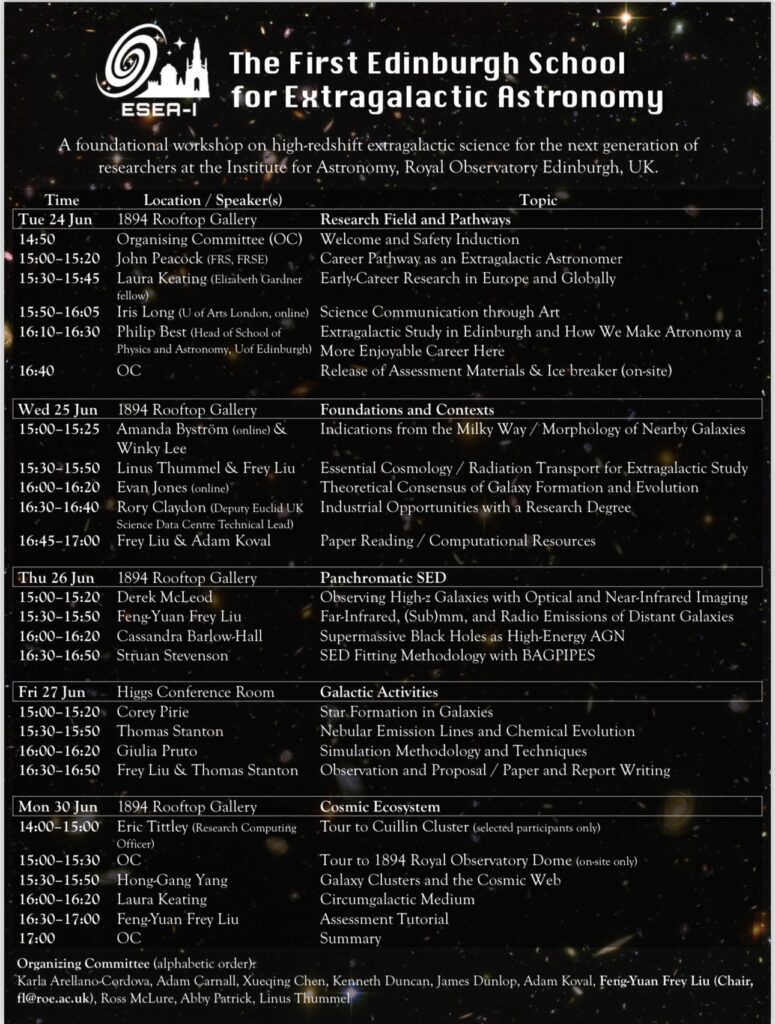
Figure 1. The agenda of the ESEA-I. I have attached the official agenda of the ESEA-I workshop (see Appendix X), which gives a glimpse into the topical landscape of this emerging academic training space. Several sessions appear to resonate with my project: the session on simulation methodology (27 June), for instance, might involve algorithmic implementations relevant to EA-family design. Similarly, the session on theoretical consensus of galaxy formation (25 June) may reflect on the epistemic frameworks through which cosmological models are stabilised, selected, and circulated—often in ways that intersect with or are enabled by optimisation algorithms. These present opportunities for ethnographic reflection, though I remain cautious and undecided about how much to integrate these empirical observations into my final project.
In summary, my new expansion to the existing proposal—Structured Blog Post 9—aims to articulate a novel critical lineage across computational epistemologies and astronomical knowledge production. The proposal seeks to push the boundaries of what constitutes scientific objectivity in the era of machine learning. In doing so, it also aims to extend and update the critique of “scientific objectivity” proposed by Daston and Galison, bringing it into conversation with the evolving landscape of digitalisation, AI technologies, and computation.
My question raised from here to my supervisor, Dr. Hackl, is: Is this expansion of my research into a technical genealogy between evolutionary algorithms and cosmic knowledge—a cross-disciplinary ontological and epistemological critique—feasible? While there are clear advantages—such as its conceptual richness, and the completion of what I consider a previously missing chain in my original proposal’s critical lineage tracing, and it invigorates me (I have ADHD, and I need passion to fuel my writing)—might this expansion also be risky? (Although, based on my physiological understanding of myself, abandoning the parts that excite me might lower my motivation to execute.) I need your advice based on your academic and supervisory experience.
- Excavating the Epistemic Roots of Evolution: Should My Critical Lineage Tracing Extend Beyond Darwin to Pre-Scientific Philosophical and Theological Foundations?
At present, my project already contains a full, standalone literature review[4] that explores the theoretical disputes and paradigm struggles between Darwinian evolution and symbiogenesis. It points out that Darwinian evolution is not purely a natural science product but is deeply shaped by ancient Greek philosophy (e.g., Aristotle’s teleology) and medieval theology (especially Aquinas’s doctrine of order).[5]
So here is my sincere question: Given the project’s already genealogical and excavative nature, should I extend the critical lineage tracing further? Not merely analysing how EA inherit Darwinian logic, but tracing how evolutionary theory itself became possible as a system of knowledge and the fundamental architectural roots of it? Would it be worthwhile to excavate the philosophical and theological epistemic sediment underlying evolution, incorporating the very earliest epistemic layers of this knowledge chain, for the purpose of emphasising its disciplinary impurity, permeability, hybridity, and mutation and disclosing the cultural and philosophical roots of evolution theory that have been obscured in mainstream scientific history? This would push the project more firmly into HPS (History and Philosophy of Science), with a stronger archaeological and genealogical orientation.
Put simply, should the current critical lineage tracing—”Darwinian Evolutionary Theories → EA → Non-EA AI → Application: Cosmological Knowledge Practice and Knowledge Production”—be expanded to: “Classical Thought (Greek Philosophy, Medieval Theology) → Darwinian Evolutionary Theories → EA → Non-EA AI → Application: Cosmological Knowledge Practice and Knowledge Production”?
If so, the project will shift even more toward HPS, digging deeper into the conditions of knowledge production and its cultural contaminated genealogy, rather than solely critiquing contemporary algorithms. (Of course, algorithm critique will still form the surface structure of the thesis, focusing on EA’s permeation and biases in contemporary knowledge production; the genealogy of evolutionary origins would form the thesis’s deep structure.)
Would this expansion be a deepening or an overextension? If I take this route, the benefit is a clearer focus on scientific history and epistemological archaeology. The drawback, however, might be a diluted emphasis on my technical contribution: namely, the originality of my critique that EA reconfigure objectivity in cosmological scientific knowledge production. Though I personally desire a more complete excavation and believe HPS work is immensely valuable—I have long wanted to perform an epistemological “final reckoning” of scientific domains—objectively and strategically speaking, I’m also concerned that a longer genealogy may lead to dispersal and difficulty in closing the argument within the word limit of an MSc dissertation.
Would you recommend that I incorporate this into the main body, or reserve it for the literature review or appendix? (I will send my detailed literature review on the competing sites of evolutionary paradigms privately.)
Would you advise:
- Continue digging, making pre-Darwinian thought part of the core analysis?
- Stop at Darwin, and present earlier disciplinary influences only as background context?
Your advice, Dr. Hackl, would be immensely helpful.
Alternatively, a compromise path could be taken: maintain the central axis of “Darwin → EA → AI → Astronomy/Cosmology” while presenting pre-Darwinian thought as a refined overture. That is, use the literature review or an opening section to briefly cover classical-to-medieval ideas—perhaps in 1–2 pages—with illustrations of the scala naturae or the Great Chain of Being, explaining how theological-taxonomical hierarchies laid the groundwork for Darwin’s system, whether to inherit or rebel against.
Then, devote 80–90% of the main body to analysing how the Darwinian paradigm is solidified in EA, takes form as a competition-efficiency ontology, and seeps into astronomical data workflows. In the conclusion, one could loop back to note that even today’s algorithmic cosmology carries shadows of classical hierarchical and teleological theology—thus completing an archaeological circuit.
This compromise may preserve my desire to excavate the roots without losing the research focus.
- Should I Explicitly Acknowledge My Situated Knowledge and Personal Philosophical Stances—Posthumanism and the Critique of Phallogocentrism—In the Thesis Body?
According to Sandra Harding and Donna Haraway, all knowledge is situated. While my research analyses the logic and biases of knowledge production within EA and astronomy, it is grounded in my own epistemological critique of mainstream science, especially its embedded phallogocentric structures. My personal commitments to posthumanism and the critique of phallogocentrism are elaborated in footnote 3, but for your convenience, I summarise here:
The term “phallogocentrism” was coined by Derrida to critique the fusion of masculinity, rationality, language, and truth in Western thought. This fusion is deeply embedded in modern biology and experimental science.
For example, taxonomy (the science of classification) creates hierarchies through naming and categorisation, producing systems of dominance. In experimental science, the “subject” (typically male scientist) operates on the “object” (animals, women, nonhumans), stripping the object of agency and transforming it into a passive material—wrapped in discourses of “objectivity” and “neutrality.”
This structure made me realise: even seemingly “pure” sciences like biology, AI/ML, astronomy, and cosmology may be deeply rooted in gendered, speciesist, and colonial epistemologies. As Daston and Galison point out, even “objectivity” itself is a historically conditioned epistemic ethos whose political formation should not be hidden.
Based on these perspectives, I sincerely ask: Should I explicitly acknowledge my epistemic position and philosophical commitments within the thesis and make them a generative force behind the analysis?
I understand that doing so may enhance the political and philosophical depth of the dissertation but might also shift the focus toward theoretical manifesto, dispersing the technical critique. If you believe this stance should be presented, should I insert it within the methodology section (or conclusion) as a reflexive statement, rather than making it the focus of the main chapters?
Or should I be bolder and frame it as the epistemic and ethical grounding of the entire research?
- Potential Ethical Implications
In order to complete the Ethics Form for my future project, I would like to sincerely seek advice from Dr Hackl regarding any potential ethical implications I should be aware of. EFI requires students to discuss such matters with their supervisor prior to submitting the form.
As of 24 June, most of my research has been based on second-hand data and original theoretical reasoning of mine. However, the part of my project related to the application of evolutionary algorithms (EAs) in astronomy and cosmology—which I mentioned earlier—may involve future interviews with astronomers I meet during the First Edinburgh School for Extragalactic Astronomy (ESEA-I, 24–30 June). These interviews would focus on their knowledge production processes. I also intend to take ethnographic notes, with the consent of the scientists involved, based on my observations throughout the School.
I have already stated in my ESEA-I application that I would participate as a participant-observer or ethnographer in the Latourian sense. In response, I received a kind and encouraging message from the Chair of the ESEA Organising Committee, who expressed interest in my perspective and proposed project. He also mentioned his willingness to meet in person and hoped that he and other astronomers might be able to support my work.
I understand that our current correspondence can only be considered an informal agreement, which is insufficient for the formal consent required by the Ethics Form. I am documenting this situation here for two main reasons:
- I am uncertain whether the astronomical application of EAs should be formally included in the project. This depends on Dr Hackl’s advice (please refer to section 6: Cosmic Objectivity – From Darwinian Evolutionary Theory and Evolutionary Algorithms to Epistemological Applications in Astronomy and the Universe in this blog post).
- I am unsure what role the ESEA-I will ultimately play in my research. While it will undoubtedly strengthen my background in cosmology and astronomy and sharpen my arguments and writing, I am still reflecting on whether it should also be considered a potential ethnographic field site or even an encounter zone for identifying future human participants. These possible positions will require different approaches in the Ethics Form.
[1] Link to post: https://blogs.ed.ac.uk/s2766608_data-inequality-and-society-kipp–futures-project-2024-25/2025/06/18/🦋-structured-blog-post-9-recursive-ancestors-on-darwinian-shadows-and-my-symbiogenetic-dreams-in-ai/
[2] This dynamic is particularly visible in computational cosmology, a subfield of astronomy and cosmology that relies on supercomputers, large-scale simulations, and optimisation algorithms to study cosmic structures and the evolution of the universe. Evolutionary algorithms have been employed to classify galactic morphologies or to tune simulation parameters in N-body models. As one of the core methodological pillars of contemporary cosmological research, computational cosmology increasingly integrates AI techniques—for instance, using machine learning to predict the evolutionary trajectories of galaxies, or applying Genetic Algorithms (GA) to optimise simulation parameters. (GA is one of the most widely used members of the broader family of Evolutionary Algorithms (EA), which apply Darwinian principles such as selection, reproduction, and mutation to optimisation problems.) As a result, the epistemic infrastructure of such classification is already infused with Darwinian selectionist logics: deviation is pathologised, and diversity becomes an anomaly rather than a signal. Thus, the epistemological consequences of these algorithmic techniques are far from neutral. By embedding assumptions of competition, fitness, and optimisation into the technical apparatus of astronomical knowledge production, computational cosmology exemplifies how machine learning does not merely reveal the cosmos—it performs and reproduces a particular worldview shaped by evolutionary paradigms. This raises questions about what kinds of cosmic intelligibility are foreclosed when irregularity is algorithmically discounted, and whether such logics silently colonise even the stars.
[3] The concept of Phallogocentrism was coined by Jacques Derrida. It is a compound term combining phallus, which symbolises patriarchal/masculine power, and logocentrism, which refers to the philosophical tradition’s veneration of language, reason, and truth. It critiques a system of thought that centres on the male and regards rational discourse as the supreme standard.
In modern science—especially in biology and experimental sciences—there are shadows of such a Phallogocentrics ystem. For example, taxonomy creates relationships of dominance through naming, establishing hierarchies between species or other forms of life while erasing difference and individuality.
In experimentation, the scientific experiment similarly divides the scientist (typically a male human) as the subject conducting the experiment, while animals, plants, materials (and, by extension, women—that is, the broader Other: nature, animals or non-human species, women and non-cisgender male genders, queer people, people of colour, and disabled persons) are regarded as objects to be experimented upon. The agency of the object is seized by the subject and transformed into material, resource, and exploitable matter—this is a form of objectifying violence.
This form of violence becomes operable and accepted under the guise of “neutrality” and “objectivity”, invoking the names of reason and truth as summoned by knowledge itself, thereby evading accountability. Power and coloniality are rendered invisible, while non-standard “voices” become meaningless noise, and the Other is forced into silence (Spivak’s “Can the Subaltern Speak?” may also be involved in this context).
Here, objectivity plays a crucial mediating role in packaging and legitimising the system. Wrapped in strict, standardised scientific procedures, the outcomes produced are proclaimed to be “objective data”. And it is precisely the pursuit of “objective” knowledge that obscures the violent essence of Phallogocentrism embedded within scientific practice and knowledge production.
Ironically, according to Daston and Galison’s work Objectivity, objectivity itself is revealed to have a history and to be an epistemic ethos, which further exposes the lack of legitimacy within Phallogocentrism that speaks in the name of objectivity.
As for why the “rational man”—the default producer and subject of knowledge, the idealised and universalised capital-H “Human”—is so frequently associated with whiteness, maleness, heterosexuality, and able-bodiedness, this is precisely where Rosi Braidotti’s posthumanism becomes deeply relevant.
In relation to the above critique, in addition to posthumanism and Phallogocentrism, the ideas I repeatedly reference in my proposal—such as those of da Silva, Barad, Daston and Galison, and Kimmerer—are also highly pertinent to this critical framework.
[4] I will attach my detailed literature review on the emergence of evolutionary theory and the contestation among paradigms when contacting my supervisor privately via email correspondence.
[5] I also found in the literature review that Darwinian theory did not emerge naturally but was the result of different intersecting and competing ideas in specific historical-cultural contexts. To de-sacralise, historicise, and subvert this narrative is fully legitimate.
(the first Edinburgh School for Extragalactic Astronomy (ESEA-I) )