1000 Word Preliminary Project Proposal and Title (Informed by Reflective Blogging)
- Proposed Title: Bridging the Gaps: Investigating AI-Generated Representations of Women from the Global South and the Cultural Influences of Developer Demographics
- Key Ideas from My Blog So Far (Synthesis of My 12 Nov 2024 Blog Post):
In my blog, three recurring themes emerge: AI algorithms, digital representation, and women of the Global South. These themes are interwoven, reflecting complex interconnections. Below is a detailed exploration of how they manifest in my blog content:
AI Algorithms
In discussing technological issues in the Exclusion and Inequality course, I highlighted how biases inherent in AI algorithms exacerbate existing inequalities. For example, Iran’s use of AI-based recognition systems to enforce strict dress codes on women underscores the ethical challenges embedded in algorithmic design. This emphasises the need to explore fairer technological practices. Furthermore, the Interdisciplinary Futures course made me realise how the lack of support for endangered languages in LLMs (Large Language Models) results in cultural wisdom being lost, thereby deepening the tension between technology and cultural inequality.
Digital Representation
In the Human Health in the Anthropocene course, I observed how Taiwan is frequently represented as a “blank spot” in global health data. This reflects Taiwan’s marginalisation in international health statistics and illustrates how data, as a resource, is unequally collected and presented. Such “absent” digital representation not only affects Taiwan’s global health governance rights but also mirrors the commodification and erasure of cultural identities by AI-generated digital imagery, which aligns with my concern about digital representation.
Women of the Global South
My blog explores how AI and LLMs, which predominantly prioritise mainstream languages such as English, impact the linguistic agency of women in low-resource languages. Inspired by the Indigenous Futures course, I reflect on how this technological centralisation exacerbates the erasure of indigenous feminist practices. For example, women in Global South communities often play a critical role in seed preservation, ecological management, and localised climate awareness—knowledge that is deeply intertwined with their linguistic traditions. However, as 88% of the world’s languages are not supported by LLMs, the disappearance of these languages is accelerating, along with the unique perspectives they carry. This further deepens the epistemic divide between Western mainstream frameworks and indigenous systems of knowledge.
Epistemic Network Analysis of my key ideas:
This is the graph illustrating the relationships among my key ideas, generated using the Epistemic Network Analysis method.
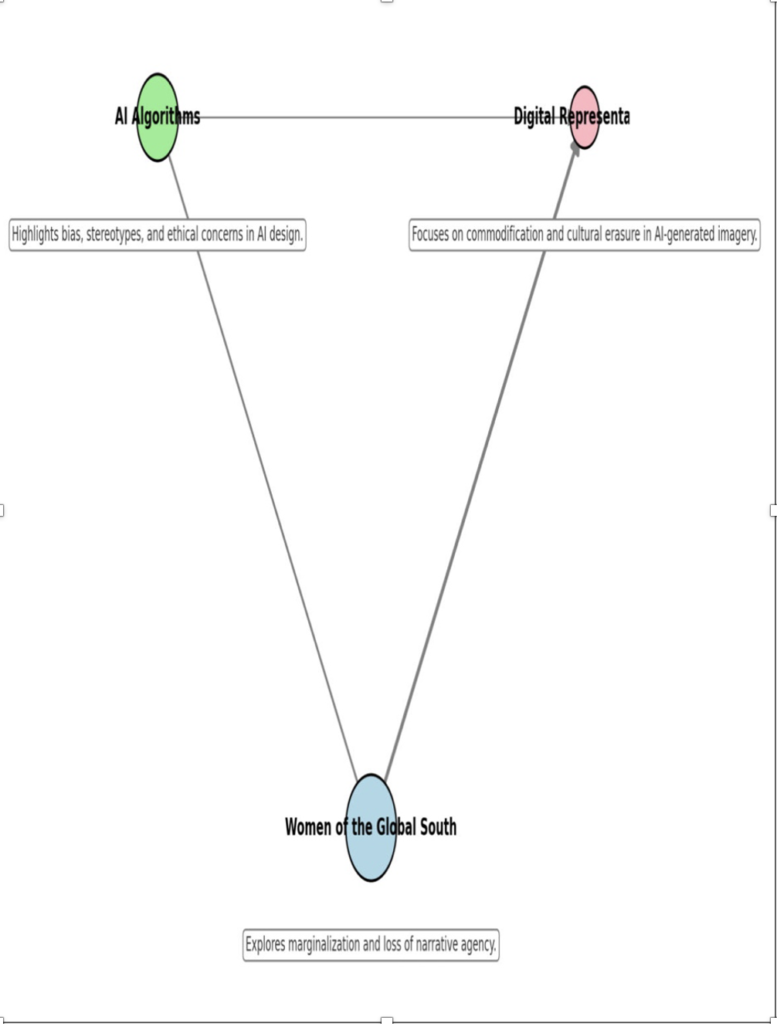
Synthesis of Ideas
These themes are deeply interconnected. Using epistemic network analysis, I view AI algorithms as mediators that shape digital representation and directly impact marginalized groups like women in the Global South. For instance, the exclusion of Taiwan from global health governance parallels how algorithmic systems exclude certain groups, reinforcing systemic invisibilities. Similarly, Indigenous perspectives on multi-species kinship offer alternative frameworks for designing equitable AI systems.
In summary, My KIPP blog focuses on how AI technologies perpetuate and deepen structural inequalities through algorithmic design, digital representation, and the narrative agency of women in the Global South, while exploring interdisciplinary solutions to mitigate these challenges.
- Your Project as You Currently Understand It (Synthesis of My 31 Oct 2024 Blog Post and My 12 Jan 2025 Blog Post):
At present, I envision a dream research project titled Symbiogenetic Evolution as a Posthuman Feminist Framework for AI Ethics: Beyond Anthropocentric and Patriarchal Paradigms in Algorithmic Design. This project builds upon the core ideas in my KIPP blog and proposes a posthuman feminist intervention in artificial intelligence (AI) ethics through Lynn Margulis’s symbiogenetic evolutionary theory.
The dream research explores how Darwinian paradigms embedded in genetic algorithms (GA) perpetuate patriarchal and anthropocentric power structures in AI development. Specifically, it examines how Margulis’s theory of endosymbiosis, which emphasises multi-species cooperation and mutual enhancement, can inspire alternative algorithmic frameworks. These paradigms challenge existing AI assumptions that prioritise competition, human supremacy, and hierarchical structures, which often marginalise disadvantaged voices—both human and non-human.
Contemporary AI systems, particularly GA, are shaped by Darwinian principles that mirror historical power structures, reinforcing social and ecological inequalities. This “patriarchal-anthropocentric recursion” promotes inequities in both algorithmic design and broader technological landscapes. By integrating Margulis’s theory, I aim to conceptualise new frameworks for AI systems that emphasise cooperation and inclusivity.
- Key Methods Explored So Far (Synthesis of My 12 Jan 2025 Blog Post):
My dream project will unfold in three phases, each building on the methods and insights I have explored through my coursework and blog. Additionally, drawing from my interest in digital scholarship, I incorporate a variety of digital humanities methods and tools.
In the first phase, I plan to analyse how Darwinian paradigms influence AI systems, particularly in GA. This involves conducting multi-case studies and content analysis of documentation, research papers, and software development practices to identify recurring patriarchal and anthropocentric biases. Using techniques such as topic modelling, sentiment analysis, and network analysis, I will quantify and map these biases within AI training corpora.
In the second phase, informed by the findings of the first, I will develop theoretical frameworks for translating Margulis’s symbiogenetic principles into algorithmic terms. This will involve secondary data analysis of existing cooperative AI systems, as well as expert interviews with AI developers and ethicists to refine the framework. Tools such as graph-based modelling and multi-agent systems will be used to simulate cooperative dynamics, incorporating evolutionary techniques like co-evolutionary algorithms.
The final phase will validate the proposed frameworks through experimental simulations, combining expert feedback and performance metrics to ensure ethical and functional efficacy. These methods aim to culminate in practical guidelines for implementing ‘endosymbiotic evolutionary algorithms’ that prioritise multi-species cooperation and mutual enhancement.
What excites me about this dream project is its potential to extend beyond academic circles, reshaping how AI is developed to amplify marginalised voices and foster equitable technological futures. However, I remain uncertain about the practical translation of Margulis’s principles into computational terms and whether the proposed frameworks can effectively address existing biases at scale.
- Major Points of Uncertainty:
Although my original proposal brought me excitement and intellectual joy, a significant point of uncertainty arose after my first supervision with Marlee in Semester 1. While she recognised the potential and originality of my proposal, she also pointed out that its scope was overly ambitious for a one-year master’s degree. Marlee advised me to refine it to a more manageable scale.
She offered some excellent suggestions, such as focusing on specific aspects like data collection—whether it involves over-collection or insufficient collection—and the misalignments in representation. These suggestions have given me clearer direction, but I am still working on refining the scope to ensure the project is both feasible and impactful within the given timeframe.
- Next Steps:
Reflecting on my original core ideas, I recognise the need to significantly reframe my research while remaining aligned with my overarching research interests. As a next step, I will revisit the epistemic network analysis graph to generate new, more focused research topics. This process will also incorporate Marlee’s advice to concentrate on data representation, ensuring my work remains both feasible and impactful within the scope of a master’s programme.
From this reorientation, a new research proposal has emerged: ‘How do AI-generated representations of women from the Global South diverge from their authentic cultural identities, and what role do developer demographics and cultural values play in shaping AI-driven narratives about women from the Global South?’
Based on the epistemic network analysis of my key ideas, my new research question directly addresses the interconnected themes represented in the graph. The question, ‘How do AI-generated representations of women from the Global South diverge from their authentic cultural identities, and what role do developer demographics and cultural values play in shaping AI-driven narratives about women from the Global South?’, bridges the three primary nodes: AI Algorithms, Digital Representation, and Women of the Global South.
First, the node AI Algorithms highlights biases, stereotypes, and ethical concerns embedded in AI design. My research question aligns with this by investigating how AI systems embed cultural biases that distort representations of women from the Global South. These distortions are often rooted in the demographics and cultural values of the developers, which shape the underlying algorithmic processes. Second, the node Digital Representation focuses on the commodification and cultural erasure present in AI-generated imagery. My study delves into this issue by examining how AI representations fail to capture authentic cultural identities, thereby perpetuating misalignments and contributing to cultural erasure. Finally, the node Women of the Global South explores the marginalisation and loss of narrative agency faced by these women. My research question centralises this theme, aiming to reveal how AI-driven narratives further entrench systemic inequalities and diminish the voices of women in the Global South.
This analysis shows how the research question bridges the three interconnected themes, demonstrating their mutual influence. By focusing on the interplay between algorithmic design, representation, and marginalisation, the study seeks to provide a cohesive and critical exploration of these pressing issues. This approach not only refines the scope of the project but also maintains the intellectual integrity of the original epistemic network analysis.
This refined proposal maintains the intellectual integrity of my original research while narrowing the focus to a manageable scale. My immediate priority is to conduct a literature survey in two key areas to build a solid foundation for the project. The first will focus on the processes and mechanisms behind how generative AI creates images, while the second will examine what other scholars have said about authentic images and the representation of women from the Global South. I plan to organise these two surveys into topic tables, transforming them into a database and reference system that will support my subsequent work. Using the literature review methods taught by Ian in Semester 1, I will synthesise these surveys to identify the gaps between these two areas, highlighting the issues with AI-generated images and the underlying causes of these problems.
Here is a link to my Notion workspace, where you can access the topic tables from my literature survey and review my current progress:
https://www.notion.so/15c910f6464e80fc8117c84ca2f6741d?v=e9068050a7194e7998251a3ece5c143e&pvs=4
When I next meet my supervisor, I would like to seek their guidance on selecting appropriate methodologies, identifying key case studies, and ensuring that my current plan aligns with the project’s scope. Additionally, I hope they can offer feedback on the evolution of my research from the original dream project to this refined version. I would like to ask if this progression is reasonable and whether there are ways to bring the new proposal closer to the original vision while keeping it manageable within the scale of a master’s programme.
Bibliography
Books
- Barad, K. (2007). Meeting the universe halfway: Quantum physics and the entanglement of matter and meaning. Duke University Press.
- Braidotti, R. (2013). The posthuman. Polity Press.
- De Jong, K. A. (2006). Evolutionary computation: A unified approach. MIT Press.
- Haraway, D. J. (2003). The companion species manifesto: Dogs, people, and significant otherness. http://ci.nii.ac.jp/ncid/BA65788953
- Haraway, D. J. (2013). When species meet. University of Minnesota Press.
- Harding, S. (1986). The science question in feminism. Cornell University Press.
- Hayles, N. K. (1999). How we became posthuman: Virtual bodies in cybernetics, literature, and informatics. University of Chicago Press.
- Latour, B. (2012). We have never been modern. Harvard University Press.
- Margulis, L., & Sagan, D. (2023). Microcosmos: Four billion years of evolution from our microbial ancestors. University of California Press.
- Mitchell, M. (1998). An introduction to genetic algorithms. MIT Press.
- Minh-Ha, T. T. (2009). Woman, native, other: Writing postcoloniality and feminism.
- Said, E. W. (2014). Orientalism. Vintage.
Hooks, B. (2014). Black looks: Race and representation. Routledge.
Articles
- Desai, D. (2000). Imaging difference: The politics of representation in multicultural art education. Studies in Art Education, 41(2), 114. https://doi.org/10.2307/1320658
- Haraway, D. (2010). When species meet: Staying with the trouble. Environment and Planning D: Society and Space, 28(1), 53–55. https://doi.org/10.1068/d2706wsh
- Spivak, G. C. (1988). Can the subaltern speak? Macmillan.
- Wellner, G., & Rothman, T. (2019). Feminist AI: Can we expect our AI systems to become feminist? Philosophy & Technology, 33(2), 191–205. https://doi.org/10.1007/s13347-019-00352-z
- Alcoff, L. (1991). The problem of speaking for others. Cultural Critique, 20, 5. https://doi.org/10.2307/1354221
- Gates, H. L. (1987). Authority, (White) power and the (Black) critic; it’s all Greek to me. Cultural Critique, 7, 19. https://doi.org/10.2307/1354149
- Said, E. W. (1989). Representing the colonized: Anthropology’s interlocutors. Critical Inquiry, 15(2), 205–225. https://doi.org/10.1086/448481
- Jazeel, T. (2012). Postcolonialism: Orientalism and the geographical imagination. Geography, 97(1), 4–11. https://doi.org/10.1080/00167487.2012.12094331
- Maggio, J. (2007). “Can the subaltern be heard?”: Political theory, translation, representation, and Gayatri Chakravorty Spivak. Alternatives: Global, Local, Political, 32(4), 419–443. https://doi.org/10.1177/030437540703200403
eBooks
- Feminist AI. (2023). In Oxford University Press eBooks. https://doi.org/10.1093/oso/9780192889898.001.0001