Ecosystem Services from Urban Parks
When the last green open space turns into a business place, what tradeoffs from what nature gifts are we missing here? Ecosystem services are a framework to value nature better. Ecosystem services look through the full range of benefits from nature, not just from ecological benefits, but also social and economic benefits. These benefits could be tangible (i.e., water, food, fibre) and intangible (i.e., health, cultural).
Meanwhile, DLH DKI Jakarta, in collaboration with Vital Strategies (2021) estimated Jakarta’s air pollution contributed to >7,000 health problems on juvenile, >10,000 death cases, and >5,000 hospitalized cases. The total of yearly expenses for those health problems is equal to IDR 41,2 trillion (USD2,943.42 million) also worth 2.2% Gross Regional Domestic Product of Jakarta Province.
While urban park benefits have been explained in my previous blog. The issue above specifically resonates with Xiaqi, F. et al (2024), that analyzed the relation between health care cost (especially cardiovascular) and tree canopy rate in a built urban environment. It reminds me of Singapore’s parks, the existence encourages people to walk, and the tree canopy provides us with shaded areas, which are ideal for outdoor activities. Park connectors are available to connect every area with its public transportation.
Current Urban Park Design in Jakarta
Other than the underachievement of green open space (including urban parks) percentage, the existing park design is rarely discussed in Indonesia. The majority of the park design in Jakarta is covered with asphalt or cement, with not enough shaded areas, which discourages me (family & friends too) from hanging out there, especially on hot sunny days. Not every park is wide enough and equipped with well-maintained facilities.
While the interconnectedness with other public spaces is often not well-rounded. It takes a huge amount of determination just to go to an urban park in Jakarta. Not to mention, the availability of public transportation to take you there is another issue.
Biophilic & Regenerative Design
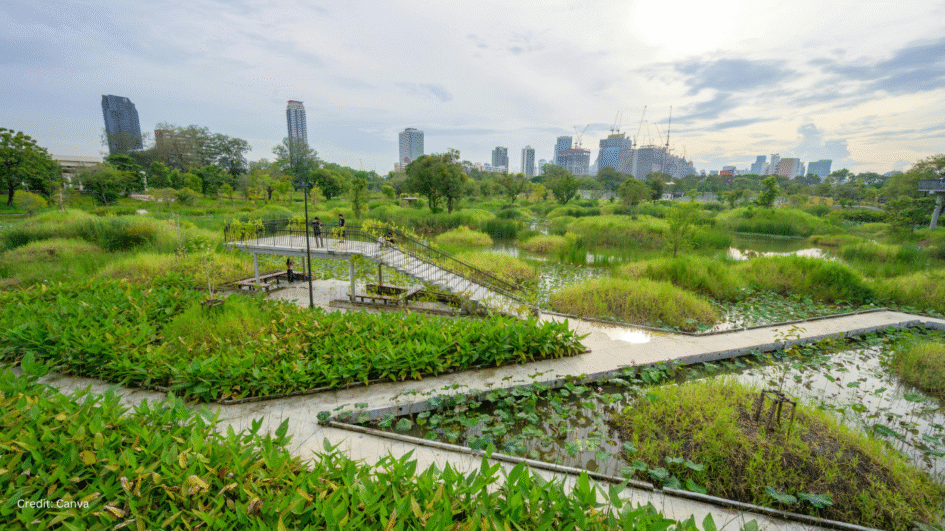
Biophilic design focuses on strengthening human-nature connections not just through visual but also experiences. While regenerative design is beyond the net-zero concept, you let the ecosystems heal. Back to the initial question, when we have more biophilic design, will we appreciate nature more then?
There’s a study in Semarang that investigates the use of biophilic design for urban parks in promoting resilience toward climate change. Not just resulting positively with the average temperature of the parks could be decreased by approximately 0.5 °C, but also the park visitors preferred to incorporate biophilic design elements.



Leave a Reply