Climate change will be next generations’ legacy as it is already from the generations before. The issue is getting more awareness recently given more prominent effects have been felt closer in our daily life. Climate mitigation and adaptation projects start to flourishing globally, especially in developing countries like Indonesia. Though achievement and impact are another point of discussion. Without buy-in from the relevant stakeholders, climate regulations and programs are just another gimmick which does not address the root issues.
Klockner C.A. (2013) said “If we would like to change people’s behavior, we need to understand what determines their actions and decisions”. For instance, why do some people choose to use public transportation rather than personal vehicles? At large, I am curious what drives pro-environmental behavior? Pro-environment behavior defined as doing no harm and/or making a good impact towards the environment.
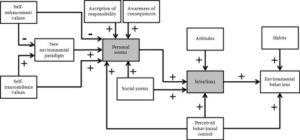
The figure above shows that behavior is influenced by intention, habit, and perceived benefit control. According to Dietz et al., 2009, behavior can create ripple effects subject to: (a) the impact the behavior has, (b) the number of people who perform the behavior, and (c) the percentage of those people who are willing or able to change the behavior, referred to as ‘plasticity’. These ripple effects are crucial when we try to tackle wicked issues like climate change. However, behavior itself doesn’t explain why we are committed to doing pro-environmental actions repeatedly. Klockner added repeated behavior plus motivation for the achievement of desired goals will turn into a habit.
Green Infrastructure <-> Human Behavior
Humans tend to appreciate something that gives them tangible or direct benefits. When we are talking about green infrastructure, restorativeness is the most discussed among scholars. Other environmental services like support for the microclimate and human physical health are intangible or indirect. How can we appreciate (develop pro-environment behavior or habit) if we don’t know or have the chance to show it?
A study by Zang, D., Yong, T. (2021) aimed to understand how green buildings and their residents relate to their pro-environmental behavior and well-being. The findings show that green buildings can serve as a potential intervention for increasing pro-environmental behavior.
Several studies about urban park justified, park design directly affecting restorativeness which plays a role in encouraging pro-environmental behavior built in an urban environment (1, 2). Positive anticipated affect and subjective norms should be the priority for the design of urban park interpretation and environment education activity in collective culture to maximize individuals’ pro-environmental intentions (3).
Inducing visitors’ positive anticipated affect can be achieved by making necessary pro-environmental resources and opportunities available to visitors and communicating the benefits and significance of eco-friendly behaviors to visitors through the on-site interpretation system and the relevant social media (4).
When we bring more nature to the current concrete jungle, will we appreciate nature more then.



Leave a Reply