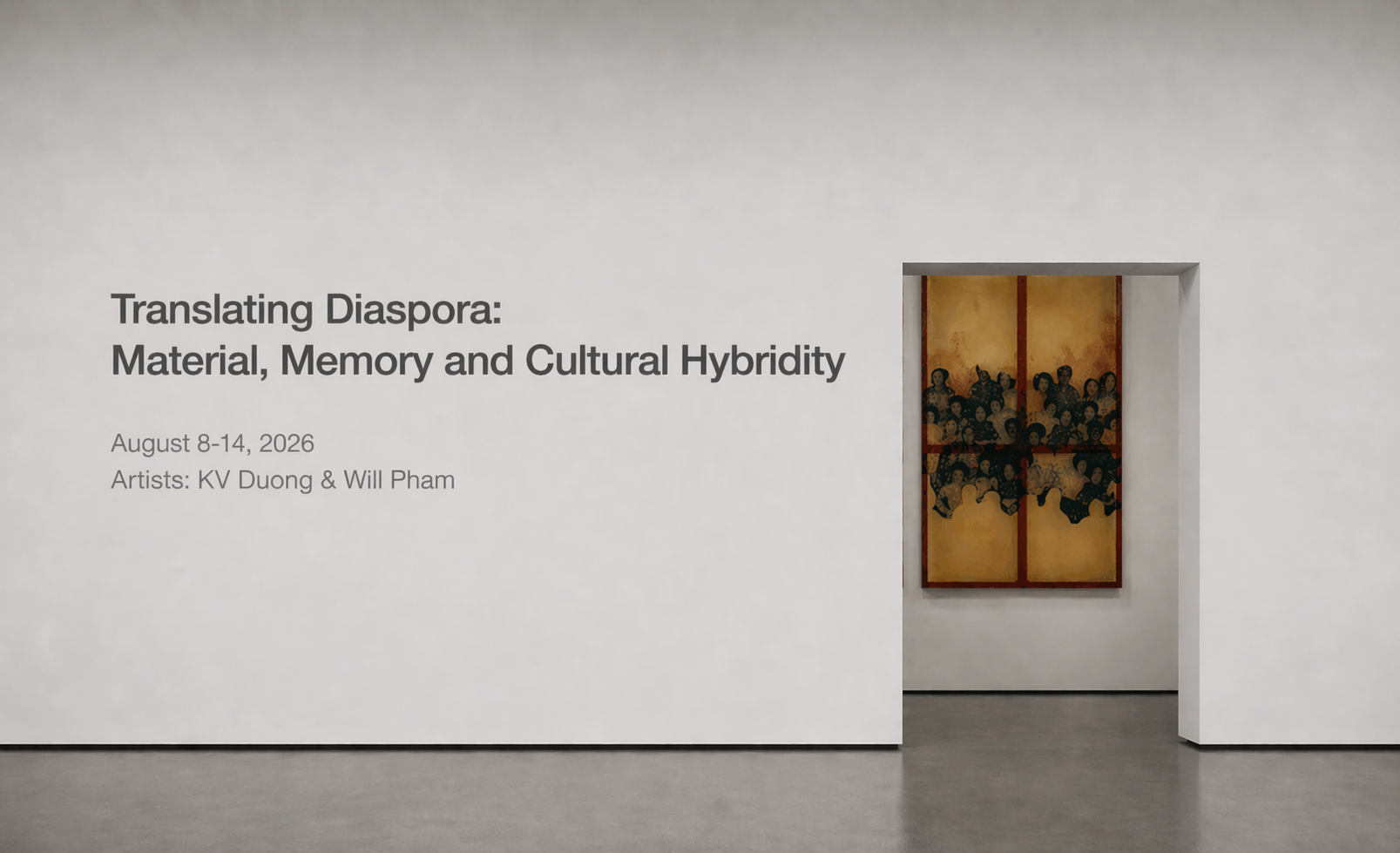


Project Information
Title: Translating Diaspora: Material, Memory and Cultural Hybridity
Duration: August 8-14, 2026
Venue: Edinburgh Palette (St Margaret’s House), 151 London Road, Edinburgh EH7 6AE
Artists: KV Duong & Will Pham
Curatorial Narrative Text
This exhibition focuses on how identity continues to be formed within the contemporary Vietnamese diaspora through the interweaving of migration, history, and culture. Diaspora is not a fixed starting point or label, but a constantly changing process that is reinterpreted in different contexts. In this context, art not only presents experience, but also becomes a medium for cross-cultural translation, allowing individual memory and collective history to be connected.
The exhibition is developed through material and visual practices, presenting the distinct yet interrelated approaches of the two artists. KV Duong uses materials such as rubber to reference colonial history and global trade systems, transforming material into a carrier of power relations and labour memory. Will Pham, by contrast, works with video and everyday experience, focusing on emotion, memory, and the position of the individual in a cross-cultural context. The juxtaposition of their works guides the audience from broader historical structures to more intimate narrative experiences, opening up a layered understanding of diasporic identity.
The exhibition is not only centred on the artworks, but is also extended through public programmes. Audiences will be invited to participate in workshops and discussions, transforming their personal experiences into texts, images, or objects. Through this structure, the exhibition moves beyond simply presenting diasporic narratives and instead creates a space where cross-cultural experiences take shape. In this process, the audience transforms from viewers to co-producers of the content, and the exhibition thus becomes a dynamic and generative space.
Through this structure, the exhibition no longer merely presents diasporic narratives, but instead creates a space where cross-cultural experiences occur. Here, materials, bodies, and participation interact together, making translation not merely confined to the level of language or symbols, but becoming a process that can be experienced and practiced.
Key Themes
- Diaspora as Becoming
Diaspora is understood not as a fixed identity, but as a process of ongoing formation shaped by migration, history, and cultural negotiation. In this project, identity is approached as something continuously reconfigured rather than stable or rooted (Hall, 1990, p.225).
- Translation Between Cultures
Translation is treated not only as linguistic exchange, but as a broader cultural and material process through which meanings shift across contexts. The exhibition considers how artworks operate as sites where such translations are made visible (Bhabha, 1994; Edwards, 2003).
- Material Memory
Materials are approached as carriers of historical, political, and embodied memory, rather than neutral forms. Through material practices, histories of colonialism, labour, and displacement are made present in the exhibition space (Stoler, 2013, p.3).
- Embodied Experience
The project emphasises the role of the body and lived experience in shaping diasporic identity. Through participation and workshop activities, audiences engage with translation as an embodied and experiential process (Kester, 2004, pp.23-25; Bourriaud, 1998, p.28).
Artists & Works
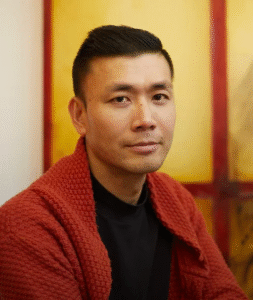
KV Duong, Image courtesy of Brave Projects and James Champion.
KV Duong (born in Vietnam in 1980 and currently residing in London) is a multidisciplinary artist who uses latex as the core material in his works, connecting the history of colonial rubber, labor experiences, and bodily memories (Duong, 2026). In this exhibition, the materials used in his works, the thread of history, enables the audience to perceive the formation of fragmented identities at the material level. At the same time, these material practices also serve as triggers for subsequent participatory workshops, allowing history to be continuously activated and translated in the reproduction of the audience.
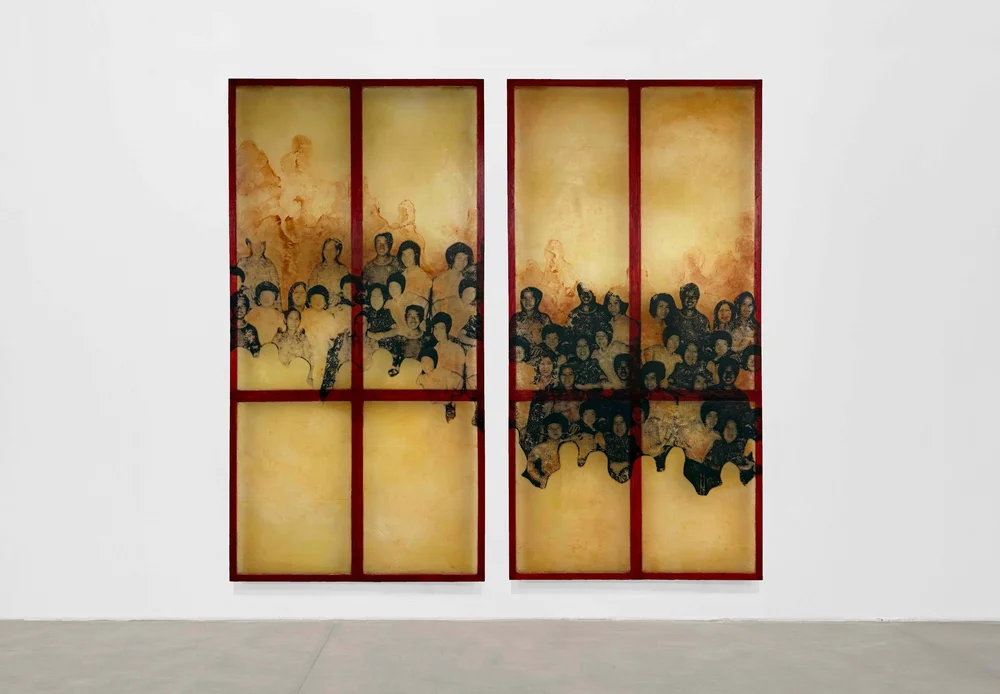
Family Portrait 2025 / KV DUONG Ink and acrylic on latex (resin-fibreglass backing), painted wooden stretcher / 198 × 100 cm (x2)
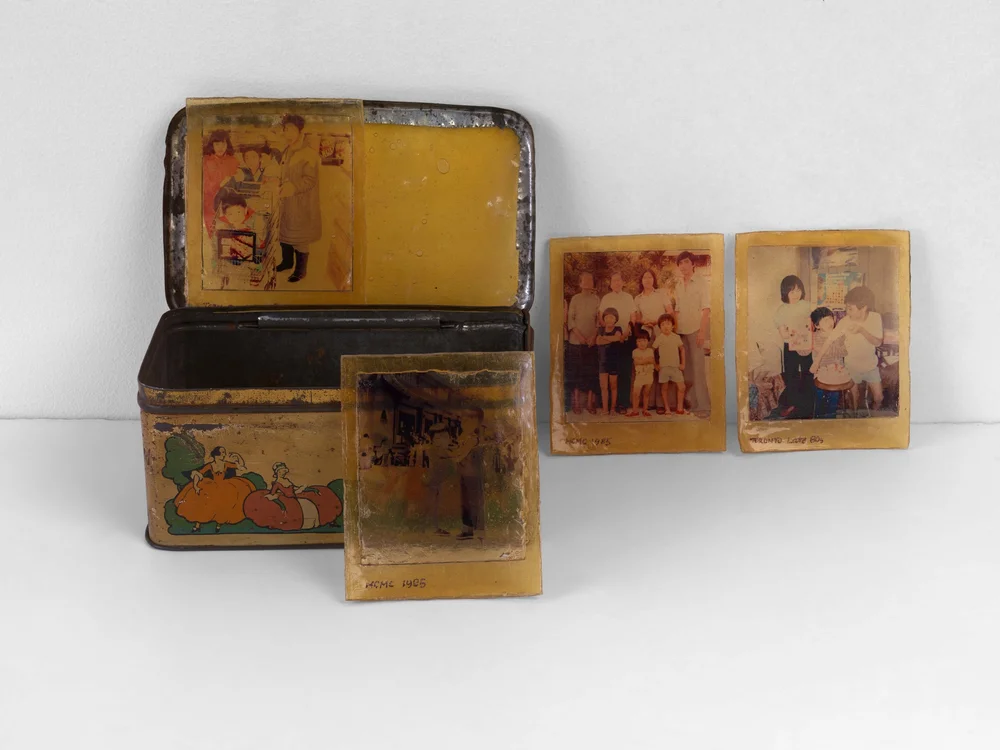
Memory Box (Biscuit Tin)
2025 / KV DUONG
Tin box, latex (resin-fibreglass backing), ink / 17 × 38 × 20 cm
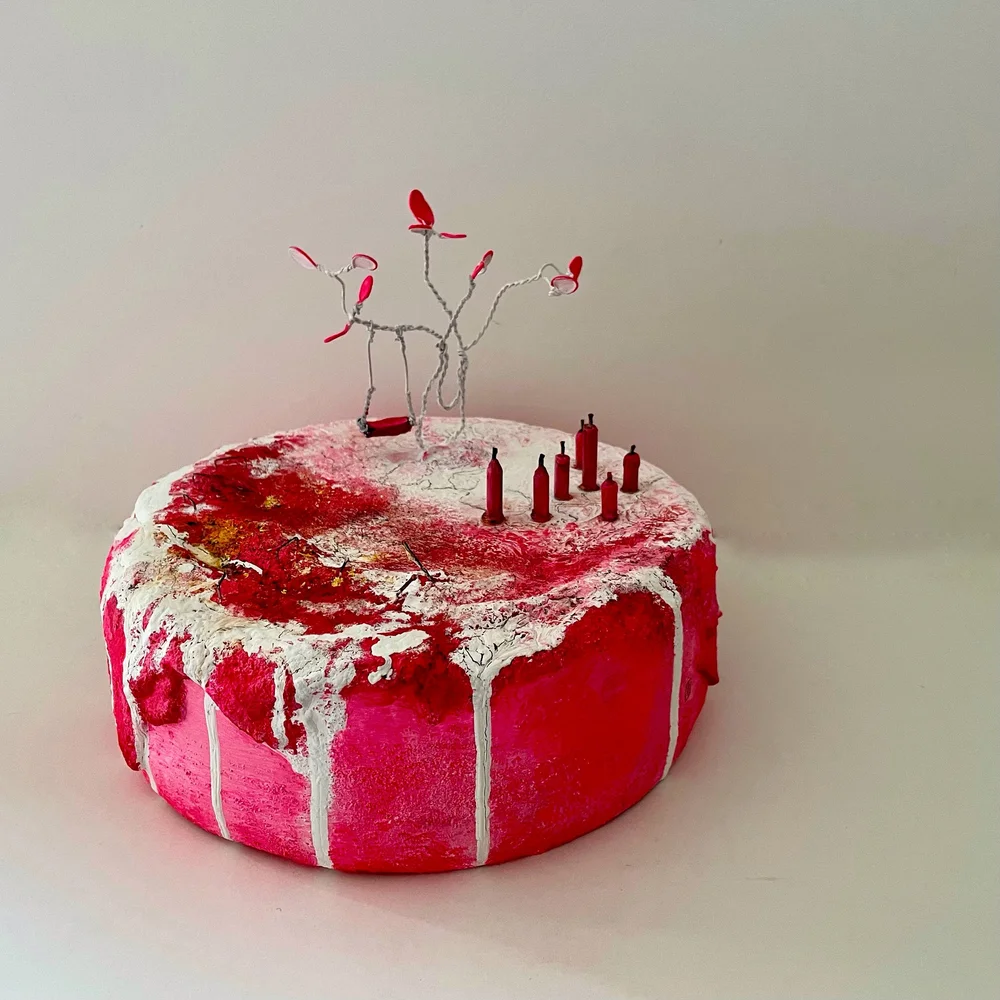
Birthday Cake to My Younger Self
2023 / KV DUONG
Acrylic, concrete grout, found wax candles, staples, and metal wire on clay / 22 x 22 x 18 cm
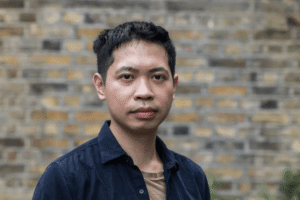
Will Pham. Photo: Hydar Dewachi https://www.newcontemporaries.org.uk/artists/will-pham
Will Pham (born in 1990, currently residing in London) is an interdisciplinary artist of Vietnamese origin. His works integrate video, performance, and social participation practices, focusing on the fragmented, cross-generational memories and community experiences of Vietnam. Through the interweaving of archival research and personal memories, he activates historical experiences at the physical and perceptual levels (Pham, 2026). In this exhibition, his practice forms the thread of record to archive, and through video archives and workshop participation, he transforms individual narratives into continuously generated archives, promoting the re-translation and construction of dispersed experiences in the presence of the audience.
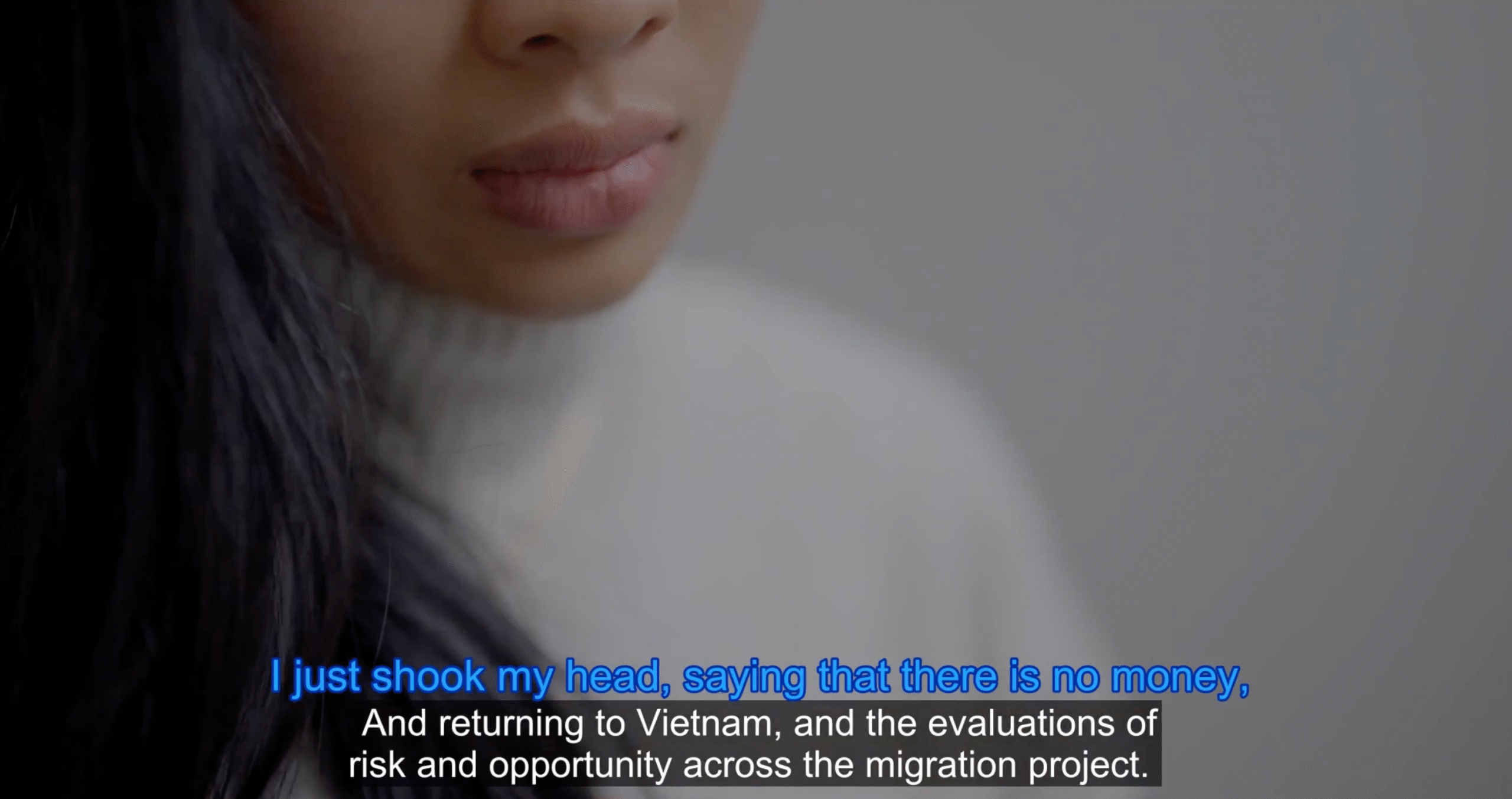
Legends
2024 / Will Pham
HD video, stereo sound / 12 mins
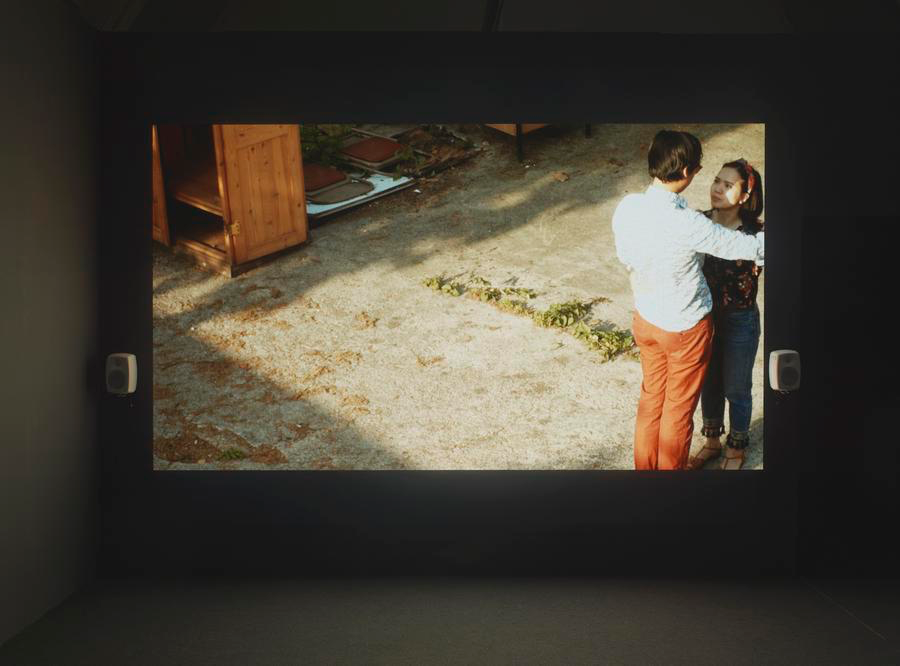
An Viet (Well Settled)
2018 / Will Pham
HD video, stereo sound / 19 mins 20 sec
Their works functions as the entry point of the exhibition, introducing translation as a sensory and material process.
Spaces and Location
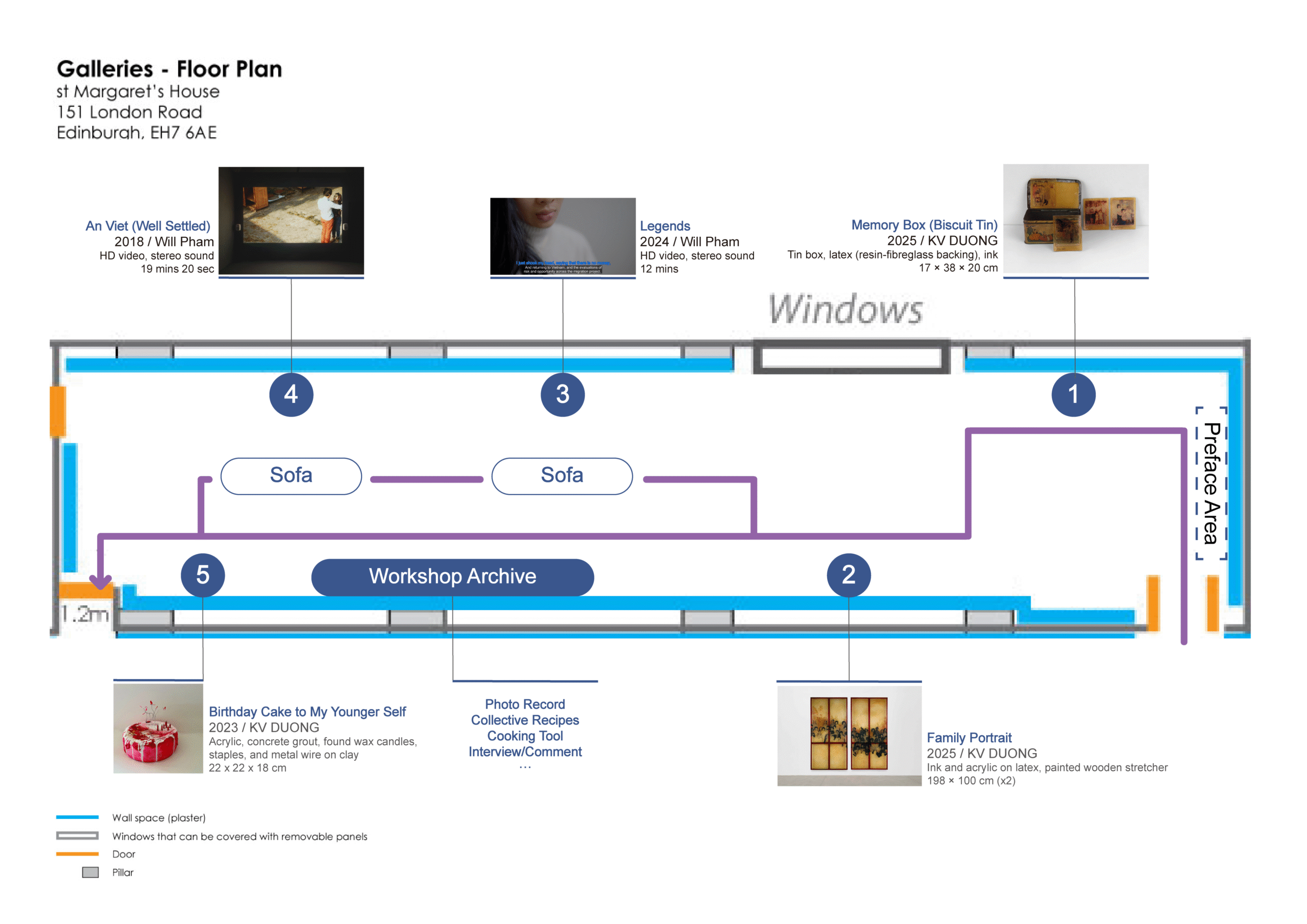
The exhibition adopts a linear flow design, guiding visitors from the entrance context into the exhibition area of the works, and gradually transitioning to the “Workshop Archive” area. This area showcases the video records, interview archives, and used cooking tools generated by the workshops, allowing visitors to come into contact with the participation process and its transformation into the archive results during the viewing. Finally, a cake work is placed there to celebrate the future appearance of the dispersed group.
Visitors encounter the exhibition through a sequential spatial logic:
- entry → material history
- middle → video record
- exit → participatory archive
The project is primarily aimed at diasporic(vietnamese) young adults and students, who are navigating cross-cultural identities in everyday life. St Margaret’s House is selected for its role as a community-oriented arts space, which supports participatory and socially engaged practices aligned with the project’s curatorial approach.
Public Programme – Cooking Workshop
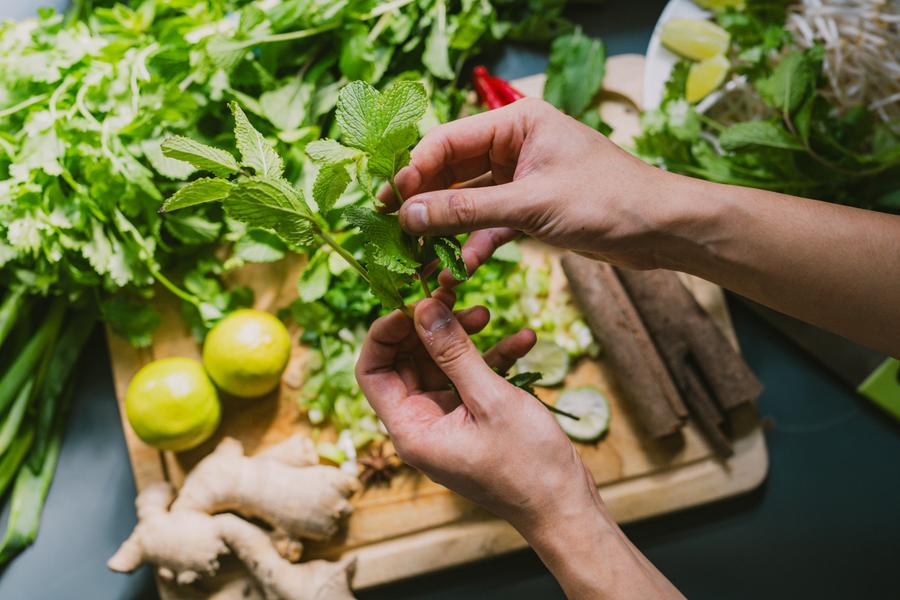
Recipes of Life
Will Pham, 2025
Socially engaged artwork
Multi-channel video installation
(https://willpham.co.uk/Recipes-of-Life-2025)
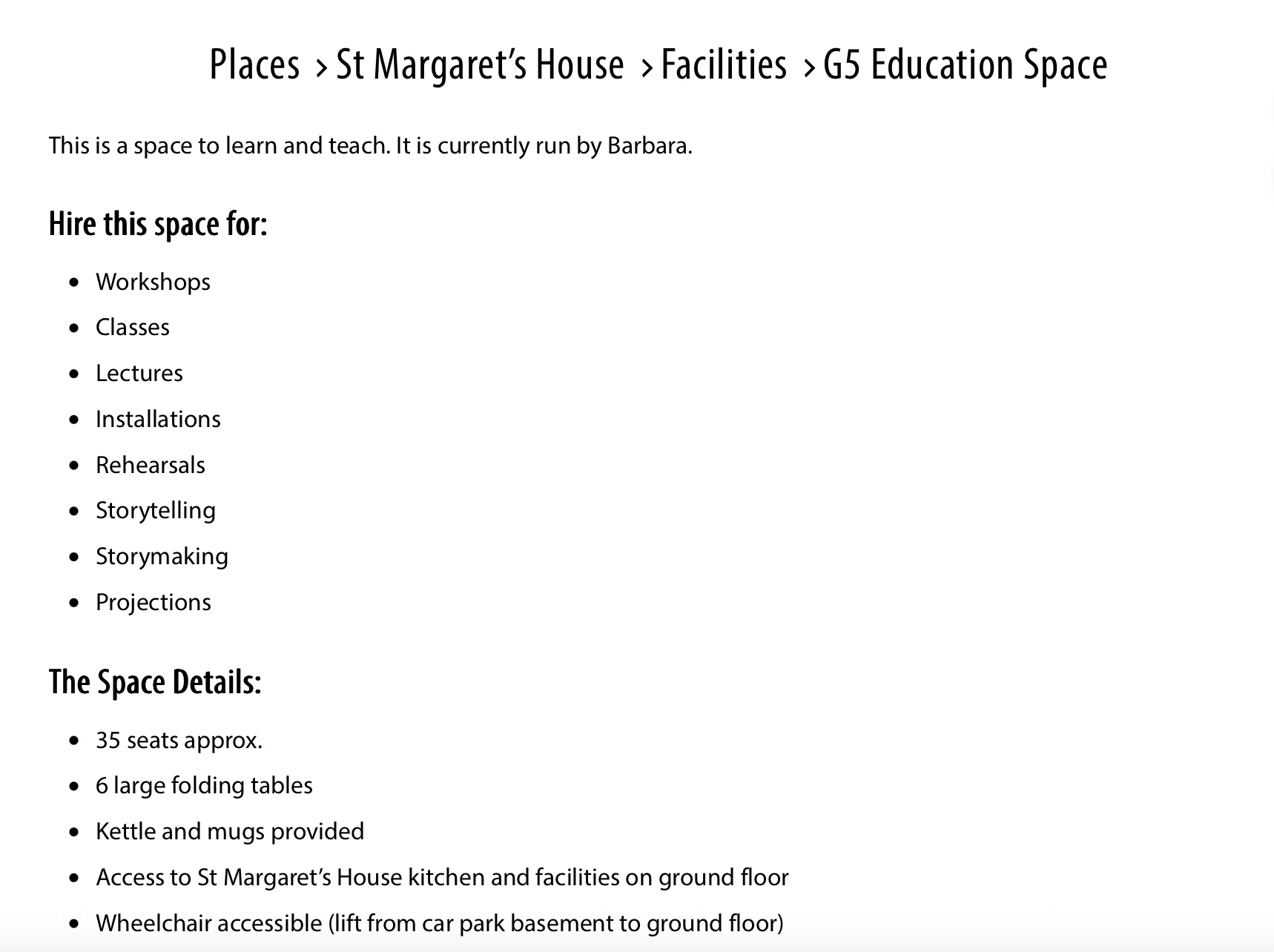
This participatory cooking workshop will be led by the curator and draw inspiration from Will Pham’s “Recipes of Life”. It will be held simultaneously at the G5 Education Space during the opening ceremony of the exhibition and will be open to students and members of the Vietnamese diaspora community. Participants are invited to share their personal stories related to food, prepare dishes collectively, and engage in conversations. These interactions will be recorded through video, audio, and written responses, forming materials that will later be displayed in the workshop archive section of the exhibition.
Curatorial Rationale
This project builds on the understanding that diaspora is not a fixed identity label, but a process of ongoing formation within historical and cultural contexts (Hall, 1990). The exhibition approaches diaspora as a dynamic condition constructed through materials, memory, and individual experience. Here, translation extends beyond language and becomes a process of meaning-making across cultures.
This project adopts a relational and participatory approach by structuring the exhibition as an evolving archive, where audience contributions are continuously integrated into the display. This operationalises Bourriaud’s concept of relational aesthetics not as interaction alone, but as a system of meaning production (Kester, 2004; Bourriaud, 1998). Participation is central: workshops function as a mechanism of translation, enabling audiences to transform personal experience into texts, images, or objects. These contributions are continuously integrated into the exhibition, forming an evolving archive rather than a fixed display.
In terms of the selection of artists, KV Duong and Will Pham create a dialogue between material history and bodily experience. Duong uses latex materials to engage with colonial history and the labor system, while Pham works with video and everyday experience, emphasizing memory, emotion, and individual perception. The spatial layout further reinforces this logic, guiding audiences from contextual understanding to engagement with the artworks, and ultimately transitioning to the Workshop Archive area, where the images and archives generated by the workshops are presented. In this process, audiences shift from passive viewers to active contributors.
From an ethical perspective, this project avoids essential diasporic identity of diasporic identities, instead offering a space for the expression of diverse and specific experiences. The participation mechanism is based on voluntary participation and dialogue, ensuring that individual narratives unfold in an environment of respect and support. Through this structure, the exhibition presents translation as a continuous and collective practice.
While participatory approaches are often framed as inclusive, this project critically acknowledges their limitations, including uneven participation and authorship ambiguity. The project therefore structures participation through guided workshops rather than open contribution.
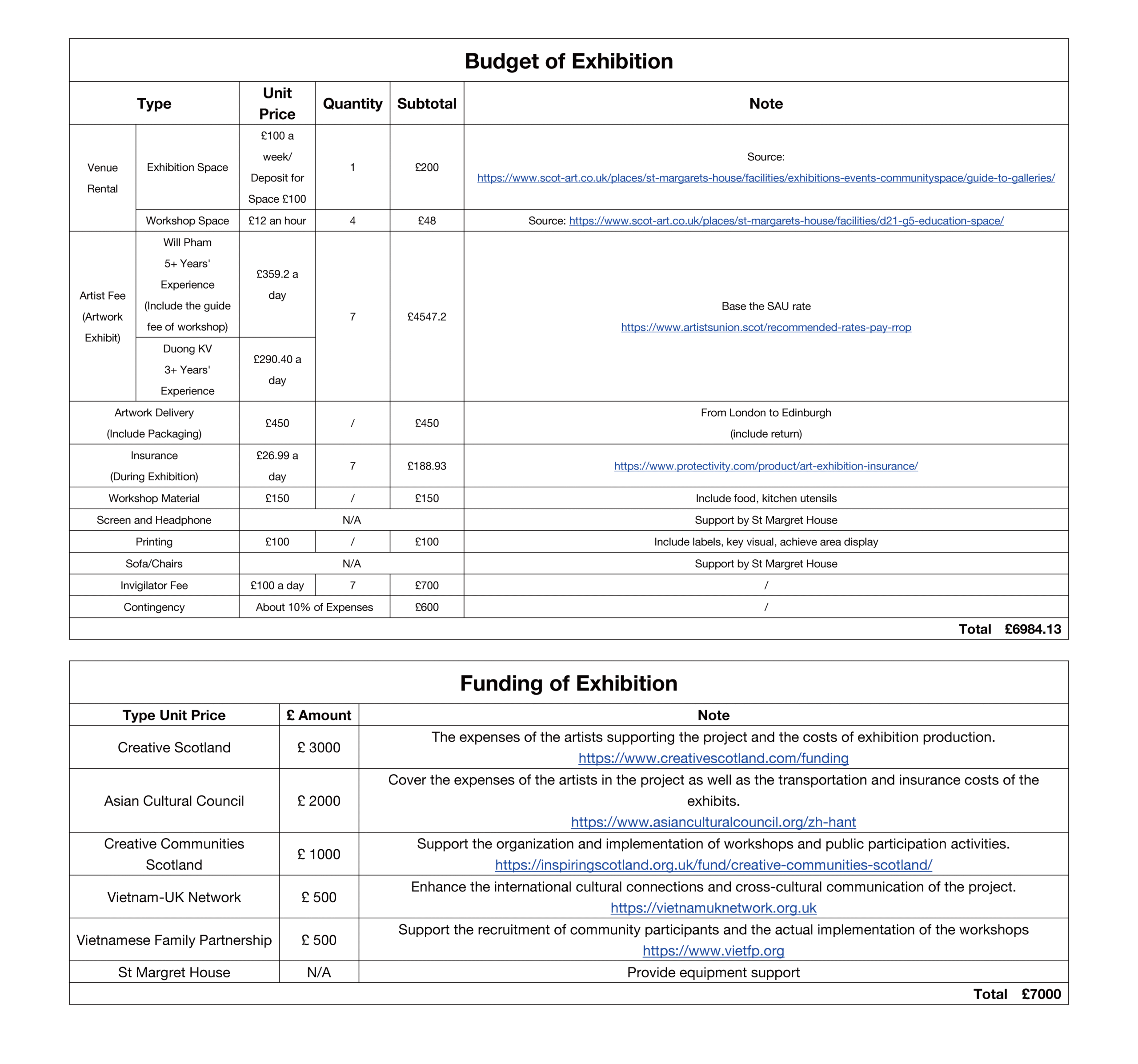
Basic Budget
Reference List
Bhabha, H. K. (1994) The Location of Culture. London: Routledge.
Bourriaud, N. (1998) Relational Aesthetics. Dijon: Les Presses du Réel.
Duong, K. (2026) Bio-KV Duong. Available at: https://www.kvduong.com/bio (Accessed: 18 April 2026).
Edwards, B. H. (2003) The Practice of Diaspora: Literature, Translation, and the Rise of Black Internationalism. Cambridge, MA: Harvard University Press.
Hall, S. (1990) ‘Cultural Identity and Diaspora’, in Rutherford, J. (ed.) Identity: Community, Culture, Difference. London: Lawrence & Wishart, pp. 222–237.
Kester, G. (2004) Conversation Pieces: Community and Communication in Modern Art. Berkeley: University of California Press.
Pham, W. (2026) About Will Pham. Available at: https://willpham.co.uk/About (Accessed: 18 April 2026).
Stoler, A. L. (2013) Imperial Debris: On Ruins and Ruination. Durham: Duke University Press.
(Translating Diaspora: Material, Memory and Cultural Hybridity © 2026 by Tianshun Zhao is licensed under CC BY 4.0)



Leave a Reply