

Overview
In the twelfth week of the research, I was considering how to enrich the issue of exhibition rationality. Therefore, I attempted to start from literature research and exhibition cases, seeking some content that could be referenced and learned from. From the perspective of literature, I supplemented The Black Atlantic and The Practice of Diaspora, exploring rationality through the transnational system and translation; from the perspective of exhibition cases, I discussed Lubaina Himid: Make Do and Mend (2024) and Decolonising the Outdoors: Places That Built Us (2025) for the reflection on diaspora. I tried to provide some ideas for my scip and critical reflection.
Theory Perspective
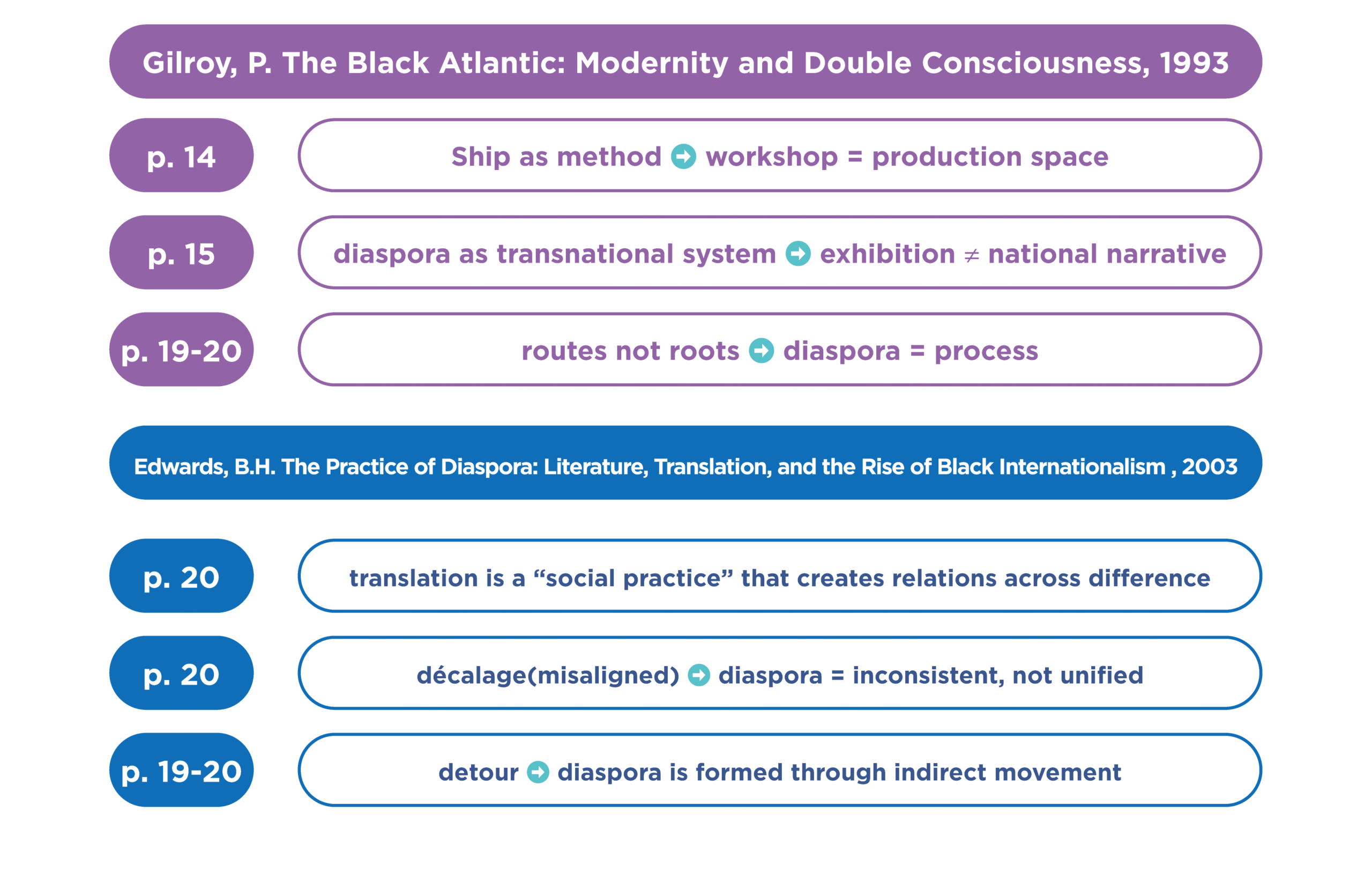
Image by: Tianshun Zhao
- Drawing on Paul Gilroy, diaspora is not rooted in origin but shaped through movement, “routes rather than roots” (p.19). He redefines the Atlantic as a transnational cultural system (p.15), challenging nation-based frameworks. The ship, as a mobile space (p.14), becomes a key site where identities are produced through circulation rather than fixed belonging.
- Drawing on Edwards, diaspora is not a unified identity but a process of translation that produces relations across difference (p.20). This process is structured by inevitable gaps, or “décalage,” meaning cultural exchange is always partial and uneven (p.20). Moreover, diaspora unfolds through detours rather than return (p.23–24), emphasizing indirect, non-linear movements of identity and meaning.
Exhibition Case
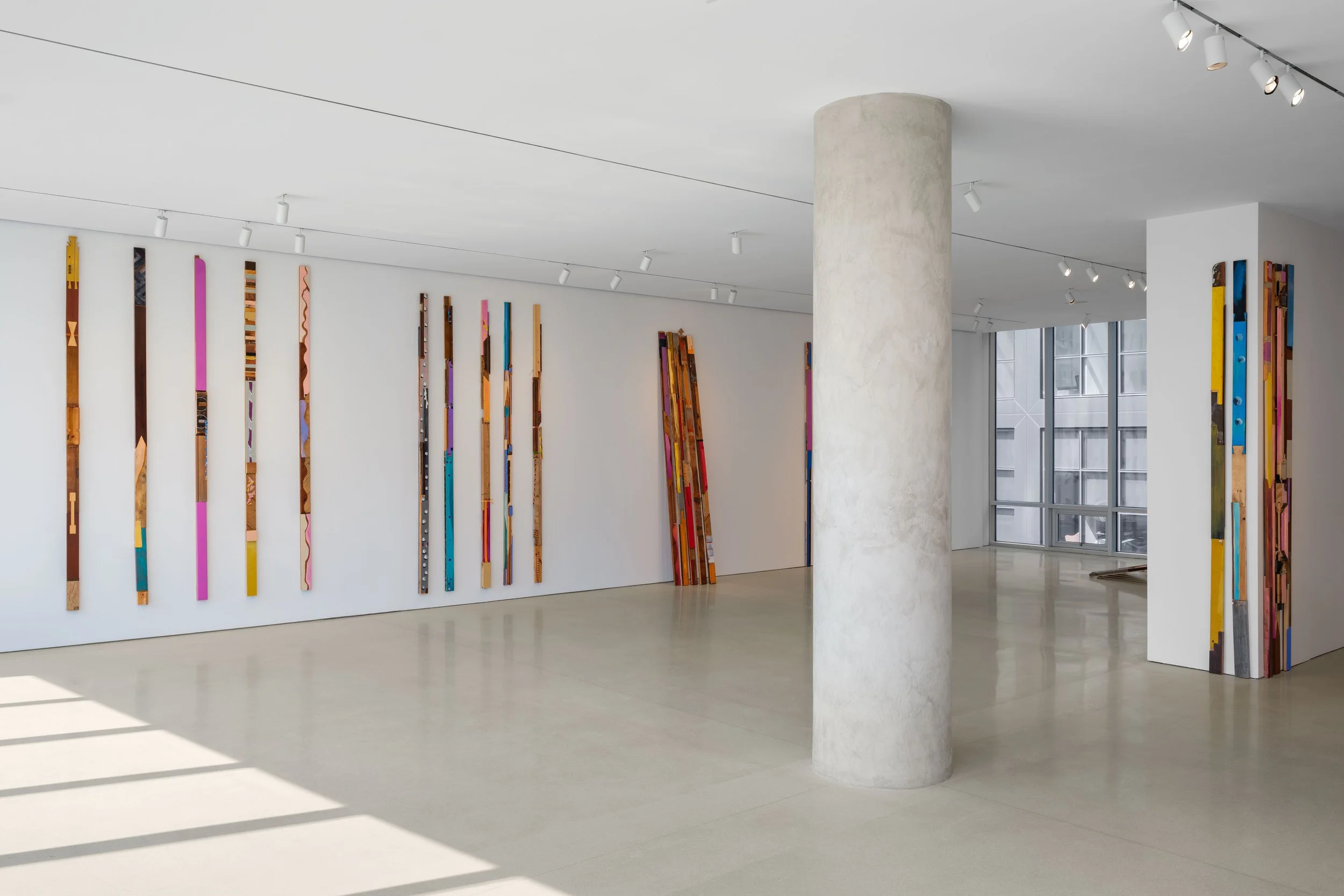
Installation view of Lubaina Himid: Make Do and Mend at The FLAG Art Foundation, 2024
Photography by Steven Probert
Exhibition as problem solving
The exhibition presents characters discussing problems around the table through “Strategy Paintings”, simulating the decision-making and thinking process.
Material as memory
The wooden board work of “Aunties” draws on the form of East African funeral objects and points to historical and cultural memory.
Collective identity construction
In the exhibition, the group characters discuss global issues (care, war, land, etc.) together, emphasising the collective rather than the individual.
The exhibition shifts focus from representation to process, using material, collective interaction, and problem-solving structures to construct meaning.
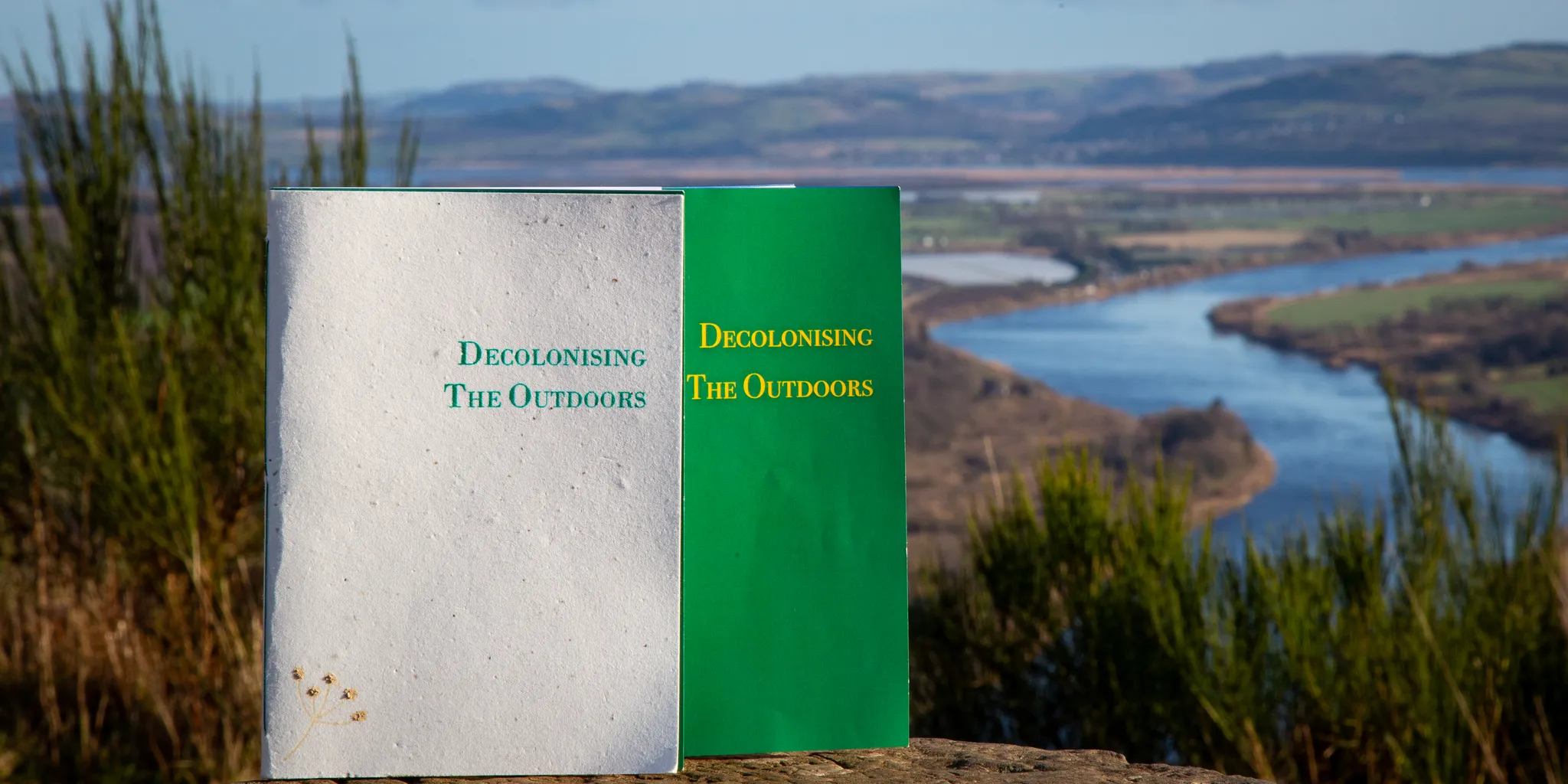 Decolonising The Outdoors, Aillen Lees, 2025, Edinburgh’s Radical Bookshop, Source: https://statuesque-figolla-ae8704.netlify.app/decolonisingtheoutdoors/
Decolonising knowledge production
Through discussion, reading and participatory activities (workshop), knowledge is no longer output by the institution in one direction, but generated in collective interaction.
Workshop as decolonial space
The workshop transforms the audience into participants, enabling them to engage in the process of expression, discussion and negotiation.
Situated belonging
In the cross-border context, through collective discussion and experience sharing, the sense of belonging is reconstructed in the situated context.
The project operates as a decolonial platform where knowledge is co-produced through workshops, transforming exhibition into a participatory space in which belonging and meaning are collectively constructed.
Reference List
Edwards, B. H. (2003) The Practice of Diaspora: Literature, Translation, and the Rise of Black Internationalism. Cambridge, MA: Harvard University Press.
Gilroy, P. (1993) The Black Atlantic: Modernity and Double Consciousness. Cambridge, MA: Harvard University Press.
(Rational Consideration and Exhibition Case © 2026 by Tianshun Zhao is licensed under CC BY 4.0)
(Rational Consideration and Exhibition Case © 2026 by Tianshun Zhao is licensed under CC BY 4.0)
(Theory Tag © 2026 by Tianshun Zhao is licensed under CC BY 4.0)
(Installation view of Lubaina Himid: Make Do and Mend at The FLAG Art Foundation, 2024 Photography by Steven Probert)
(Decolonising The Outdoors © AILEEN LEES 2025)



Leave a Reply