In his seminal 1935 paper, Taylor gave both practical and fundamental results [1]. For instance, in his equation (19), he gave a general expression for the dissipation per unit volume. We can convert this to dissipation per unit mass by dividing across by the density, putting  ,
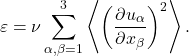
,  , and it becomes more in line with current practice. He also introduced the concept of isotropic turbulence and showed that this led to a simplified expression which we repeat here as:
(1) 
Secondly, he also expressed the mean dissipation for isotropic turbulence in terms of the Taylor microscale  , which is:
(2) 
Note that this expression also contains the viscosity and is an alternative formula for the dissipation rate in isotropic turbulence but is not a surrogate for it.
Now we come to Taylor’s dissipation surrogate. In his unnumbered equation which immediately precedes his equation (55), Taylor presented a surrogate expression for the dissipation rate. We quote the preceding passage from page 439 of Taylor’s paper, as follows:
`It seems that the rate of dissipation in such a system must be proportional, so far as changes in linear dimensions, velocity and density are concerned}, to  , where
  is some linear dimension defining the scale of the system.’
Note that the system highlighted is actually flow through a pipe.
Note also that we have changed from Taylor’s original notation, in that we have replaced  for the rms velocity by
  , and
, and  by , the latter denoting the integral length scale, which is invariably used in this expression nowadays when applied to isotropic turbulence. Evidently Taylor was considering how results could be scaled from one turbulent system to another but he did not dwell on the origins of this expression. In a more modern notation, Taylor’s relationship can be written as if it were the expression for the dissipation
  , thus:
(3) 
where the prefactor  may depend on the Reynolds number. It is this expression which leads to the notion of the dissipation being independent of the viscosity, and hence being thought of as anomalous. In fact, this is too hasty a conclusion, as it rules out the possibility of depending on the viscosity (through the Reynolds number), which in fact it does.
Let us now make a preliminary analysis of the dissipation surrogate. It is clear that equation (3) is an approximation, and that in writing it down Taylor replaced continuous variables in some expression by characteristic values which are constant with respect to spatial variation. That is,  is replaced by
  and
and  by
by  . It is also clear that the expression being simplified was not equation (1), and this was first pointed out in 1938 in Goldstein’s book [2]. This volume is a compilation by a panel of authors which included G. I. Taylor and which was edited by S. Goldstein.
Presumably the work that I am referring to here was actually by Taylor himself. Section 90, page 221 of [2] (also dealing with flow through a pipe) reads like an extension of Taylor’s 1935 paper. It points out that a hypothetical relationship between the turbulence patterns at different speeds is inconsistent with the condition that the dissipation of energy due to viscosity must be equal to the work done. This is because (in our present notation):
[A] The rate of dissipation in geometrically similar fields is proportional to  . (Note: from the context, the expression being approximated is clearly the one given by (1));
[B] Since the Reynolds stresses are proportional to  , the rate at which work is done is proportional to
  ,
,
and the condition that these two quantities are equal will not survive scaling to different speeds.
So, at this stage it seems that the surrogate given by (3) is really for the rate of doing work by internal forces, although it should be borne in mind that this reasoning is for shear flow in a pipe. In the next post we will go on to consider further interpretations by Dryden in 1943 and by Batchelor in his well-known monograph of 1954.
[1] G. I. Taylor. Statistical theory of turbulence. Proc. R. Soc., London, Ser A, 151:421, 1935.
[2] S. Goldstein. Modern developments in fluid dynamics. Oxford University Press, 1938.