After attending the 2026 International Women’s Day lecture by Caroline Criado Perez, Year 2 medical student, Mona Eskandaripour shares her thoughts on the women’s health data gap, how we got to where we are today and what medical students can do to both navigate and question it.
What is it about being a woman that seems to invite such wanton disregard and lack of consideration? As a female medical student, listening to Caroline Criado-Perez bring her brilliant combination of pithy humour and brutal reality to the 2026 International Women’s Day lecture was equal parts intriguing, inspirational and frustrating. I was first introduced to Caroline’s work when a friend recommended her book, Invisible Women (which I now recommend to all of you!) Invisible Women is a journey through the global industries and infrastructure schemes that are designed by and for men, disadvantaging women in everything from where they live and the cars they drive, to the healthcare standard by which they are treated.
Several weeks ago, I had the privilege of listening to Caroline take me on an emotional rollercoaster through the evolution of women and medicine. She reflected on the questionable historical treatment of female medical professionals, detailed the present state of the women’s health data gap, and finished with an optimistic projection of our resilience and the choices we face about our future.
One of my favourite parts of her speech was her use of the term backwash (meaning the receding of a wave). This was to signify how waves of feminism and progress towards equality are met with lulls and opposition and backlash, which eventually give way to the next wave. I found comfort in knowing the patterns, appreciating the inevitability of both. That is not to say that we can sit back and passively wait for the wave to hit us again; each subsequent wave comes from continually trudging towards a more equitable future despite the backwash we find ourselves in.
Invisible Women – a must read
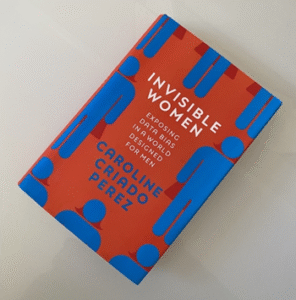 I’m an avid reader – when exams, projects, and reports allow – but I can only point to a handful of books that have influenced the way I think about and approach the world. Invisible Women was one of them. Not only was I shocked to discover how systematic and pervasive the bias against women is, but as a future healthcare professional, reading about the data gap in women’s health was appalling.
First and maybe most importantly, women’s health cannot be diminished to bikini medicine, i.e. to sexual and reproductive health. It has to include conditions that affect women differently or disproportionately including autoimmune conditions, Alzheimer’s disease and cardiovascular disease.
Some quick research uncovered several reasons as to why women have been excluded from clinical trials. Following the consequential birth defects from thalidomide use in the 50s and 60s, women of child-bearing age were discouraged from early clinical trials, even if they were on contraception. This meant that only the drugs that succeeded in men passed the phase I and II trials, so we may never know if they could have provided benefit for women.
Another excuse was that women are “hormonal.” It was too complicated and costly to analyse data from female participants, so science decided to simplify the matter. By assuming women were just ‘smaller men,’ they were able to assuage their concerns and their funders by defaulting the male models and ascribing any finding to women without compunction. And it isn’t just clinical trials; this applies to animal and cell models – basically any research which founds our “evidence-based” practices.
But you can see where the logic falls short: “Let’s not test this in women because their biology is different to men. Let’s test it in men and give it to women because we are assuming their biology is the same.” It is no wonder that women report more adverse reactions to drugs than men. Or that most drug withdrawals result from greater health risks to women than men. Or that risk prediction models fail to recognise high-risk women because the same characteristics in men are low risk. Or that women have a longer lifespan but a shorter health span, often with more misdiagnoses, mistreatment, and poorer outcomes. Or… I could go on.
How will AI impact the existing data gap?
And as we move towards the future where artificial intelligence is used with increasing frequency in the administrative, diagnostic and support of our healthcare careers, I fear for what that will mean for women’s health if we stand by and let it continue unchallenged. Caroline highlighted that when the data off which AI models are trained is biased, it amplifies said bias in its outputs. As well, she noted that claims that AI is better at diagnoses than humans actually neglect a huge gender disparity: AI is better in men but worse in diagnosing women. With flawed data, how can we not expect flawed results?
I’m not trying to be pessimistic, I promise. There is great potential in using AI intentionally, where its ability to process data and unlock patterns can be used to better understand women’s health. The principles of evidence-based practice and well-designed research are fundamental to medicine, and AI undoubtedly will have a place in our future clinical care. The key lies in critically thinking about this research in a way where we do no harm. In the context of the women’s health data gap, I believe it is where we, as medical students, have the opportunity and responsibility to question. What we read in Davidson’s or NICE: Is it true? Why are there different guidelines for women? Is it based on robust evidence that analyses responses in women? Or is it due to the lack of evidence in women because menstruation is too difficult to account for?
So, as a woman and a medical student, as a future healthcare provider and a future patient, if I can’t trust clinical decisions to stem from unbiased data, then both me and my future female patients are at risk. That is why I loved Invisible Women – it was my call to action to keep this at the forefront of my training now and in future. What will yours be?