McInerny, R. (1997) Ethica Thomistica: The Moral Philosophy of Thomas Aquinas. Revised edition. Washington, DC: The Catholic University of America Press.
Chapter 1: Morality and Human Life
1. Human Action and Moral Appraisal
Human actions are moral actions. A human act is one that is conscious, deliberate, and free, and therefore something for which the agent is answerable.
All human actions are purposive: they are undertaken with an end in view. The appraisal of an action therefore involves assessment of both:
- The end (what is aimed at), and
- The means (how that end is pursued).
Both ends and means can be evaluated as good or bad. Means may be more or less appropriate to the end, and ends themselves may be morally worthy or unworthy.
Although every action is undertaken under the aspect of the good, this does not imply that every human action is in fact good.
2. The Good: Real and Apparent
For Aquinas, the good means what is perfective or fulfilling of the agent.
Latent in every action is the belief that its end is in some way perfective or fulfilling. This belief may, however, be mistaken.
- A real good is something pursued as fulfilling that genuinely perfects the agent.
- An apparent good is something pursued as fulfilling that in fact fails to perfect the agent.
Thus, when one acts badly, one does not aim at evil as such, but rather pursues a misconceived good.
3. Internal and Moral Appraisal of Action
Human actions admit of multiple forms of evaluation:
- Internal (or technical) appraisal, where actions are judged according to the standards of a particular practice or role.
- External (or moral) appraisal, where actions are judged in terms of their contribution to the agent’s overall good and the good shared with others.
For example, a teacher’s actions can be assessed internally according to pedagogical criteria, but they can also be appraised morally: do these actions, taken as a whole, contribute to the teacher’s flourishing and to the common good?
For Aquinas, no human action escapes this broader moral appraisal.
4. Two Senses of ‘Moral’
McInerny distinguishes two senses of the term moral:
- Moral¹: Any act that is subject to moral evaluation.
- Moral²: An act that is morally good, i.e. rightly ordered.
Every human action is necessarily moral¹, since all human acts can be evaluated morally. However, not every action is moral².
As McInerny puts it:
It is a matter of necessity, not choice, that any act I perform is moral¹. It is a matter of choice, not necessity, that an action of mine is moral².
Thus, freedom concerns not whether actions are morally evaluable, but whether they are morally good.
The question Why should I be moral²? admits a straightforward answer: because this is already implicit in intentional action itself. In acting, one aims at what one takes to be perfective or fulfilling. If an action fails genuinely to fulfill, this failure provides the criterion by which it is judged defective. The demand to act well therefore arises from within the structure of agency itself, not from an external moral imposition.
5. Bad Action and the Structure of Intention
Because all human action is purposive and oriented toward what appears good, even bad actions are undertaken under the guise of the good.
When I act wrongly, I do so because I mistake an apparent good for a real one. The structure of intention remains intact: I still aim at fulfillment, but my practical judgement is defective.
6. Human Acts and Non-Human Acts
Not all actions are human (and therefore moral) acts. Many of our behaviours are unintended, involuntary, or spontaneous.
Human life therefore consists of a complex mixture of:
- Intended actions, for which we are responsible.
- Unintended occurrences, including chance events and the effects of good and bad luck.
Accordingly, Aquinas distinguishes between:
- The good and evil of action, for which the agent is morally accountable, and
- The good and evil that befall the agent, which may result from action but do not necessarily attract moral responsibility.
This distinction parallels Kierkegaard’s separation of ethics and history.
Ultimately, life is complicated and we have an imperfect control over how our lives, broadly conceived, turn out.
Chapter 2: The Good for Man
1. The Central Question: What Is the Human Good?
The fundamental ethical question is: What is the good for man? This is equivalent to asking what it is to live well as a human being.
The good for man must be specific to human nature, not merely generic (e.g. survival, pleasure, or satisfaction).
This frames ethics as an inquiry into human flourishing, not rule-following or preference satisfaction.
2. Aristotle: The Function Argument
Following Aristotle, McInerny presents the function (ergon) argument:
- The good of anything lies in performing its distinctive function well.
- The distinctive function of human beings is rational activity.
- Therefore, the human good consists in excellent rational activity.
Human flourishing (eudaimonia) is thus activity of the soul in accordance with virtue, not a passive state or mere feeling.
The human good is objective, grounded in human nature, not subjective preference.
3. Happiness and Activity
Happiness (eudaimonia) is not a psychological state, but a way of living.
It consists in ongoing rational activity ordered by virtue, across a whole life.
This avoids identifying happiness with:
- Pleasure,
- Wealth,
- Honour,
- Power.
These are at best instrumental goods, not the final end.
4. Aquinas: Development and Transformation of Aristotle
Aquinas adopts Aristotle’s basic framework but transforms it within a theological horizon.
Key developments:
- The human good remains rational activity in accordance with virtue.
- However, Aquinas distinguishes:
- Natural happiness (imperfect fulfillment possible in this life), and
- Perfect happiness, which consists in the vision of God and lies beyond natural human powers.
Thus, for Aquinas, philosophical ethics remains valid, but the ultimate human end is supernatural.
5. The Hierarchy of Goods
Human life involves multiple goods, ordered hierarchically:
- Instrumental goods (e.g. wealth, health, pleasure)
- Goods of activity (virtuous action, understanding, friendship)
- The final end, which gives unity and intelligibility to all action
Lower goods are genuine goods, but derive their meaning from their relation to the final end.
Disorder arises when lower goods are treated as ultimate.
6. Continuity and Difference: Aristotle and Aquinas
There is fundamental continuity between Aristotle and Aquinas in their understanding of:
- Human nature,
- Rationality,
- Virtue,
- Happiness as activity.
But there is also a decisive difference:
- Aristotle: the highest fulfillment is contemplative rational activity.
- Aquinas: perfect fulfillment is beatific vision, exceeding philosophical ethics.
Thus, Aquinas preserves Aristotelian ethics while embedding it within Christian theology.
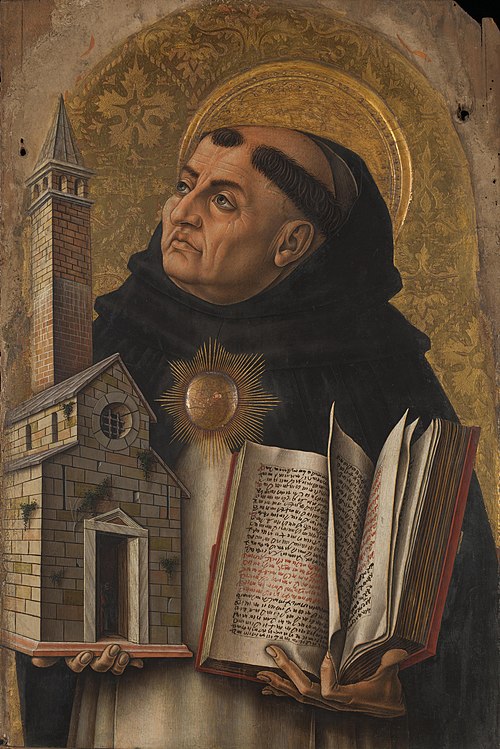
(Carlo Crivelli: Saint Thomas Aquinas)