A day after submitting my blog post (The Good Life of the University) to the Teaching Matters blog team, I happened on an interview (2012) with MacIntyre in which reference is made to an essay of his (Catholic Universities: Dangers, Hopes, Choices) which appeared in an edited book called Higher Learning and Catholic Traditions (2001). The interview contains this somewhat polemical sentence:
it is a primary responsibility of a university to be unresponsive, to give its students what they need, not what they want, and to do so in such a way that what they want becomes what they need and what they choose is choiceworthy (2012, page 1)
The essay itself provides the preceding sentence, which is also useful:
Universities have made a similar mistake. They have responded all too readily to an invitation to treat students as consumers to whose demands they ought to be responsive. But it is a primary responsibility of a university … (2001, page 15)
In the interview, MacIntyre then adds to this the following:
Of course students need to be well-prepared for the world of work, but for this they need not only the relevant sets of skills, but also an ability to make reflective choices. There are the skills that everyone needs, whatever their career path, some of them mathematical – everyone should have a course in probability and statistics – as well as others that enable us to understand difficult texts or to disentangle complex arguments. Those skills are put to use in learning what the different disciplines have to teach us about nature and human nature, about what it is to choose and act as a rational agent in our particular time and place. It is the task of any worthwhile university not just to educate in particular disciplines, but to enable its students to understand how each discipline contributes to an overall understanding of the human condition and so to become reflective. (2012, page 1)
I also appreciate this sentiment:
Too often they [students] do not want an education which is both rigorous and demanding and unsettling and disturbing, that gives them reason to be less than entirely happy with themselves and with the world (2012, page 2)
And later he discusses the concept of an educated public and links this to the role of conflict that my post only hinted at:
The task of bringing into being an educated public is the task of every university … An educated public shares at least four things. It acknowledges common standards of argument. It recognizes a shared cultural inheritance that gives expression to some measure of agreement on what is required if human beings are to flourish. It agrees further to some significant extent on what the difficulties and problems that it confronts are. And it is able to view its informal discussions of great issues, over dinner tables, in coffee houses, in debating clubs, in magazines, newspapers, and now the internet as contributing to the making of decisions in the decision-making organs of that particular society, whatever they are. In modern societies the first three of these will only be adequately achieved when a sufficient number of citizens receive a good higher education. Yet, even when this is so, it may not be enough. Why not? The debates of an educated public require a willingness to listen to a variety of conflicting voices and to allow the argument to carry one forward to what are sometimes quite unexpected conclusions. Such debate is frustrated when significant voices go unheard. (2012, page 7)
Naturally, I wish I had seen this essay earlier in the writing process, though arguably it might have taken my post in a slightly different direction. Nevertheless, there are strong and clear sentences here which would have served my post well. And yes, while yet another post could be written to incorporate more from this essay, the resulting post would likely be too close to the one I have just submitted. Alas. I might try to revise the post for submission to the BERA Blog … For now, I will summarise the essay in a new post.
References
Liam Kavanagh (2012). ‘Interview with Alasdair MacIntyre’, Expositions, 6(2), pp. 1–8. Available at: https://expositions.journals.villanova.edu/index.php/expositions/article/view/1452/1314
Alasdair MacIntyre (2001). ‘Catholic Universities: Dangers, Hopes, Choices’, in Robert E. Sullivan (ed.) Higher Learning and Catholic Traditions. Notre Dame, IN: University of Notre Dame Press, pp. 1–21.
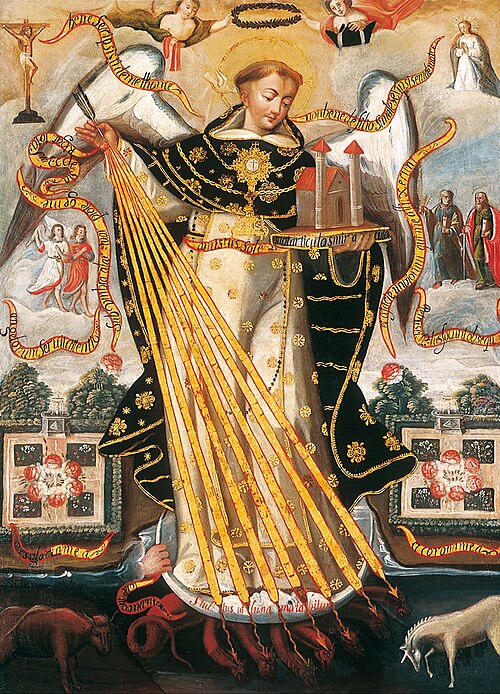
(Saint Thomas Aquinas, Protector of the University of Cusco)