In Leisure, the Basis of Culture (first published in 1948), Josef Pieper notes the difference between looking as contemplation and looking as observation. With the first kind of looking – as when we look at a rose – we are ‘passive and receptive’, and ‘our attention is not strained’. We are simply looking, open ‘to whatever offers itself’; indeed, ‘the things seen enter into us’ (p. 31).
With the second kind of looking, we are working at looking. Observation, he reminds us, involves counting, measuring, and weighing up. Unlike contemplation, observation is ‘a tense activity’, effortful and strained, and as such, as Pieper recalls from Ernst Jünger, an ‘act of aggression’ (p. 31).
There is nothing particularly new about this characterisation, of course. Still, reading it made me reflect on how many institutions use observations – for both quality control and teacher development. Many years ago, when I worked as an English language teacher, observations – formal or developmental – were often free of fixed criteria. Of course, the observer undoubtedly had some standards in mind (typically rather basic: allows students to talk, speaks clearly, sets meaningful tasks, gives useful and accurate feedback on language, etc.). But rather than allowing these standards to dominate – as they might if written down – observers would often take a more contemplative approach. Rather than measuring and weighing up what we were observing in terms of fixed criteria, we would look and open ourselves to what was being offered.
(To pre-empt the obvious rebuttal – that since criteria are always involved, it’s better to make them explicit rather than leave observees guessing what’s in the observer’s head – I would say that once written down, such criteria tend to dominate. They frame what is seen, determine what is looked for, and often overshadow everything else – potentially making it harder to attend receptively to what is actually happening in the room.)
Today, while we still have observations for quality assurance (for temporary teachers, for example), most are now framed as developmental. However, the paperwork is often the same – forms and lesson plans to complete beforehand, with feedback entered onto a sheet listing various professionally approved criteria that the teacher or lesson either meets or does not meet.
Perhaps a more interesting approach to these so-called developmental observations would be to dispense with the criteria and the measuring – and instead to take the opportunity to simply look at what presents itself, and then to talk about what we both saw, without strain or aggression.
References
Josef Pieper (1952). Leisure, the Basis of Culture : The Philosophical Act. London: Faber.
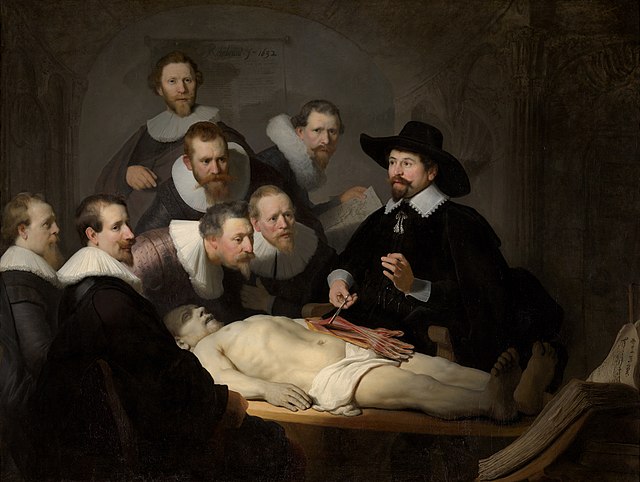
(Rembrandt van Rijn: The Anatomy Lesson of Dr Nicolaes Tulp)