

How I survived my viva and PhD thesis defence in creative writing
Viva Survivor. That’s the name of the preparatory course to get fourth-year doctoral students across the finish line and through their PhD defence. Organized by Nathan Ryder, the former podcast and now online workshop, is designed to calm the fears and anxieties of researchers, and set them up for success.
General advice for success
I took the session in April 2025, and Ryder reiterated that a thesis defence (a VIVA in the UK) is meant to be a discussion that explores your significant original contribution, unpacks the how and why of your research, and examines your capability as a researcher.
He outlined six key areas in order to prepare:
- Really read your thesis from end-to-end
- Annotate your thesis – underline, notes, highlight, sticky tabs. Make a limited edition of your thesis for the purpose of the VIVA.
- Create summaries and find valuable questions and formats to gather thoughts.
- Check recent publications to show you are keeping up-to-date but you are not looking for “more stuff” to cram into your thesis.
- Research your examiners and check their recent publications
- Find rehearsal opportunities and do mock viva’s and seminars.
And while everyone has their own method of preparation, here is what I ended up doing.
My preparation for the VIVA
Record a podcast
I recorded myself on my voice memo app asking myself mock questions prepared by my supervisor. These questions included things like:
-
Your choice of the police procedural genre, its limitations and possibilities, and your approach to working within / pushing at the edges of that genre
-
The dynamics of plot, character, theme and literary place – how these intersected in your novel
-
Other influences on your creative work (i.e. work of other novelists, but you can mention other things than novels, too, if they’re important to your writing)
-
Why did you choose the methodologies / lenses you’ve applied?
-
Are there other ways you might have gone about things, e.g. other novelists you might have put centre stage, or other theoretical frameworks that you considered?
-
What challenges did you experience in the course of working on the project?
I recorded my answers to these questions, and others, without preparation. Then, I did it a second time after I had annotated my thesis.
Annotate the thesis
I spent the majority of my time deconstructing my thesis and annotating it like a madman. I had my full thesis printed and bound, and before I put a single sticky note on it, I created a legend/mind-map of categories:
- limitations
- key learnings
- possibilities and new methods
- plot, character, and setting
- genre and writing process
- creative influences
- key texts
- method and frameworks
I created this legend in my notes app, and wrote down each category and relevant information before I wrote anything in the thesis itself. I was worried I might confuse myself if I started without a plan.
-
- Notes app legend
-
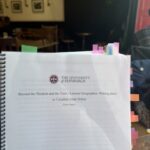
- Printed thesis
-
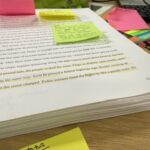
- Highlight and sticky notes
Once I felt satisfied with my system, I began highlighting relevant passages and sticky noting sources.
Annotated bibliography
I didn’t create an official annotated bibliography, but I did create a chart in my notes app with the top 8 sources I used, and I wrote down the most relevant/key ideas I thought I might want to speak to. From there, I wrote the most high level notes on sticky notes and put them in the back of my thesis for reference. And this is actually what I ended up using most often in the VIVA itself. It’s not because I was being tested on these sources, but because I wanted to specifically mention why I liked these passages and ideas, and how they connected to my novel.
For example, I wanted to explain why Sarah Groeneveld’s research, that Canada’s identity is dependent upon the erasure of First Nations, was relevant to why I examined Canadian highways.
2 minute blurb
I was also encouraged to write a two-minute blurb about my thesis overall, just in case I got asked my most feared question, “So, tell us a little bit about your research”. Admittedly, I somewhat forgot to do this until the morning of my VIVA, and I scribbled this out while I was killing time in the postgraduate room on the 4th floor of 50GS.
It turns out, I would need this.
“My research output is a crime novel set in Canada, which is informed by setting and literary place. The literary place is Calgary, AB Canada and operating throughout the narrative is the resurgence of a fictional white supremacy group. They have reasserted themselves on the landscape, both urban and rural. The novel is a police procedural, and the main protagonist is a detective who has returned home from Police Scotland, to find herself caught in this unfamiliar world, where she must investigate the murder of a local barista. The critical reflexive is the investigative research on my process of making the novel, where I interrogated my creative choices, and conducted research into how writers can create place. The critical has a generative relationship with the text, and as I uncovered how other writer-researchers create place, and examined their frameworks, I employed those techniques into my own methods as well as built on them using Australia researcher Meg Mundell’s place-oriented experiential techniques.”
Viva-eve, the night before
On viva-eve, what I affectionately referred to as the night before my viva, I didn’t put too much pressure on myself to keep revising. At this point, I had come to the realization that I wasn’t going to get any smarter, and I wasn’t going to retain any new information. I either knew what my thesis was about, or I didn’t.
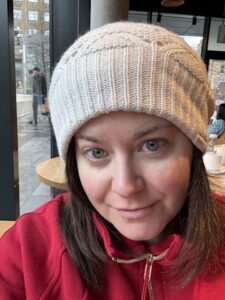
Starbucks on Viva-eve!
I spent the morning at a Starbucks, doing some light re-reading, and then I had a normal dinner and went to bed early. Alot of people were wishing me luck, and sending messages of encouragement, but I didn’t spend too much time responding to them. I set out my clothes, made a plan for the next morning, and did my best to get a good sleep.
And suddenly, the viva was here
In the morning, I had a light breakfast and got dressed. I packed my thesis in my backpack, as well as a bottle of water, my notebook, pens/highlighter, and some chocolates I had brought from Canada to give to my examiners and my non-examining chair. I went to Blackwell’s to look for book (they didn’t have it) and then spent about an hour at Kilimanjaro, a cafe I often wrote in, and had eggs and toast. This was basically my lunch. I left there around one, and went to the postgraduate room to kill some time. I was meeting Jane, my supervisor at 1:30 p.m. to walk over to the room together. That’s when I realized I needed to write a 2-min blurb. It was kind of bizarre to sit there and wait for time to click by, but eventually, at 1:30, I met my supervisor and we walked over to the Chrystal MacMillan building, into meeting room 4.
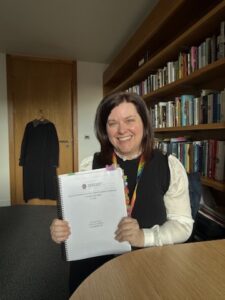
At my supervisor’s office before the viva.
There were a bunch of things that didn’t work out for how I had envisioned my viva.
The date changed, the room changed (and I had really wanted a room in 50GS), and I had asked that my supervisor be in the room but there was conflicting advice on this, and so she didn’t attend. The cafe on the main level of the Chrystal MacMillan had been completely removed and was replaced with an automatic vending machine, so I did not get the drink I had planned on buying. Edinburgh is famous for removing things you swore were just there.
My non-examining chair went to the wrong room, and she was flustered arriving because she was late getting to the new location. But, as I said to my supervisor, there was no need to rush at this point — I wasn’t getting any smarter while I waited. I wasn’t nervous or anxious. Instead, I felt excited to talk about my research because this was my project after all, and I was curious about how the examiners felt about it.
What happened during my viva
Nathan Ryder talked alot about the uniqueness of the viva. The thesis is unique to the doctoral student who wrote it. Many of the questions I prepared for, never materialized. And I was told things like, examiners won’t ask you to flip directly to a page number, but mine referenced page numbers three times. So, whatever people tell you about a viva — take the advice knowing that your viva can not be predicted.
The only significant advice came from my supervisor, when I asked what not to do. She said, don’t be offended or defensive if examiners feel there could be an improvement.
To open the discussion, the examiners asked me to “tell them a little bit about my novel” and “why I wanted to do a PhD”. I was ready for the first part because I wrote my 2 min blurb thirty minutes earlier, but I had a feeling that the second question about my motivation to do a PhD was seeking a rationale about doing research into creative practice. It is not typical for writers to get PhD’s in creative writing.
All told, I was asked ten questions on my novel, and six questions on my critical. After about 75 minutes, I asked to go to the bathroom, and when I returned to the room, the examiners only had one final question.
Things I did in the room that made a difference
There were a few things I did in the room that made my viva successful, and afterwards, my non-examining chair said it was the best viva she had ever seen.
- I brought a blank notebook with me and I wrote down each question. I wanted to make sure I was answering the question, and only that question – nothing more.
- I opened my thesis as soon as I sat down, so it wouldn’t be awkward if I did need to open it.
- I recognized when I could correct an assumption, such as why I wrote about highways when highways weren’t a significant part of the novel (because highways are connected to the Canadian identity).
One of the things I realized is that my answers could prompt going down an alternative path. For example, I had mentioned a secondary character and the examiners decided to follow that path and ask me about some of the additional characters in the novel. I was also asked about the true crime podcast in the novel, and I off-handedly mentioned that I read Denise Mina’s novel Conviction, which had a podcast as well. I didn’t include that in my thesis because the majority of my inspiration came from the Canadian True Crime podcast, but my examiner thought I should include Mina’s novel as well, and I had a gut feeling that it would become a minor correction (and it did.)
After I answered my final question, I left the room and sat with my supervisor for about 7-8 minutes and then the non-examining chair came to retrieve me. I asked that my supervisor join me for that portion, especially because if I got minor corrections, I wanted her to hear them too. The examining chair said I was being awarded the degree with minor corrections, and the panel gave me three corrections. One being to include Denise Mina’s novel as part of the podcast inspiration, and then two others related to adding in Louise Penny’s contributions to the Canadian detective figure, and including more about the history of Canadian crime fiction.
-
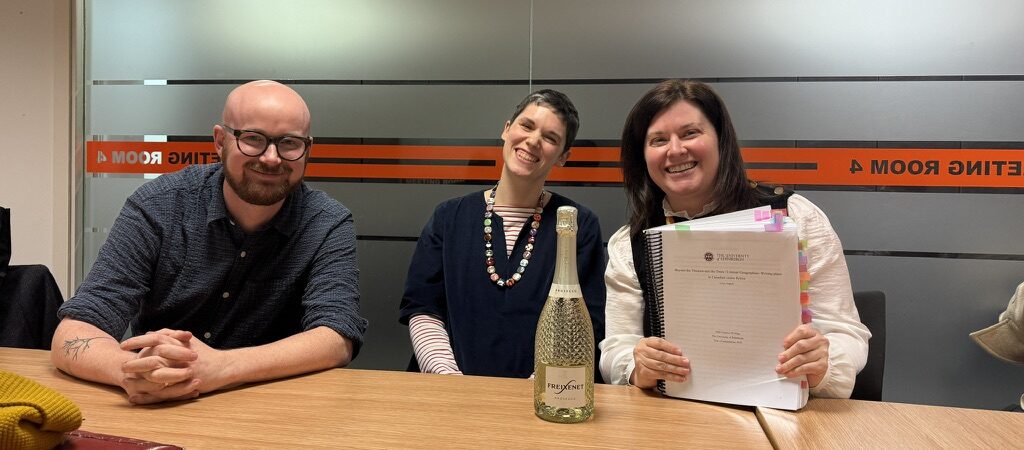
- Viva is done! Me with my supervisor, Dr Jane Alexander
-

- Friends at the pub!
Then, my supervisor gave me a bottle of prosecco and we went to the pub for some celebratory drinks. A few of my friends showed up, including Frank, who I call my gateway drug into the PhD.
Post-viva recovery
The funny thing about finishing the PhD, and completing the viva, is that I felt no different than hours earlier. I wasn’t anxious or nervous going in, and the biggest sigh of relief was knowing all of the other things I had done to support my degree would come to a close. When I left the pub, I felt like I had just let go of 100 balloons. Up until that point, I was holding the entirety of the thesis in my head, but after the viva…I could let go of every single thought. What a relief!
Everyone’s PhD journey is different. But, for me, writing and producing the thesis was ‘easy’ part.
The hard stuff included: applying for grants, scholarships and funding, flying multiple transcontinental flights each year, organizing travel logistics and accommodation issues like letting my flat, trying to juggle work and academia, stacking my schedule to take advantage of Edinburgh’s opportunities with the limited time I had left, and shuttling my luggage all over town. The end of the viva meant I would no longer have to manage multiple Teams calendars, join meetings at 7 a.m. local time, and keep track of pin codes, locker keys, library access, book returns, and annual reviews. All of these tasks were melting away.
In fact, part of me feels like I deserve a PhD in PhD Management. The logistics of everything I did, over four years, through a pandemic, deserve more recognition than my novel and my research. It was far harder, required more sacrifice, and dominated my mental energy.
What’s next?
Even though I have a few corrections on the horizon, I’m entering a new phase. Now begins the letting go process of the University of Edinburgh, and finding my footing in the academic and publishing world. I have imminent deadlines for journal submissions, grants, and postdoctoral fellowships. And I’m waiting on my official corrections to come from LLC.
I was speaking with the University of Rouen about returning in May to host a writing workshop on detective fiction, and how to get federal funding for it. I have student journals to comment on for the Future’s Institute course I’m supporting, as well as edits for my own press, and for the Fungal Gothic project that Sam and I are working on.
In many ways, things have accelerated for me. But this is the close of a chapter, one I am thankful for, and very proud of.

Share



Dr Angelo, many congratulations, and so very deserved. I do not know you personally, but your post meant a great deal to me. I am not at the viva stage yet, but it has already built up in my mind as one of the most serious moments of the PhD. Perhaps that is because so much time, effort, patience and youth goes into this work, and the viva can feel like a few hours being asked to speak for several years. What I found so comforting in your post was not that it made the viva seem small, but that it made it feel real, human, and survivable. And perhaps because it felt so real, I could also feel my own nerves rising as I read. I suspect many readers, especially non-native English speakers, will understand that feeling. Thank you for sharing this with such honesty and generosity, and I wish you all the best for what comes next.