

Three things that didn’t happen in my VIVA (but, I thought they would)
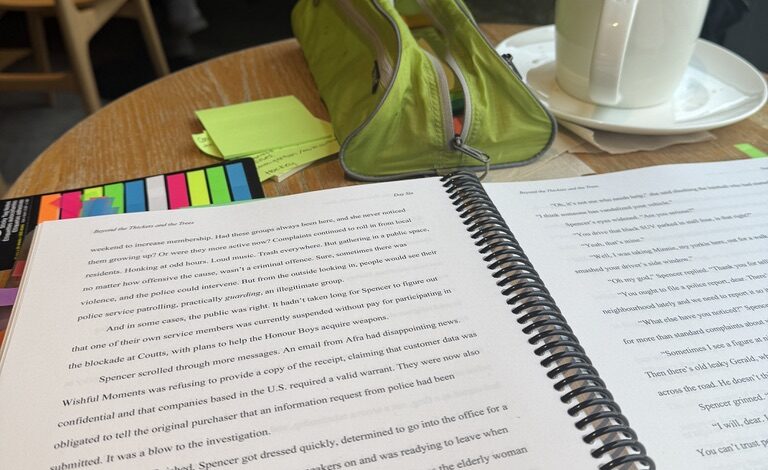
I completed my VIVA in January 2026, and I wrote pretty extensively in a previous post titled How I survived my viva and PhD thesis defence in creative writing about how I prepared.
Preparing for the viva was the most dominant part of the PhD journey. And since everything is leading up to that one discussion, the viva is the thing we all fear. So, even though I did extensive preparation for my viva, I thought I’d also share three things that didn’t happen.
1. We did not discuss my original research contribution
This surprised me.
I was fully prepared to discuss my original contribution to research (naturally!) because I was excited that I had built on Meg Mundell’s POET model, and contributed a new sub-category to her writing model. But when we got to the question where I expected the examiners to ask about how I developed my new method, and how I built on the POET model, the examiners said, “I think your original contribution is obvious so we can move on.”
The obviousness of my research was enough for the examiners. They were satisfied. So, just like that – we moved onto the next question where they asked me about memory and how Canada is haunted.
2. I was not asked about specific academic sources
Although I was asked to flip to certain pages, I wasn’t expected to discuss specific academic sources or reiterate their findings. I did make annotated notes in the back of my thesis so I could refer to key ideas that I liked about certain sources, but I wasn’t directly asked why I used one source over another, or what I gleaned from these sources. Instead, I only referenced them in my responses if it made sense.
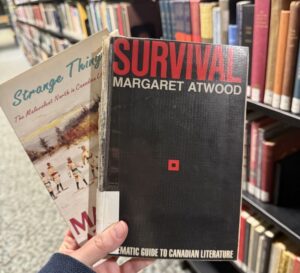
Margaret Atwood’s critical text Survival
For example, I was asked about the setting of the novel (in Alberta) and why my critical focused on creating a method to write about highways when there weren’t many highway scenes in the novel. Examiners were like, “this crime novel isn’t about a highway patroller or anything highway-related, so why did you focus your critical research on highways.” This is where I could correct an assumption – the examiners thought there was a gap between the plot of my crime novel, and my critical research. I never considered that the examiners might be confused about this because the highway is omnipresent in Canadian culture. So, I reiterated why the highway links to the Canadian identity, and Canada’s settlement and haunted past, which were argued by Sarah Groeneveld and Margaret Atwood.
My explanation cleared things up for the examiners.
3. No one asked about my future contributions or plans
I was loosely anticipating that I might be asked about my future projects and plans for research beyond my thesis, but – I wasn’t asked about this either. I thought there might be an opportunity to discuss publication plans, or postdoc opportunities, but it didn’t come up.
That said, we had been talking for a long time, so when I went to go to the bathroom at the 75 minute mark, I could hear the examiners talking as I left. I can only assume they had agreed to wrap things up at that point because when I came back to the room, there was one final question.
I am very grateful for that bathroom break because there might have been even more questions!
Learning while in the viva
What I learned during my viva was that I could do a few things:
- steer my viva in different directions depending on my responses
- correct any assumptions about my work
- prompt potential corrections
I took a blank notepad into my VIVA to write down all of the questions as they were asked, and this helped me limit the length of my responses. It also helped me stay on topic, and not stray into other lines of thinking because rambling on is where potential corrections live.
There were two instances where I thought I should ‘talk beyond my thesis’ which is something my supervisor said she liked when she examined students. In her mind, the viva + the thesis = the PhD. But, my one examiner preferred that anything I said in my viva should also be in the thesis (so that’s how I inadvertently prompted two minor corrections).
For example, I spoke about Denise Mina’s novel Conviction because it contained a podcast as well, even though I didn’t really use her novel as a template for my mine. However, one examiner felt that Mina’s use of the podcast should be in the thesis. Similarly, I spoke about Canadian crime writer Louise Penny, who has contributed alot to Canadian crime fiction but is under-studied. I only knew of her in a cursory way and I had only read one of her novels, but, this is where assumptions can come back into the examination. It was assumed that because I was Canadian, surely I must have been influenced by one of Canada’s most prolific crime writers – so, mentioning Penny in the viva prompted a correction. Examiners wanted me to add her in.
It would have been way too complicated in the viva to discuss why Penny’s work didn’t relate to me (plus I wasn’t prepared for it). Rather than get defensive in the moment, I recognized that now was not the time to discuss Canada’s French and English history, the differences between Montreal and Calgary, and why Penny’s anglophone/francophone dynamics differ from Alberta’s Indigenous/settler-colonizer tensions. I simply agreed that I could add Penny in.
The corrections period
I chose to use my corrections period as an opportunity to delineate my work from Penny’s in the thesis itself, so it was clearer where my route to crime fiction really came from. That said, I recognized that I played a role in making these corrections appear.
Of course, every viva is different. Every examiner is different. And that’s why it’s really difficult to compare experiences. But, this is just my personal account and what happened to me – so maybe it’s helpful!

Share