The day is slow to start and when it finally does, it stays overcast and grey. Thankfully the rain is holding off when I meet Linsey. We walk up the high street, and I point out the boarded-up windows on a couple of the shop fronts. When I bought a wreath for my front door in Moss Flowers a few days ago, I discovered that the glass had been smashed during the night. There was a lot of vandalism that weekend. Graffiti tags have appeared on signs and walls. Christmas brings out the best and worst in people.
Linsey and I are both off work today and we are meeting for a walk between present buying and wrapping. My house is going to be busy next week, so I am getting as much done as I can before my children and extended family and all their dogs start to arrive. Linsey has lots to get ready too, but she has stopped by Lenzie on her way to visit a relative. A walk round the Moss will be a welcome break for both of us.
Linsey started to visit Lenzie Moss during the lockdown years of 2020 and 2021. With two young children to entertain, and the usual indoor play centres closed, she began to venture out into local parks and woodland. From their home in the neighbouring town of Bishopbriggs, they searched for nearby places to spend time outdoors. Lenzie Moss was a perfect size for a morning’s visit. They would poke sticks into the bog to see how deep they went, take detours along woodland trails to see what they could find, and seek out ruined buildings and public artworks. Their visits always took longer than expected.
In the years that followed, Linsey kept coming back here. Once, after a friend had been through a difficult time, they walked round the Moss together and talked things over. For Linsey, there is something about the circular route that makes a walk here particularly satisfying. You know where you are going and you leave the site at the same place as you enter it. The layout of paths around the perimeter of the bog lends itself to an hour in company, as I can attest.
As we turn onto the northern path through the wood, I notice a canvas structure through the trees. It looks like a tent or some sort of shelter. The woodland is very wet today, and it is not easy to get any closer, so we move on without investigating further. I hope that nobody is sleeping in there at such a cold and wet time of year. Hopefully it is a hideout for adventurous local kids – those who don’t vandalise public property for fun.
Linsey tells me about a den that her family built in the woods four years ago. It still stands, although it has deteriorated with the years. They visited lots of other places during lockdown, many of which they continue to return to. The den was in the Wilderness Plantation – the site of a Roman fortlet on the Antonine Wall. And they have also enjoyed visits to Cairnhill woods in Bearsden and the fairy woods in Milton-of-Campsie. Often, Linsey finds out about new places through community groups and social networks. Some of these sites, like the Moss, have intriguing industrial pasts. Wilderness Plantation is close to Mavis Valley, a former mining village with a tragic history, which was abandoned in the 1940s. Linsey tells me that the remnants of the old buildings can still be found amongst the trees.
Linsey values the proximity of people. She likes places where back gardens border green spaces and is drawn to games and activities arranged by local parents and teachers. I have seen this side of the Moss. I remember Steve telling me about stone painting, and recall the various artworks and performances I have encountered here. These qualities made the Moss a popular site during lockdown and a lot of people discovered it then, or began using it in a different way (as with Cathy’s 6am walks).
We pass a large group of dogs and their walkers at the top of the boardwalk. I tell Linsey about my own dog, and I mention that he spends a lot of time in Bishopbriggs. It turns out that Linsey knows my friends, James and Annabel, who live with Clyde’s sister, Bonnie. James looks after Clyde whenever I am at work in Edinburgh. Linsey’s daughter is in the same class as my friends’ eldest (my Humanist ‘guide son’). She has often seen them with the two puppies on the school run. Connections like this often happen on these walks, as I recently noted when I walked with Michael. In another such coincidence, I will be walking here with James and Bonnie tomorrow.
During our walk we have noted the location of the stacks – the public artworks that Linsey always looks out for when she comes here. We reach the third and final one as we pass the old peatworks. This, too, has been graffitied: a tag with a V and and N forming an X in the centre. I wonder what it means and who put it there. Close to the stack sculptures are signposts with QR codes, which link to the Trails and Tales website. Linsey has discovered a few artworks and new places to explore through this online resource, which documents a large-scale heritage and arts project that ran for a few years from 2014 across the East Dunbartonshire area.
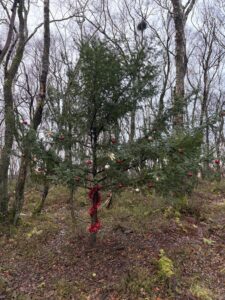
As we wander along the path by the railway line, we pass a spruce tree that somebody has decorated with baubles and tinsel. Against the barren birches and the leaf litter, it is a welcome moment of festive cheer. In the busy run up to Christmas, someone has taken time to make this gesture of community spirit. There is a strange sort of balance enacted by this tree. It somehow makes the broken windows less impactful.
In different ways, people will continue to mark this landscape. While the graffiti, public artworks, signage, and festive installations are all created for different reasons, by people with different relationships to the Moss, they are all part of this complex, multi-faceted site. I understand why Linsey is drawn to green spaces that are characterised by human inhabitations. Lenzie Moss is no wilderness: it is lived in, used, and loved. As I am discovering through this project, these human interventions create this place, as much as they take place within it.