… ‘field’ describes a place to learn from, to research, to draw from. (Suzanne Ewing, Introduction to Architecture and Field/Work)
Today’s walk starts with low, bright sunshine and cold, dry air. I forget that that my colleague Suzanne is bringing her dog with her, so when she steps off the train at the far end of the westbound platform, it is a lovely surprise to see Lina the black labrador by her side. Suzanne is a Professor of Architectural Criticism at the University of Edinburgh. I have enjoyed contributing to her postgraduate course on ‘Cities as Creative Sites’ at Edinburgh Futures Institute, as well as co-authoring a book chapter with her. Like me, Suzanne is interested in field work and has an incredible eye for the materials, patterns and spatial configurations that create places.
For the last two decades, Suzanne has worked at the Edinburgh School of Architecture and Landscape Architecture (ESALA), which she directed from 2016 to 2019. She teaches her students to attend carefully to the edges of things, the objects and lines that demark a place, the surfaces and marks that inscribe patterns on the landscape. Good architecture grows from these starting points and enters into a dialogue with them, rather than imposing a predetermined structure on a blank canvas. I am interested in Suzanne’s perspective on the architectures of the Moss.
I haven’t seen Suzanne for a couple of months, since she had a bad accident on her bike. Cycling home from work one day, she hit a pothole, tumbled face-first over the handlebars, and ended up in A&E with a cracked cheek bone. Suzanne doesn’t remember it happening, but she was helped, and looked after, by a group of people who were at the scene. Suzanne says she was lucky and is recovering well. I admire her optimism.
After some time off work, Suzanne has eased back into teaching and research. Today, she is in no rush and will head back to Edinburgh later to meet a friend for another walk. For Suzanne, the freedom and flexibility that academia can sometimes provide is key to the creative practice that she uses in her work, and teaches to her students. These walks round Lenzie Moss have brought this into focus for me – the benefits of wandering, exploring, talking and learning. This is the work of fieldwork.
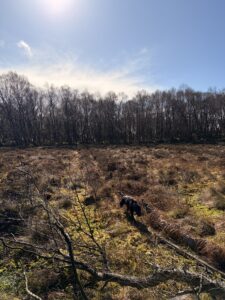
As we walk up Bea’s Path, the weather changes dramatically. Within minutes we are struggling through heavy snowfall. We pass several dog walkers, all of whom have been caught off guard. Luckily, we are in waterproofs and hats, although the snow quickly gives way to rain, and water runs down my jacket to soak my jeans. Lina is excitedly exploring this new place and jumps confidently into the large pools of water that have formed amongst the birch trees. Her muddy paw prints add another layer to my wet clothes.
We make our way along the north woods path, and by the time we reach the boardwalk, the sky has cleared again, and we are back in the sun. Suzanne talks about fieldwork and says that when she started studying architecture at the age of eighteen, their class took many trips. This cultivated a sensibility to the expanded field of an architectural site, and the work that might take place there. Suzanne has written that ‘fieldwork is a practice, not a discipline’.
At Lenzie Moss, Suzanne considers the bridges, dams, and enclosures that are now part of navigating the bog. She says that these features ‘inhabit its thicknesses’, by which I think she means that a certain quality emerges over time, which shapes the way that this site is used and perceived. In the boardwalk, the fences, the paths and the waterways, there is something of a taxonomy of architecture and material that ‘feels appropriate in its scale and deliberation’. Suzanne is interested in the tensions here between management and access, which are encapsulated in the anti-vandal painted fence posts that now stand ineffectively in the centre of the Moss. She wonders whether the various elements of this site become contested partly due to the intentionality that determines their placement.
Despite the sunlight casting birch shadows across the glowing sphagnum, it is still very cold. I am finding it hard to write notes on my rain-soaked paper and I give up after writing ‘cold hand’, almost illegibly. We pass a dam and Lina explores its wooden structure, which leads to one of the clearly visible desire lines that Stewart and I followed earlier this month – marking a connection to the south woods through the heather. Suzanne sees the fundamental building blocks of architecture in this arrangement of lines, edges, surfaces and materials. Where are the areas of stability? What kind of structures could be developed here? How does the field provide clues, offer suggestions, and open up an enquiry?
We arrive at the ruined buildings and I show Suzanne around. A couple of days after my walk with Stewart, I visited ESALA to talk about my Lenzie Moss project with some postgraduates. We also heard from architect and PhD student Adrian McNaught, who shared an experiment with materials left in the woods to be marked and shaped by the environment. It struck me that ruins work in the same way: co-created by the elements and the flora that take root in the cracks and openings. Suzanne and I explore the old peat plant – imagining its past uses and comparing its solid, enduring foundations to the more fleeting installations of the fencing and the dams.
We have time for a post-walk coffee, so return to Billingtons, only to find that the outdoor seating – that most temporary of architectures – has been stacked away. It is now a beautiful spring morning in Lenzie and it is hard to accept that there was a blizzard here just 45 minutes ago. We can’t go inside with Lina, especially now that she has brought half the bog back with her. So we head up the road to share a cafetiere in my kitchen. Lina meets Clyde, who has been patiently awaiting my return, and they play power games with a bone while Suzanne and I chat away.
My house, too, is part of the architecture of the bog. Reminiscent of the West End of Glasgow, which Suzanne and I both know well, these streets were created over 150 years ago (which I now know thanks to my walks with Eddie and Sophie). The new buildings and streets stabilised and fixed the edges of the Moss, and established a local population, who accompanied the flourishing and decline of the peatworks, and eventually fought for environmental protections and rights to access the site. We are still very much in the expanded field of Lenzie Moss and I entertain the thought that enjoying a cup of coffee with Suzanne in my kitchen is, in fact, still part of our fieldwork.
