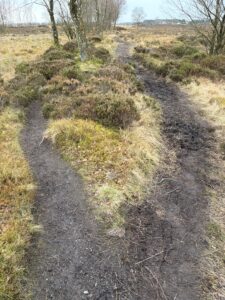
In every town and city today, cutting across parks and waste ground, you’ll see unofficial paths created by walkers who have abandoned the pavements and roads to take short cuts and make asides. (Robert Macfarlane, The Old Ways)
I meet Stewart on the high street and appreciate his energy right away. We set off at a quick pace, and our conversation matches our passage. Stewart grew up on the Isle of Arran, works in property development, and has lived in Lenzie with his family since 2018. His wife is from the town, and they now live in her old family home. They have three children at the local primary and secondary schools and relatives nearby – in Lenzie and Bishopbriggs. While Stewart occasionally walks their dog on the Moss, it isn’t a place that he spends much of his time, but he is enthusiastic about the chance to walk with me today and to think about the possible futures for this place.
Stewart’s thinking is shaped by a varied career, including ten years as a navy officer and several in a senior banking role, with RBS and Barclays. He is used to being part of and leading complex multi-partner projects. Now, in his current job, he is always thinking about chains and networks and management. What would it mean to manage the ‘project’ of Lenzie Moss differently?
Stewart tells me about the ‘dig once’ concept in urban planning, which encourages the integration of different workstreams. If a gas engineer is digging up a high street to replace pipes, then it makes sense for the telecommunications, electricity and draining projects to come together to use the opportunity to do their work at the same time. That makes a lot of sense, but it requires clear communication channels, effective databases and strong project management. Stewart suggests that these things might be missing here and that they may be key to navigating the multiple interests and requirements of the Moss – from broken benches to hydrological surveys to community access. Everyone needs to have ‘skin in the game’.
We also discuss the funding required to maintain a place like this. Local councils are under severe financial pressure at the moment, leading to increases in tax and difficult decisions about priorities. In the long term, there is no guarantee that the Moss will receive the same level of investment. But if I have learnt one thing about bogs over the last year, it is that they are always changing. As Jackie said to me at the start of the project, without continual conservation, homes could flood and fires could start; the site would quickly dry out and revert to scrub-land, and birch trees would take over.
Stewart mentions the plans for community ownership of Lenzie Public Hall, which I learnt about when I walked with Clare. For community-driven development projects like this, Stewart promotes pragmatism about sustaining the business. Leasing, corporate hires, philanthropy – all these could be key to sustaining the community groups and education activities that people want to see thrive. I think back to my time working at the Arches arts centre in Glasgow, which closed in 2015 after many years of large-scale club events supporting a vibrant artistic community and arts programme. I remember lots of tension between the different uses of the building; every new project involved a negotiation with the different programming teams about space and resources.
We leave the boardwalk and wander across the bog, following the well-established ‘desire path’ that skirts this side of the south woods path. Desire lines have been mentioned several times during this project. These are trails made by people or animals taking the most desirable route through a landscape and sometimes creating an ‘unofficial’ pathway through repeated footfall. In The Old Ways, Robert Macfarlane explains that these rough trails establish themselves and become part of the physical and cultural landscape.
There are examples of Scandinavian and North American landscape architecture responding to desire lines. Perhaps most famously, the Ohio State University paved the lines created by student’s repeated footfall over the years, modelling the network of new paths on the lines made by previous generations. It seems that this has happened on the Moss as well, as the relatively new boardwalk includes a short side route with steps down onto the main desire path – just at the point where Deirdre and I noticed the exposed root system, which I took as a metaphor for the entanglement of lines that comprise this project.
The Moss is criss-crossed with desire lines, which are most prominent in the woodland around edges of the bog. The newly erected fencing, placed at intervals along the central raised bank, is intended to prevent this practice from continuing into the centre of the site. Today, it would be difficult to circumvent these structures due to the wetness of the mire. But in very icy or very hot weather, it would be possible to simply walk around them. Elsewhere on the Moss, when barriers are put in place, desire paths form as routes meander round pools and fences. We follow the unofficial lines through the wood to return to the main path, which takes us back to the station carpark.
As we walk up Kirkintilloch Road together, Stewart offers more examples of planning and infrastructure projects, which have shaped his approach to site development and long-term planning. From navy boat docking to aeroplane engineering, medical bookings to large-scale tourist events: Stewart pays close attention to how systems work and applies this thinking to the Moss, too.
What else could Lenzie Moss be used for? What are the alternative funding streams that haven’t yet been considered? How can the different users be brought together to work towards the same goals? How should such coordination be managed? Stewart suggests that we need to ask such questions here. He implies that the Moss would benefit from more ambitious and radical plans. He talks about the importance of listening to the ‘voice of the customer’. By bringing together what the different groups – such as conservationists, dog walkers, and families – actually want, we can define the ‘so what’ and the ‘why’. This would allow the Moss to develop in a way that is intertwined with its users, rather than treating different needs as ‘parallel pillars’.
Just before we go our separate ways, Stewart mentions that his perspective and his way of talking about community spaces isn’t always welcome. To bring a property developer into the room is often to disrupt established approaches; to set a cat amongst the pigeons. I can see how some of Stewart’s terms, questions and suggestions could run counter to the slow, careful conservation that is often preferred for the Moss. But my own thinking about the site has been challenged today and I have valued the many examples and analogies that Stewart has shared with me. Thinking differently about the Moss might be just what is required for more ‘customers’ to invest in its future. Perhaps this is how new desire lines are formed?