It is the last day of the year, and I am walking with four-year-old Minnie and her mum, Jenni. Jenni and I were in the same tutorial group when we started university in 2000, and we have stayed close friends ever since. We have been in each other’s lives for quarter of a century now, which is both amazing and alarming. We are all spending Hogmanay with James and Annabel and their family in Bishopbriggs, but there is just enough time for a walk round the Moss before the festivities begin.
We would have had longer, but shortly after Minnie and Jenni left their home in Galashiels in the Scottish Borders, their car broke down. Thankfully, after the AA and Jenni’s mum came to the rescue, they made it to Lenzie shortly before sunset. We set off quickly, keen to complete our circle while we can still see the paths. Minnie loves being outside and she is full of energy and excitement, which seems only to have increased after four hours in the car (much of which was spent happily watching films on her mum’s phone).
As we walk up Bea’s Path, Minnie sets the pace. She alternates between slow motion and hyperspeed, as only a preschooler can. I am called to action, ‘Come on, Uncle Dave!’ While 95% of people in my life now call me David, there is a small proportion of my oldest friends, who have resolutely stuck with Dave. These people indoctrinate their children so that I will never be fully free of my diminutive past.
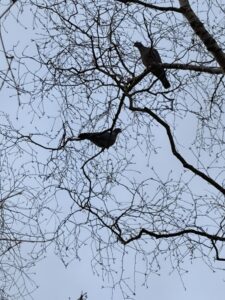
I teach Minnie Ruairidh’s ‘Moss animal game’ and she enjoys picking out the imposters from our sets of bog inhabitants: a fox, a hedgehog and a giraffe; a pigeon, a hippopotamus and a deer. We don’t see the latter today, but there are plenty of pigeons nesting in the bare branches, which Minnie is keen for me to photograph. Minnie stops to crunch the ice with her wellies.
Next week, Minnie will start full time at nursery, where she will spend two full days of each week outside. I tell Jenni how much Iona got out of her time at an outdoor nursery, and I remember my recent chat with Brian about the Residential Outdoor Education Bill. As a primary head teacher, Jenni is well versed in the shifts and turns of Scottish education policy. It has been interesting to discover that there are connections in our work on interdisciplinary learning and teaching.
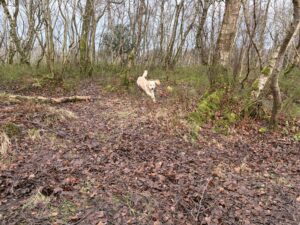
Minnie wants to race, so I sprint alongside her on the north woods path, maintaining a strategic second place. The race evolves and Jenni joins in too. We hop, jump and skip along. Each time we pass a bench, Minnie demonstrates her gymnastic skills and uses them as balance beams. We pass the bin by Heather Drive, which is overflowing with coffee cups and dog poo bags. The service has paused for the holiday, which highlights how regularly this site needs to be cleared, and how well-looked after it usually is. Minnie asks me why I am photographing a bin.
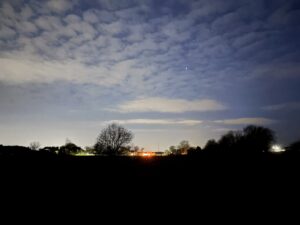
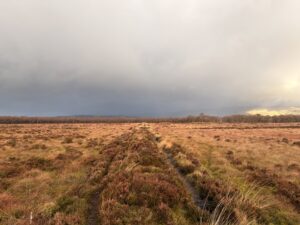
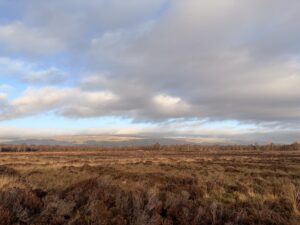
Minnie picks moor-grass and pokes me with it. I retaliate and we battle with grass swords. In the final moments of daylight, an otherworldly atmosphere descends on the Moss. The moon shines brightly above the mire and shadows move in amongst the trees. Minnie picks up on this and says she is scared, but an encouraging word from her mum soon sets her mind at ease. We watch the lights appear on the urban horizon to the west and we look out across the heather, and I think how ideal the conditions would be for a sighting of the ghostly lights of a will-o’-the-wisp, dancing across the bog.
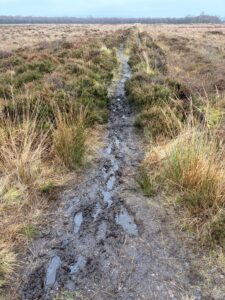
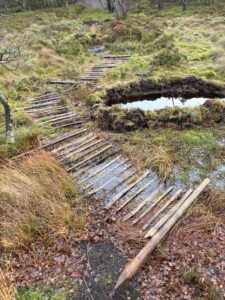
And then, Minnie falls over. I am leading the way along the muddy path, and I miss the moment it happens. When I turn back, she is being lifted out of a puddle, and her hands and knees are covered in black muck. Minnie is not happy. The next ten minutes are focussed on consoling her. We follow the meandering pathway through the trees, and Jenni has to carry her distraught child. I lead the way, directing her round boggy areas and looking for the easiest route back to the main path.
Jenni finally has some success when she tells Minnie that she can wipe her hands on her mum. I also offer up my hat, which is refused at first, but later it helps to lift her spirits again. Little by little, Minnie cheers up. But she is upset that she will have to change her favourite dress, chosen specifically for the new year’s celebrations. As we emerge from the woodland, Jenni has mud smeared across her face like a camouflaged soldier.
Back at my house, Jenni gets Minnie cleaned up and changed, while I load the car with bottles and boxes. Tonight, we will eat together, play games with the children, watch television, drink champagne, welcome in the new year in good company.
Last Hogmanay, Jenni and Minnie joined me and my children in the Lake District, and we jumped into the new year together – a Danish tradition that I learned from my brother-in-law, which requires standing on chairs and leaping off into a prosperous future. Jenni and I have decided we will do this every year. I like the positivity, the energy, and the action of meeting any new experiences that the coming year might bring.
Since I leapt into 2025 with Jenni, the year has brought me many things, and among the most valuable have been the 34 walks that I have completed round Lenzie Moss. I have walked with friends, family, neighbours, ecologists, scientists, artists, writers, and I have met several new people from the local area. I have circled the Moss in summer, autumn and winter; early in the morning and late at night. I have come to know this place well and I have learnt a lot from its pathways and its peat bog, and from the stories of the people who live and work here. I am happy to be bringing this year to an end by sharing this place with my old friend and her wonderful little girl.