Any views expressed within media held on this service are those of the contributors, should not be taken as approved or endorsed by the University, and do not necessarily reflect the views of the University in respect of any particular issue.
Do you need help with your research? Have you got yourself into a muddle using legal resources online? Do you just need to know what you need to know?
Book a one-to-one meeting with our Law Librarian team to discuss your research issues or library problems. In previous one-to-ones we’ve helped students with:
search strategies
using our subscription databases
finding international case law
finding historical Scots material online (specifically the Institutional Writers)
referencing (specifically using OSCOLA)
setting up news alerts for cases or legislation
We arrange appointments once a fortnight using the MyEd booking system. Search for “Literature search clinic” and select the Law specific event, or search for “Law” and select provider group “IS Library and University Collections” to find all our Law related training. Future dates include:
19th January
9th February
23rd February
1st March
15th March
30th March
13th April
4th May
Please note: due to our current staffing situation these appointments are all on Wednesdays and Thursdays. If you require a different day please get in touch.
We release appointments approximately three weeks before each scheduled date. This semester we’re trialling a combination of online and in-person appointments so when you book feel free to contact us to discuss how you would prefer to meet. If you cannot see an available meeting slot that suits you please email law.librarian@ed.ac.uk and we will find a suitable time.
For those rejoining us in January for Semester Two, welcome back! For those who are new to the Law School or just this blog, welcome! This is where we report news, updates and offer tips for training in library resources. The blog is currently written by SarahLouise, the Law Librarian who works Wednesdays to Fridays, as we have a vacancy for the other half of the post. We hope to have a new Law Librarian joining the team over the next few months and will introduce them when they start!
We’ve received quite a few queries about locating some key resources for research and study over the last few months so we wanted to clarify how best to access these. First up, the Stair Memorial Encyclopaedia. This is a resource which is core for our undergraduate students as they get to grips with Scots Law. We do have instructions listed on the Law Databases Help & Training page under ‘Resources for Scottish Legal System’, but we wanted to add some screenshots here for the visual learners.
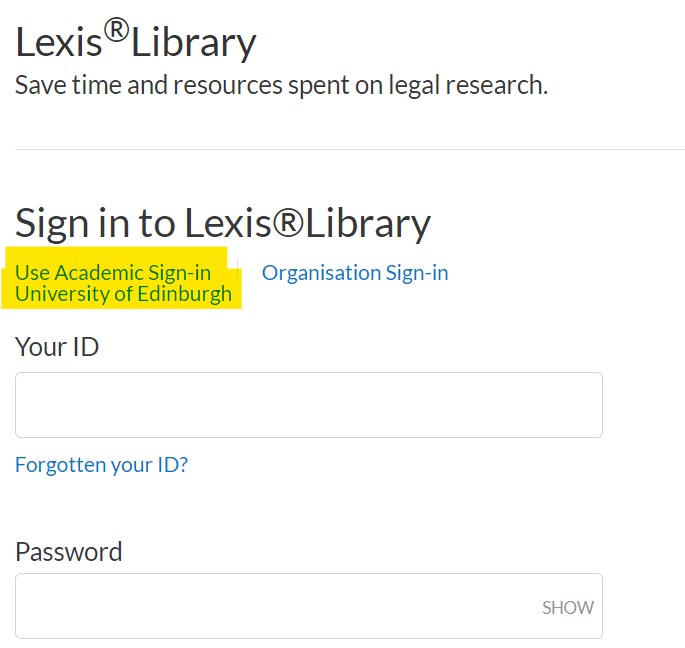
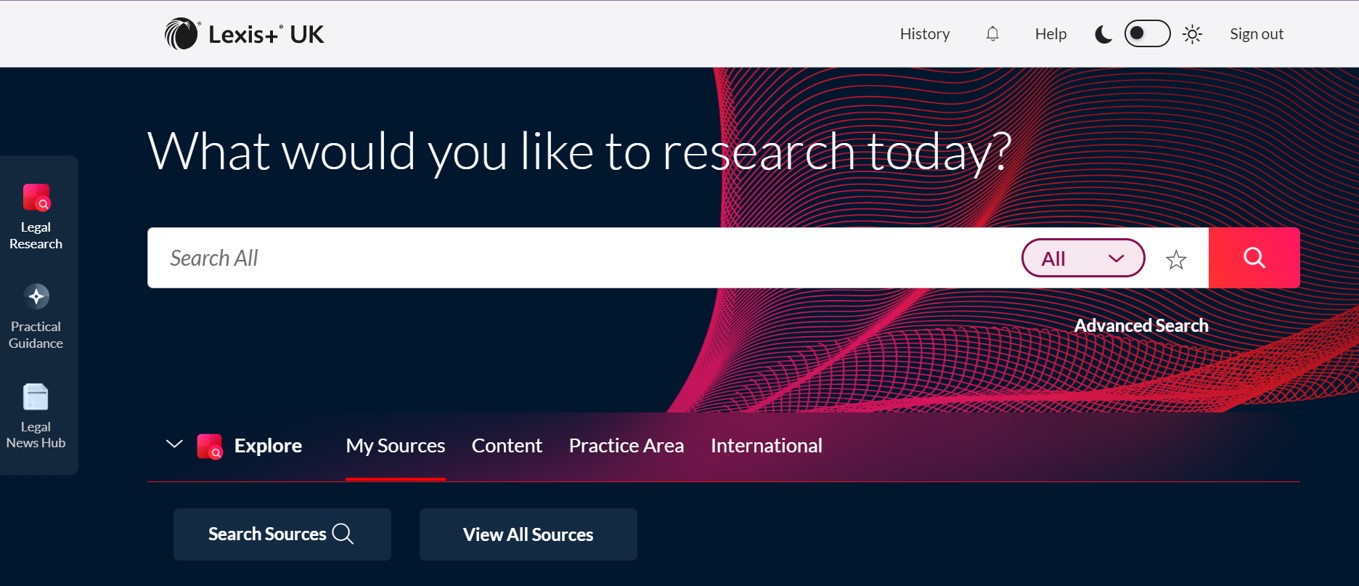
To log in toLexis+, you will need to select ‘academic log in’. You may then be presented with a dropdown box to select ‘UK Access Federation’. Select ‘University of Edinburgh’ from the list, and you will be logged in. Alternatively you may have the option to select ‘University of Edinburgh from the front page – do this if available!
You may be asked to log in with your UUN at this stage if you’re not on-campus. Use your usual student ID and password.
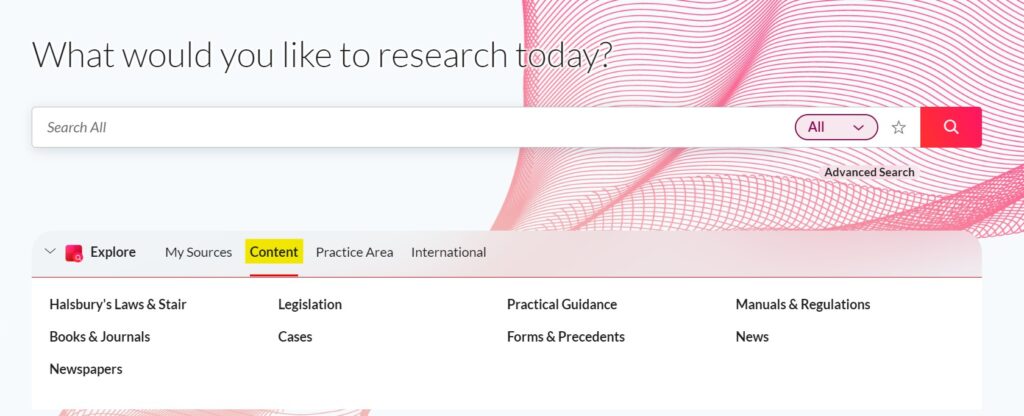
In the middle panel in the centre of the page, select ‘content’ from the navigation menu.
The resource will be one of the first items listed as ‘Halsburys Laws and Stair’. Click this.
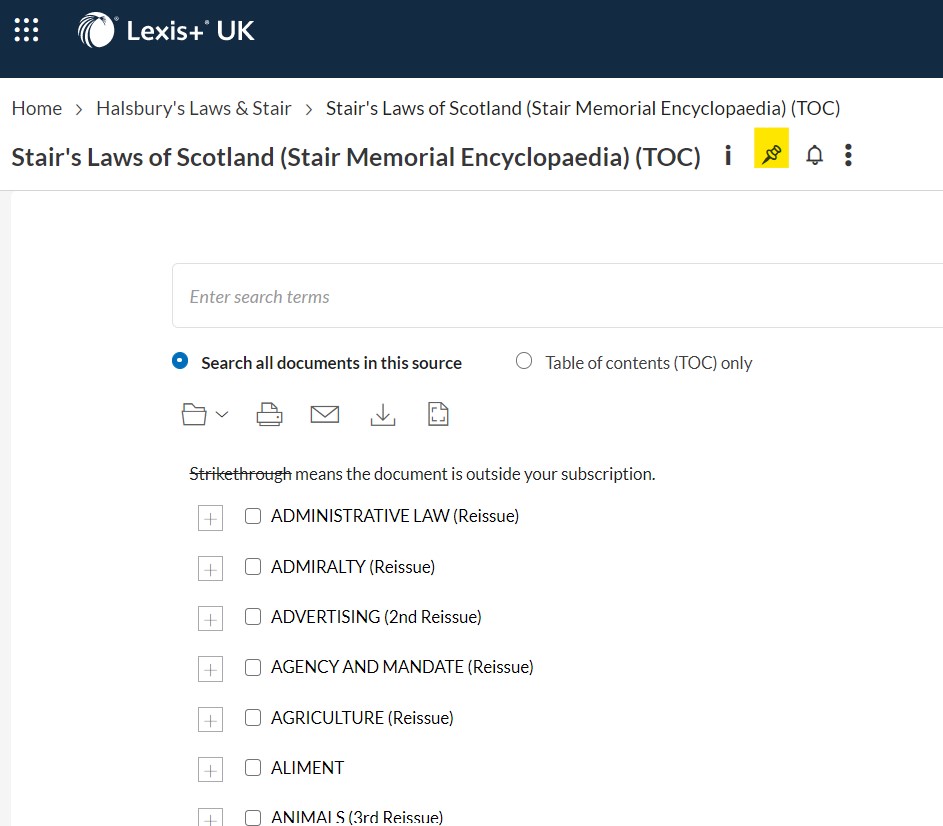
Then you will see a link to Stair Memorial Encyclopaedia. Click the title, and use the plus and minus boxes to navigate through to find the section you need.
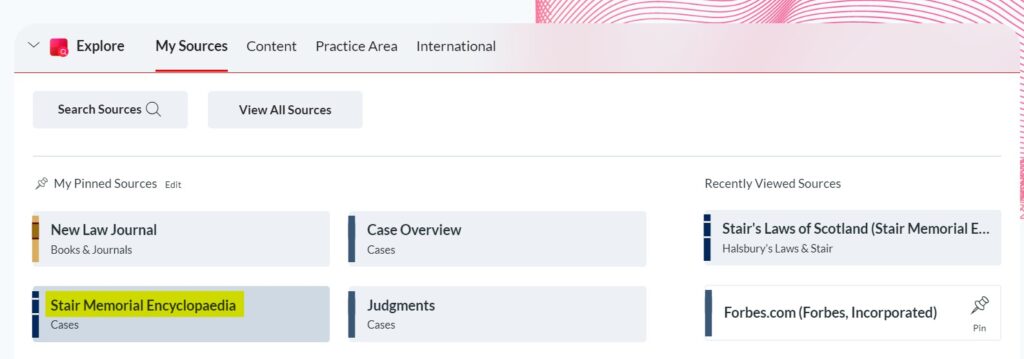
If you want to, use the pushpin icon near the title to add this to your pinned sources. This bookmarking tool means that a shortcut will appear under ‘My Sources’ on the main panel when you log in to Lexis in future, which will save you a few steps.
We hope this is helpful. If you have a resource you’d like a little more advice on accessing, please let us know by email (law.librarian@ed.ac.uk) or by commenting on this post.
Working in the Law Library today has been like night and day since the study space scramble of last week, and that’s because most students have now finished up for the term and are beginning their winter breaks. The Law Library is still open until 4.50pm tomorrow (Thursday 22nd December), and we will then close our doors until Wednesday 4th January 2022. If you are studying or conducting research over the winter break you will find our online resources remain accessible via the usual channels, but should you run into difficulties we will not be able to respond to any messages until we return in January. Alternatively the Main Library is available during the holidays, you can find out more on their page on the website.
It’s been a bit of a tricky year in the land of Law Libraries as we’ve been short staffed for much of Semester One both on the Helpdesk and in the Academic Support Librarian team. We appreciate your patience while we do what we can in the time available, and look forward to Semester Two where we hope we’ll be back up to a full complement before too long.
We wish you a pleasant and restful winter break and hope for your health and happiness during your time away from the University. See you next Semester!
You may have seen that we’ve featured LexisNexis quite a lot on the blog this semester, due to the launch of their new platform, Lexis+. We’ve provided a fair bit of information about how to access items and how to get further training, but one person we have yet to mention is your Student Associate, Olivia Riddell. Lexis employ Olivia to provide peer support for students at the University of Edinburgh who want to work with Lexis and use it for their studies or research. We had a quick word with her to ask her more about what her role entails:
Tell us a little bit about yourself! Who are you and what do you study at Edinburgh?
My name is Olivia, and I am a fourth-year law student at Edinburgh. I am from the North of England but wanted to study at Edinburgh as a bid to broaden my horizons. It has been nice to experience the quieter life and scenery that Scotland offers before accessing work opportunities in the City.
Why did you apply to be the student representative for LexisNexis?
I wanted to have experience related to law. My previous experience working in retail taught me soft skills and resilience, but this role has truly developed other areas needed in a professional capacity such as marketing strategies, proactiveness and negotiations. This is especially necessary if students want to harness their skills in preparation for a role requiring good capacity of leadership and business relations. It also challenges me personally. For example, it has improved my confidence (in reaching out to students, and teaching sessions) and stretched my ability to form professional networks with students in the law school, and with faculty staff.
What do you think is the best feature that Lexis offers for students in the Law School?
The ability to type in key words and find related journal articles and added references for essays. It enables you to find related sources that have an affinity with your argument or essay title meaning your assignment will be much stronger based on accuracy and relevancy.
When students book a training session with you, what can they expect to get from the meeting?
There are different types of sessions. I will be organising certification sessions (Foundation and Advanced) which will enhance your professional profile and experience. These downloadable and professional certificates will make you stand out, and you can showcase these on LinkedIn. In addition, I will be running assignment training in December 2022 and Easter 2023 to ensure you know how to use LexisNexis to help in your upcoming assignments. In semester two, I will also be conducting commercial awareness sessions in 2023 to help with future internship and vacation scheme placement applications, and how you can access such material on the LexisNexis site.
You can reach Olivia by email with any queries or training requests: s1925406@ed.ac.uk.
If you need help with any other databases or would like to discuss other available training please let the law librarian team know by email: law.librarian@ed.ac.uk.
One of the most common concerns for Law students at this time of year is finding study spaces in the library to help them get ready for assignments and exams. We know the Law Library is a favourite place to study, so here are some ways we’re trying to help manage during peak periods.
EXTRA STUDY SPACES:
Library Services book out other rooms in the University to help meet demand for study spaces during the revision and exam period. The spaces closest to the Law Library are the MacLaren Stuart and Quad Teaching rooms in Old College, and there are helpful signs pointing the way to these at the entrance to the Law Library:
G.158 Quad Teaching Room (seminar room, 15 seats) and G.159 MacLaren Stuart Room (large classroom, 55 seats) Open daily from Saturday 3 December to Wednesday 21 December.
Opening hours as per Law Library opening hours: Monday to Thursday 09:00-21:50 ; Friday 09:00 to 18:50; Saturday 09:00 to 16:50 ; Sunday 12:00 to 18:50 on 4, 11, 18 December.
There are also temporary additional study spaces open at the Main Library and 40 George Square for study and revision; details can be found of these and many other study spaces across campus on the Study Spaces part of the website.
More information about opening hours for the Law Library specifically over the festive period can be found on the Law Library pages of the Library website. Please note that there are extended opening hours on Sundays in December (on 4th, 11th or 18th) until 18.50. Usual Sunday opening hours (open until 16.50) will resume in January.
STUDY MONITOR:
We’ve asked our student staff to work as study monitors from Monday 12th to Friday 16th December. They will be helping students find spaces, take counts and to monitor how the study space cards are being used.
STUDY BREAK CARDS:
Cards are situated around the library that can be used to keep your space while you take a short break. Turn the card to 15 minutes for a Short Break or fill out the time you intend to be away from your desk for longer breaks like lunch (up to one hour). This scheme has been shown to encourage healthy study patterns and help utilise the space we have available. We’ve used this system in the Law Library in the past and it’s gotten great feedback, so much so that it’s been extended to other libraries in our network.
RESERVE COLLECTION DESIGNATED DESKS (NEW):
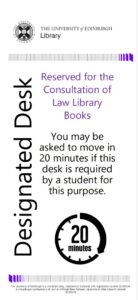
One of the concerns we’ve heard from students is that at peak times there’s nowhere to consult Reserve (3-hour loan) materials as it’s impractical to take these items far from the library for use. We listened and are now trialling a system where the 18 desks nearest the Reserve collection on the ground floor are Designated Desks in order to use materials from the Law Library specifically. If students require use of these desks they should alert Helpdesk staff who will put out a call for those not using Law Library collections to vacate this bank of desks within 20 minutes. Signs indicating this procedure are posted on these desks.
We believe this is a compromise that can work for students who need to use materials held specifically in this library without limiting who can work and study in the space. We understand Law students can feel that they should be prioritised when it comes to space in the Law Library, however the Law Library is part of a network of 13 site libraries – including the Main Library, which also houses high use law books – and limiting access to one of these is neither possible nor fair. Law students also benefit from being able to use any of the campus library facilities – for example, did you know that the new KB nucleus is directly connected to the Murray Library and is open to everyone (including Law students)?
While we can appreciate the issues with finding space in the Law Library we find it a great compliment that so many students want to study with us. We are limited in the number of seats available but we hope you’ll understand we’re doing what we can to maintain a pleasant and peaceful study environment; the fantastic Helpdesk team are always on hand to assist where they can.
If you have queries or want to speak to someone directly about our libraries and collections, you can contact us by email: law.librarian@ed.ac.uk. We’d love to hear from you.
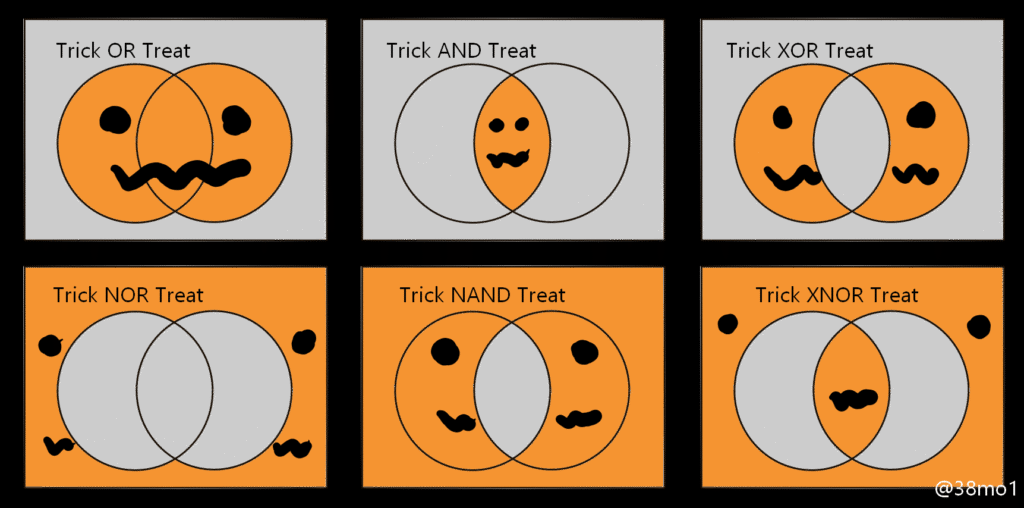
We know Hallowe’en was last week, but saw this on Twitter and it’s too good not to share! If you’ve ever wondered what library staff (and mathematicians and engineers and many other professions) talk about when they mention Boolean operators or logic gates, this handy infographic from @38mo1 may help!
Traditionally search engines and databases used Boolean operators along with keywords to help you search more constructively. Some (like Google) now accept natural language searching, but many academic or technical databases still require you to search in this format.
For example, if you search on DiscoverEd:
“Property Law” OR Servitudes: 70,745 results.
“Property Law” NOT Servitudes: 57,500 results.
“Property Law” AND Servitudes: 154 results.
Those little connecting words can make all the difference!
You may remember last week we posted a reminder about the Lexis+ training we had scheduled. That training took place yesterday and those that attended found it very helpful, so we’re putting the recording and information about how to get certified with LexisNexis up here too.
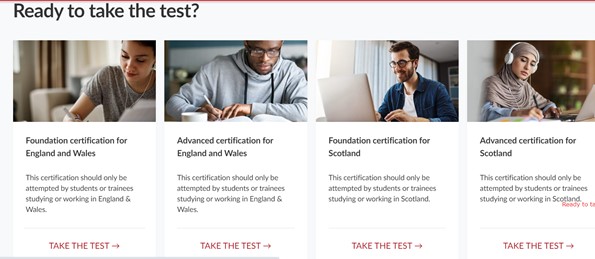
LexisNexis offers four levels of certification for students in the UK – Foundation level for England and Wales, Foundation level for Scotland, Advanced level for England and Wales, Advanced level for Scotland. Our students can pick whichever is the most relevant for them, or complete all of them if they want to collect the set!
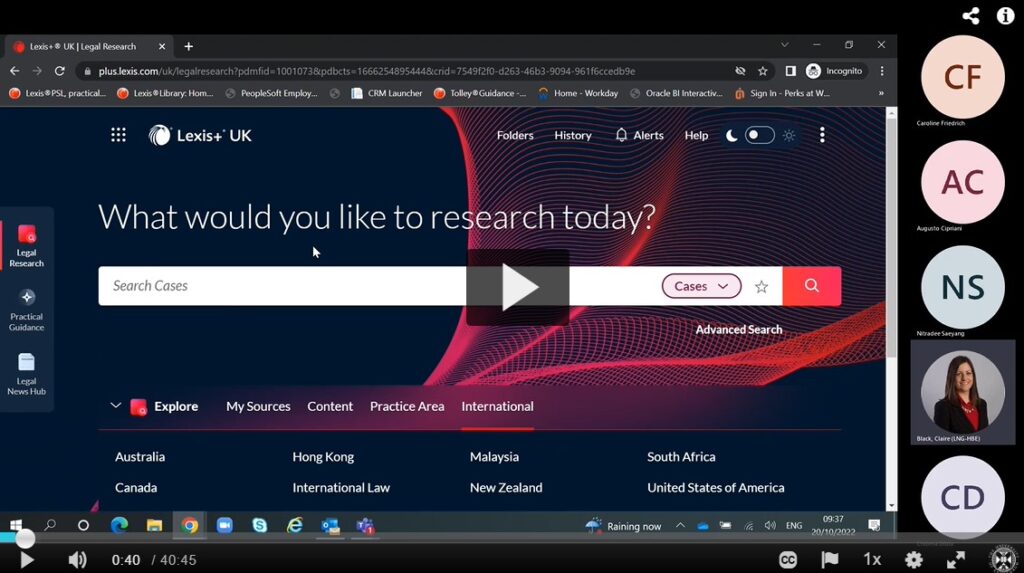
First, you’ll need to watch the Foundation level training video (recorded yesterday by Claire Black of Lexis UK). You can find that on our Media Hopper Channel or by clicking the image below.
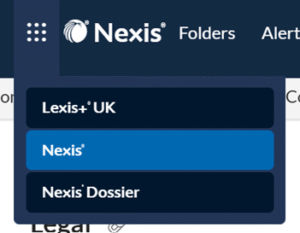
Next you will need to log in to Lexis+. The best way to do this is using the link on the Law databases page; it currently says ‘LexisLibrary’ but I’m in the process of getting that updated to Lexis+. If when you’re logged in you arrive at the screen that says ‘Nexis’ at the top of the page, click the nine dots in a square next to the Lexis logo, and you should be able to click ‘Lexis+ UK’ instead.
Then Claire has provided the following instructions:
Make sure you are logged in to Lexis+ through the University – you will need to use the site to answer the questions.
Register your details – your choice whether to choose university or personal email. It gives you access thereafter if you need to retake the test or want to do other certifications. Course end date is the date you intend to graduate.
Once registered, scroll down the page to where it says ‘Get Certified’ and choose Lexis+ UK Legal Research Certification (there is the option for the Practical Guidance one, but given access to practice areas can vary, it’s probably safer to stick to research)
You will then see a page which lists 6 steps to being certified. Scroll past this to the bottom and there are 4 options: Foundation and Advanced Certifications for either England and Wales, or Scotland.
You will then enter your email address (which allows you to come back later and will allow you to retake the test if necessary)
15 multiple choice questions which are completely randomised. 13/15 correct to pass. You must use Lexis+ to answer the questions.
You can take the test as many times as you need to pass.
Certificate will be emailed to you upon passing within 24 hours.
Our thanks to Claire and all at Lexis for making sure our students are well trained and well prepared for legal research! Good luck to anyone choosing to take one of the Certification tests. If you encounter any issues please let us know on law.librarian@ed.ac.uk.
We’ve got a training day for the new Lexis+ database coming up which we highly recommend for students of all levels. The new platform from Lexis replaces LexisLibrary and LexisPSL so it’s well worth getting to know, whether you’ll be using databases for assignments, dissertations, research or as a legal practitioner. In each of these sessions Lexis trainer Claire will take attendees through training and tips for using the platform at either foundation or advanced level.
If you book the 10.30am or 2pm slot you will also gain the chance to sit your Lexis Certification test, which means you will gain a certificate perfect to put on your CV – future employers will be impressed if you come to them with certified research skills!
Book using the links below or search for ‘Lexis+’ on the MyEd Events Booking system.
If you can’t make the sessions but still require help using the Lexis+ database, you can view our video (38 mins) recorded by Lexis trainer Claire specifically for our Diploma students. It provides a great all-round view of the database and where to find key items.
Please contact SarahLouise onlaw.librarian@ed.ac.ukif you have any questions or concerns about the live sessions or getting help with any of our databases.
If you read our last post, you’ll have heard all about the top information we like our students to have early in the semester; about inductions and key resources we want to make sure you can access. Now we’re a few weeks in we’ve had some more questions about what we have coming up next.
We have made up two documents here (one for undergraduate students, one for postgraduate students) which outlines the key training events we’ll be offering during 2022/23. This includes some law specific materials and some training that is open to all UoE students. Click on the documents below to download the PDF you need:
We’ll write more about specific training sessions nearer each event but in the mean time we hope this is useful. If you want to get in touch to discuss any library or research related questions, you can always reach us via law.librarian@ed.ac.uk.
Hello, and if this is your first time visiting the Law Librarian Blog, we’re glad you made it! This is where we post updates about training, resources, library access and anything else we think you might need to know. We hope you’ll find the blog a useful place throughout the year.
So welcome week has come and gone already and we’re straight into Week One of teaching. We’ve been busy running induction sessions for student at all levels but don’t worry if you missed out, recordings of all online sessions have been uploaded to ourMedia Hopper channel:
We completely understand the first few weeks of a new academic year are swamped with information, and it’s probable that you’ll have too much to take in for now. However if you bookmark this page or these resources we hope they’ll be useful when you need them. If you have questions please feel free to get in touch at any time by leaving a comment or emailing us directly: law.librarian@ed.ac.uk.