
“It doesn’t seem that long, but mirrors argue otherwise”
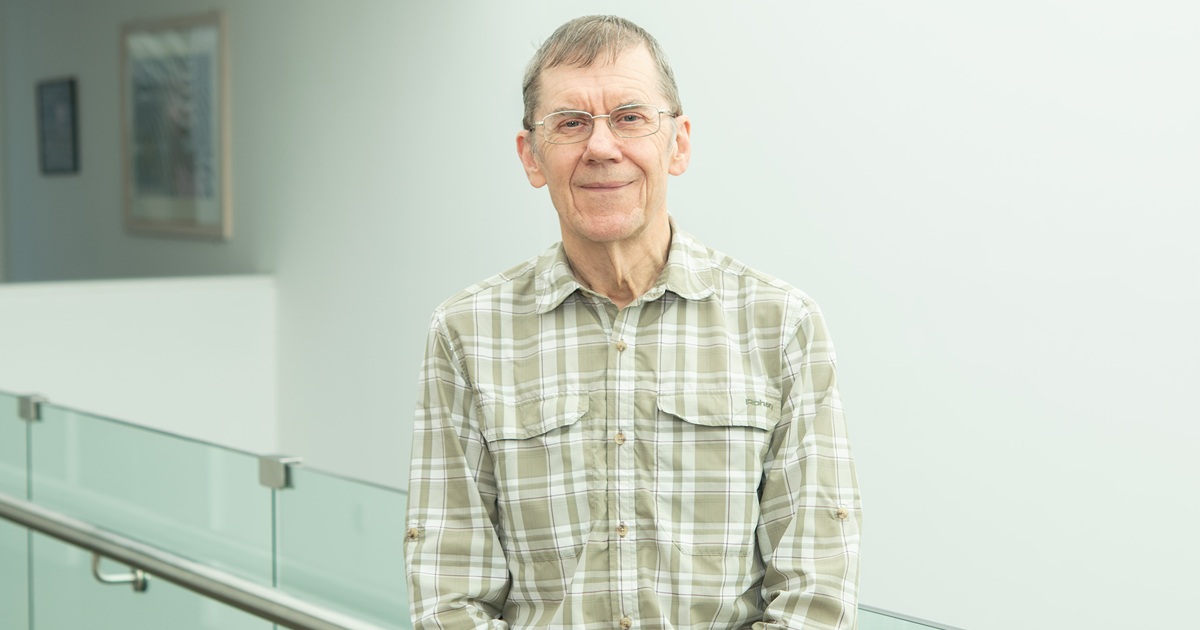
Dr Chris Boyd is retiring after starting work at the University of Edinburgh 40 years ago.
He started working independently in the Molecular Biology department in 1986 on small plasmid mobilisation systems in E coli.
Despite good progress in establishing a one-person lab from scratch, building on related studies carried out as my first postdoc post with David Sherratt in Glasgow, attempts to consolidate a career there were unsuccessful, so I made the strategic decision to switch from prokaryotic to eukaryotic research.
He moved to David Porteous’ group in the MRC Human Genetics Unit where in 1990 he started on a project to manipulate mammalian cell genomes by recombinatorial methods.
In those pre-CRISPR days, this turned out to be trickier than expected, but it did provide much-needed training in eukaryotic cell biology techniques.
It took a while to adapt to working with mammalian rather than bacterial systems and to carve out a niche that best suited me.
In 1996, he made the decisive switch to translational research when he joined David’s cystic fibrosis (CF) group – the first of several significant changes over a five-year period.
The next consequential change occurred in 1999, when the CF group moved to the Centre for Molecular Medicine which later became the Centre for Genomic and Experimental Medicine (CGEM).
Shortly afterwards, as a reward for running a successful gene therapy trial, the CF group became one of the Edinburgh partners – along with Gerry McLachlan’s group in the Roslin Institute – of the UK CF Gene Therapy Consortium (GTC) led by Eric Alton in Imperial College.
The GTC’s mission was to accelerate the realisation of clinical gene therapy for CF by combining the proven translational expertise of groups from Edinburgh, Oxford and Imperial College. As a result, the Porteous CF group put aside vector development in favour of milestone-led projects such as assessing methodologies for improving gene transfer efficiency and developing immunoassays for detecting transgenic human CFTR expression.
In 2002, he joined the Strategy Group (SG) – the GTC’s executive committee, a role that was to take up an increasing proportion of his time, with regular day trips to South Kensington for face-to-face meetings until COVID restrictions introduced the merits of Teams meetings.
In the mid-2000s he became the Principal Investigator of the CF group. It took until 2012 for the GTC to complete preclinical and toxicological studies enabling use to test its DNA/liposome formulation in a placebo-controlled Phase I/IIa multidose clinical trial involving over 100 people with CF.
Although the nonviral formulation proved safe and moderately effective, it was decided not to pursue it further. Instead, the GTC prioritised developing a novel lentiviral vector, rSIV.F/HN, which was more efficient at delivering genes to airway cells and capable of being administered repeatedly in vivo without loss of expression.
The high cost of making clinical-grade rSIV.F/HN for a lentiviral clinical trial for CF meant that only a commercial partnership could fund the later preclinical and clinical stages of the translational programme.
The SG therefore spent much time pitching the proposed project to big pharma, and eventually secured a partnership with Boehringer Ingelheim (BI) and Oxford Biomedica in 2019. The CFTR-encoding vector was exclusively licensed to BI in 2023 for further preclinical and clinical development.
In the meantime, Chris was also co-PI on a Wellcome Trust Portfolio grant awarded to the GTC for exploring the potential of the rSIV.F/HN platform for treating other lung conditions.
We in Edinburgh opted to take on the challenging goal of developing gene therapeutics for Idiopathic Pulmonary Fibrosis (IPF), a fatal, non-genetic lung condition with a largely unmet clinical need. We made rSIV.F/HN derivatives encoding DCN, an antifibrotic gene and TRIM72, an alveolar repair gene, which we showed were able to express transgene proteins in transduced lung cell models.
My colleague Gerry is optimising an IPF sheep model which we will use to assess efficacy. More recently we have been screening for novel vectorisable IPF targets with the help of the IGC imaging and drug discovery facilities.
With lab work essentially halted during the COVID lockdowns, and with the WT money running out, the SG embarked on a major drive to pitch the non-CF applications of rSIV.F/HN to several dozen private funders and pharmaceutical companies.
This all paid off in 2023, when the SG founded a spin-out company, AlveoGene, to achieve our aims. However, the seed money was strictly limited to developing the most advanced of the GTC’s portfolio targets, alpha-1 antitrypsin deficiency, so I had to support IPF work piecemeal using limited funds from charities, grant underspends and similar sources.
Unfortunately, acquiring follow-on private funding for AlveoGene has proved extremely difficult in these chaotic economic times, and although the SG has good reason to expect a term sheet later this year, I made the decision last year to retire in 2026 and hand the IPF reins over to the capable hands of Gerry at the Roslin Institute.
Looking back at his long career, Chris says his most significant scientific achievement was being part of the GTC team which conducted the largest ever gene therapy trial for CF gene therapy, split between the Western General and Royal Brompton hospitals.
I was responsible for managing the scientific aspects of the trial’s Edinburgh arm, necessitating close interactions with the NHS CF clinical teams in the Western General and Sick Kids hospitals.
I’m proud also to have served for ten years on the research advisory committee of the CF Trust, during which time I reviewed and assessed hundreds of grant applications and helped shape the research strategy of the Trust.
Scientifically, I have seen the advent and tremendous impact of transgenic animals, PCR, NGS, monoclonal antibodies, iPSCs, gene editing, kits for everything and bioinformatics, technological advances which enormously extended the reach and depth of cell and molecular biology research and incidentally helped to make gene therapy a clinical reality in several domains.
To take one example, a plasmid can be fully sequenced commercially in hours for a trivial sum, and a cDNA completely synthesized for a few hundred pounds.
Outside of his scientific work, he has seen the Western General Hospital campus grow from one to three institutes before recombining as the IGC of today.
Other highlights of his career include a moment in the mid-2010s when they unblinded the data from the multidose trial to find a statistically significant stabilisation of lung function in treated subjects compared to placebo controls whose lung function declined.
Great joy and relief all round! Although we’d hoped for an improvement in function, it was still a key result showing for the first time that gene therapy by complementation was capable of beneficially modifying lung function in people with CF.
Another highlight came from a long-term collaboration with David Sheppard, an expert electrophysiologist at the University of Bristol. Our goal was to characterise chimeras of human and mouse CFTR protein, constructed in my lab to pinpoint regions responsible for electrophysiological differences between the native proteins. It was satisfying to make an impact in CF research unrelated to gene therapy and I was glad to be the senior author on the PNAS paper describing this work.
Over the years, he has given many talks at meetings – including a plenary at the European CF Society meeting in Genoa in 2002, which he describes as “a daunting but rewarding experience in front of such a large audience”.
He has also taught undergraduates throughout his career, and particularly enjoyed giving an annual introductory lecture on CF and gene therapy to first year Biomedical Sciences students in the steeply-banked and historic Anatomy Lecture Theatre at Teviot.
Fortunately there was no need to carry out live surgical procedures as had been the custom in the past.
In addition, as organiser and chair of the monthly CGEM work-in-progress talks, he enjoyed seeing many talented young scientists honing their presentation skills.
He won’t miss the regular funding crises that are part and parcel of academic life, but says these are on the whole balanced by the “glows of joy felt after receiving grant award letters”.
And while he won’t be leaving science behind completely – with plans to maintain his links with Gerry and a couple of other collaborations as well as his advisory roles with AlveoGene and the GTC – he is looking forward to spending more time on his many existing interests ranging from solving and compiling cryptic crosswords to exotic travel.
There are still weird and wonderful lifeforms in remote corners of the world that my partner Elaine and I have yet to visit, geopolitical events permitting. I will probably also develop new obsessions, but no concrete plans at the moment.

Share


Best wishes for your retirement, Chris. I wonder if you knew my father in the Molecular Biology Group, back in the day? https://thinking.is.ed.ac.uk/melissa/2016/07/31/dr-peter-highton/
Thanks and yes, I knew Peter — have sent you an email.