

‘Bone’ Voyage – Professor of Rheumatology Stuart Ralston retires after 50 years

Having moved into his eighth decade, Professor of Rheumatology Stuart Ralston is taking flexible retirement but he has no immediate plans to slow down.
His office desk, on the third floor of the North Building at the Institute of Genetics and Cancer (IGC), is littered with papers and books he has contributed to, including Davidson’s Principles and Practice of Medicine of which he is editor.
As part of a promotional tour for a new edition of this text, he is looking forward to a trip to India.
The new edition is due to be published in April and the publishers usually organise a promotional tour of medical colleges across India. This is hard work but a lot of fun as you get the opportunity to meet the medical students and sign copies of their book.
And in early 2027, after the Indian trip, he is planning to go to Patagonia for a holiday with his wife and friends.
I enjoy travelling. I have travelled a lot with work. I have been to India five times, the USA, Europe, Hong Kong, China, Australia and New Zealand, but I have never been to South America which is one of the reasons for going to Patagonia and maybe Chile.
Meanwhile, he has several studies to write up from an advanced investigator grant awarded by the European Research Council; is chair of the Board of Trustees at the Paget’s Association; sits on two Expert Advisory Groups on Gastroenterology, Rheumatology, Immunology and Dermatology and on Medicines for Women’s Health; and is Co-Chair of the Board of Trustees at Pregnancy Associated Osteoporosis UK.
His CV is 45 pages long and lists more than 125 peer-reviewed original research articles; numerous research grants; his membership of 13 learned societies; past and current editorial positions; offices held in professional, government, NHS, charity and grant-awarding bodies; the many awards received and numerous prize lectures given.
He was recently awarded the Royal Society of Edinburgh Sir James Black Medal which recognises exceptional achievements in life sciences by an established career researcher.
I was delighted and honoured to be awarded the Sir James Black Medal – that was a real highlight of my career.
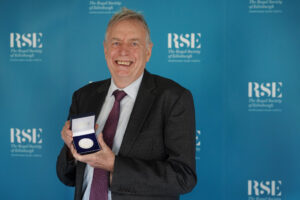
Stuart was awarded the Royal Society of Edinburgh Sir James Black Medal
© Stewart Attwood Photography 2025
Originally a graduate of the University of Glasgow, he first joined the University of Edinburgh in 1989 as Wellcome Senior Research Fellow in Clinical Science and Honorary Consultant Physician at the Rheumatic Diseases Unit in the former Northern General Hospital.
He moved to the University of Aberdeen and in 2002 became Director of the Institute of Medical Sciences and Professor of Medicine and Bone Metabolism before returning to Edinburgh in 2005 as Professor of Rheumatology and Honorary Consultant Rheumatologist at Lothian Health Board.
I have done clinical work in general medicine and general rheumatology throughout my career but have always had a special interest in bone disease.
A theme throughout my whole career has been Paget’s disease of the bone, looking at the genetic basis of the condition and doing clinical trials to establish optimal treatment strategies.
In addition to his research and clinical work, he has been involved in teaching, contributing to MBChB, BSc Honours, MRes and MB PhD programmes in Rheumatology as well as establishing the online distance learning MSc in Clinical Trials programme.
On the academic side, he was Head of the School of Molecular and Clinical Medicine until 2012 and founder and inaugural Director of the Edinburgh Clinical Trials Unit.
That was quite a big achievement. Edinburgh did not have a Clinical Trials Unit at the time which was extraordinary as these are very important for clinical research.
He enjoys watching the people he has mentored over the years progress in their careers, including IGC Group Leader Dr Erika Kague and Omar Albagha who is now Professor of Genomic and Precision Medicine in Qatar, and played a part in bringing his successor Professor Cosimo De Bari to the Institute.
It’s been great bringing in new people and seeing them make their own way over the years.
Despite all these achievements, it’s his research into bone disease he returns to when reflecting on his career.
I think a highlight has been the work in Paget’s disease.
We did two of the largest ever trials to be conducted in Paget’s disease looking at what is called a treat-to-target strategy, with drugs called bisphosphonates, in people who had already been diagnosed with Paget’s. Surprisingly these did not show a benefit of having what we called ‘intensive’ bisphosphonate therapy. I think the reason was the participants already had advanced disease with complications by the time we started treatment.
That led to the design of the ZiPP (Zoledronate in the prevention of Paget’s) study.
We recruited people who did not have Paget’s disease but had a family history, and did genetic testing for susceptibility. If the genetic test was positive, the participants were allocated active treatment with Zoledronic acid or a placebo. The results were striking – not only did the treatment prevent the development of Paget’s but it also reversed the signs of Paget’s in those where we found signs of early disease.
The main study lasted five years and we are just about to complete follow up in a five-year extension study. Preliminary results indicate that no one who was given Zoledronic acid has developed Paget’s whereas those who were given a placebo often developed symptoms with time or new signs of disease.
This is a major advance, and I anticipate the approach of genetic testing and targeted intervention will be introduced into clinical practice in the NHS within the next five years.
Laterally, Stuart has been involved in looking at the rare bone disease Osteogenesis imperfecta, known as brittle bone disease.
We have just completed a trial with the Edinburgh Clinical Trials team looking at the effect of treatment on bone fractures which are the main issue in Osteogenesis imperfecta. We had 29 hospitals in five countries across Europe involved and enrolled 350 patients.
This will be a landmark study when it is published.
It is incredible, given all these achievements in his career, that Stuart has found time for a family and social life.
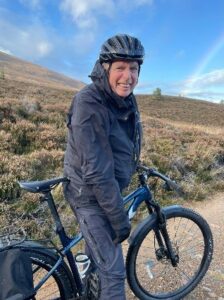
Stuart Ralston – Etape Caledonia 2024
He has four children and five grandchildren, with another one on the way.
His wife, a retired GP, also worked as a physician in the Clinical Trials Unit. One of his daughters is a consultant in Medicine of the Elderly at St John’s Hospital and the other is a Consultant Clinical Psychologist in Glasgow, while one of his sons is a lecturer at the University of Edinburgh and the other works for the Scottish Government.
As well as travelling, he enjoys hill walking, skiing, cycling – he recently did the Etape Caledonia challenge to raise funds
for the Paget’s Association – and playing guitar.
He has climbed all the Munros – and bumped into some IGC colleagues along the way.
The last Munro I climbed was Ben More on Mull. It was a beautiful day. We were in Tobermory and met Professor Nick Gilbert from IGC. I said: ‘I’m doing my last Munro, Nick do you want to come up?’ and he came along too. Another time, I met Professor Val Brunton close to the summit of Am Basteir – a Munro in the Cuillins.
Despite being troubled by arthritis, the West Highland Way is now in his sights.
I will be sad to leave but even after I retire, I will have plenty to do – I have still got some outstanding projects to finish off during my retirement.
It’s been a privilege to have been able to do what I have done over the past 50 years. I have never regretted going into medicine or pursuing a career as a clinical academic, even though It’s been hard going at times.

Share