
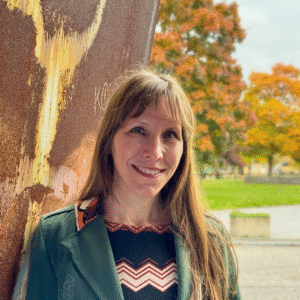
 Dr Hilal Alkan
Environmental Humanities Fellow, 22 March – 2 April 2026
Home institution: Leibniz-Zentrum Moderner Orient
Hilal Alkan is a researcher based at Leibniz Zentrum Moderner Orient, Berlin and a 2025-2026 Fellow of the Käte Hamburger Kolleg CURE. Her research concerns migration and care in contemporary settings, within frames of kinship, hospitality and future-making, and most recently through a multispecies lens. Her articles appeared in the American Ethnologist, Social Anthropology, Citizenship Studies, Migration Letters and in other collections. She has a monograph titled Welfare as Gift: Local charity, politics of redistribution and religion in Turkey (DeGruyter 2023) two edited volumes, Urban Neighborhood Formations (Routledge 2018) and The Politics of the Female Body in Contemporary Turkey (IB Tauris 2021), and has recently co-edited special issues for the Cambridge Journal of Anthropology (2025) ‘Making Place with Plants: intimacy, mobility and belonging’ and Social and Cultural Geography (2025) ‘Plant Intimacies: Exploitation, Survival and Care.’
Project title: Olive Displacements: Trees as Commodities in the Shifting Olivescapes of Turkey
Olivescapes of Turkey are undergoing a transformation. Most striking aspect of it, however, does not concern how to cultivate olives but instead how to uproot them without vital harm and revalue them as landscaping fixtures. Centennial Olea europaea are uprooted, pruned into sculptural forms, and sold as “macro-bonsais” for luxury landscapes. No longer valued for fruit or oil, these trees circulate as prestige objects—living artworks detached from agrarian livelihoods. Using “olivescapes” (Bray et al.) to denote the assemblages of human and plant actors, legal regimes, markets, and ecologies organized around the olive, this project asks how the tree itself becomes a lively commodity. It traces the multiscalar processes enabling this shift: legal changes permitting uprooting for development, agrarian precarity intensified by climate change, and the olive’s biological resilience, which allows survival after transplantation. Bringing the plant turn into conversation with political ecology, the project takes olive capacities and responses seriously while attending to the affective registers of human–olive relations. It asks what form of life is rendered saleable, and through which political, ecological, and intimate processes this life-for-sale is produced.