

The Inchcolm Antiphoner, arranged for saxophone quartet.
Summary
A description of a current project by Traditional Artist in Residence, Fraser Fifield: arranging the Inchcolm Antiphoner for saxophone quartet.
We’re told it’s good to stretch yourself from time to time, to try something new. Due to an insightful suggestion from my colleague, Dr Neill Martin, I have found myself doing just that over the past year.
The Inchcolm Antiphoner is a rare musical manuscript housed by University of Edinburgh, several fragments of it are available to view online (Fragments of the Inchcolm Antiphoner, c 1340 | ArchivesSpace Public Interface). It is Scotland’s oldest example of musical notation, thought to have been composed in the mid-13th century by an unknown person or persons on the small island of Inchcolm (Columba’s Isle), situated in the Firth of Forth, the water between Lothian and Fife. The songs comprising the Antiphoner are of a style we now call Plainchant. The text of this collection celebrates Saint Columba, the most prominent Christian Saint in Scotland for some centuries leading up to the composition of these songs, which happened at a time when the cult of St Andrew was gaining some prominence, competing with that of Columba. It’s wondered whether this might be a factor in the original impetus to create the songs.
The early style of notation isn’t readily readable by the modern musician, with a four lined stave, and notehead symbols known as Neumes which look familiar but have multiple interpretive rules attached. After a day of pondering over these beautiful scores I realised it was going to take more than a couple of Youtube tutorials to decipher them successfully, in a timely manner, or perhaps at all.
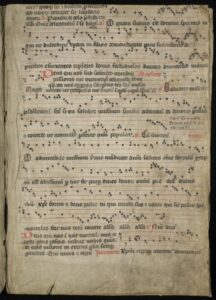
One part of the Inchcolm Antiphoner
Luckily for me (and you), there is a beautifully accomplished recording by the Scottish vocal group, Capella Nova, who, I imagine, recreated the songs in as authentic a manner as they could imagine. “Columba, Most Holy of Saints (ASV CDGAU 129), Scottish Medieval plainchant, as preserved in the Inchcolm Antiphoner” is a wonderful recording from 1992 which I recommend highly. I transcribed the melodic lines from this Capella Nova recording (there isn’t a publicly available score as far as I can see) and have arranged it all for performance by saxophone quartet.
I wasn’t bound artistically, I wanted to create something that might be performed in a concert setting, and preferably not reliant on amplification… and hopefully beautiful to listen to; because that’s the strong impression the vocal recordings left with me.
My initial explorations began to imagine a jazz sextet, 3 horns and a rhythm section. John Coltrane’s ‘A Love Supreme’ was often coming to mind. I desisted from this direction, however, after a short while. It may have been a good idea, but I didn’t establish a process that felt intuitive enough to warrant the degree of confidence necessary to ‘plough on’ through a large collection of songs.
I settled on what felt a less radical path, to arrange the songs for a quartet of saxophones, soprano, alto, tenor and baritone. The saxophone is an instrument I’ve played for around 36 years, and I have a little arranging experience under the belt from one of the early New Voices Series commissions from the Celtic Connections festival, Glasgow (2001, I wrote music for a quintet of saxophones). As you can imagine, this vocal music is sustained and resonant, qualities the saxophone has in abundance.
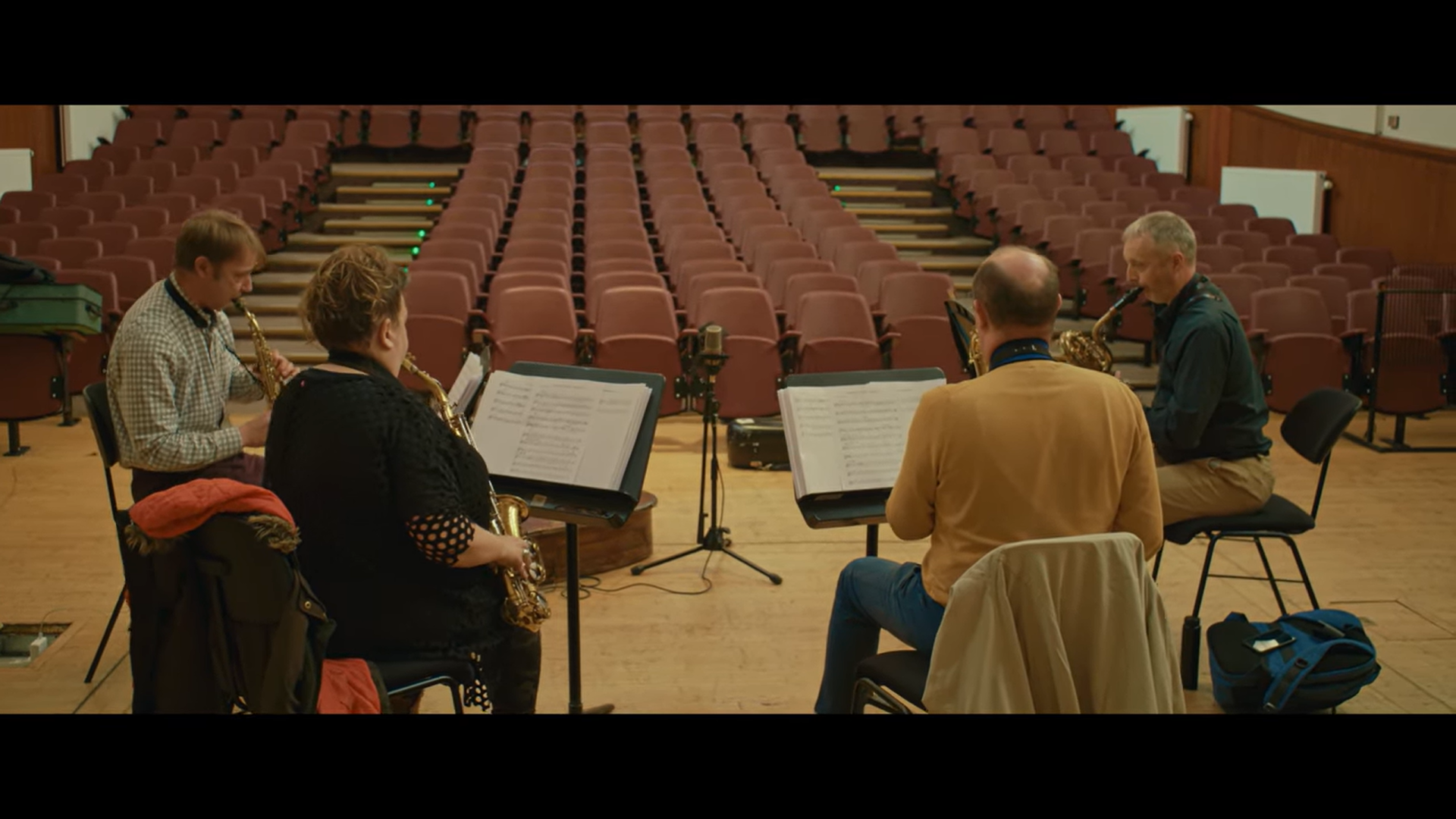
Fast forward several months and, as the following short video shows, I was joined by three excellent saxophone players (Sue McKenzie on alto, Martin Kershaw on tenor and Allon Beauvoisin on baritone) to play through my arrangements of the Inchcolm Antiphoner, about an hour of music in all, in the Reid Concert Hall, Edinburgh. We were very fortunate to be joined by the extremely talented filmmaker, Dante Harbridge Robinson, who recorded a portion of our rehearsal which you can watch below.
Dante’s video shows some improvisation from each of the players, a device I used sparingly in certain sections of the collection, and also shows what inevitably happens if ‘ambiguities’ are discovered in some musical parts… which proved the case as soon as the filming started of course.
A recently successful application to Creative Scotland means that we can, quite soon, record and release this music and we’re also going to give a concert in Edinburgh in June. Further details on both the recording and concert will follow soon!
While I’ve long held a fascination with our ancient bagpipe music, piobaireachd, I hadn’t anticipated looking further back in time for musical inspiration. In Scotland, I think we might consider this little-known material as another important branch of our National music, and I’ll be pleased if, through these endeavors, I can draw some renewed attention towards the Inchcolm Antiphoner.
My sincere thanks to all involved in the project so far.
(still from film by Dante Harbridge Robinson.)
(still from film by Dante Harbridge Robinson.)
Share