
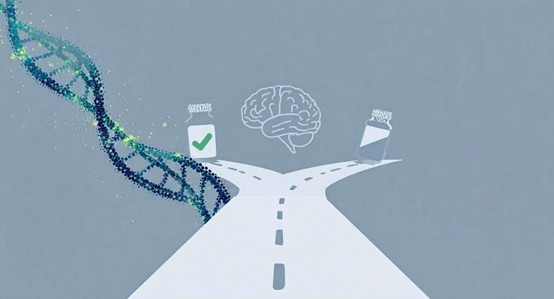
Researchers identified a DNA pattern in one dataset and used it to predict antidepressant response in another dataset. Although it is early days, this finding takes us one step closer towards future personalised medicine, using a DNA test to help doctors decide which antidepressant to prescribe.
Antidepressants are widely used to treat depression, but treatment outcomes vary across individuals. Only about one-third of patients achieve remission (a significant decrease or complete disappearance of signs and symptoms) after their first antidepressant. The reasons for this variation are not fully understood, but genetic factors are believed to contribute to treatment response.
In this study, an international team of researchers combined data from over 5,800 individuals with depression across 13 clinical studies, making this the largest study of its type to date. They analysed the DNA of these individuals, who had their depression symptoms carefully measured before and after taking antidepressants. Using a method that scans the entire human genome, the team looked for tiny genetic variations that might be linked to whether a person’s symptoms improved.
The research confirmed what other studies have shown: that the genetics of antidepressant response are partly heritable, meaning they are influenced by both genes and other factors. However, no single genetic variant had a large effect on antidepressant response. Instead, whether a person’s symptoms improved was influenced by the combined effect of many genes, each contributing a very small amount.
To use a driving analogy, imagine you are trying to predict how long it will take to drive across a city. You might hope to find a single clear motorway that dictates the exact travel time (representing a single gene with a large effect). Instead, the route consists of many small roads with traffic lights (representing many genes with tiny effects). Individually, no single traffic light determines the journey time, but together they dictate the outcome (the likelihood of response to antidepressants).
Excitingly, in this study, for the first time, researchers have been able to use the gene pattern they identified to predict antidepressant response in a different dataset.
To continue the driving analogy, it’s like they have built a primitive GPS system. If we give this GPS a roadmap for a different city, it can successfully start to predict the traffic flow, and estimate each car’s journey time (likelihood of response). The current GPS system is not accurate, but it is an important step towards building more accurate systems as we collect more data
The research also suggested genetic overlaps between antidepressant response and other human traits. Specifically, individuals with higher genetic risk for schizophrenia tended to have poorer responses to antidepressants. In contrast, those with genetic markers linked to completion of higher levels of education tended to respond better to treatment. However, confirming these links will require more research.
These findings give us hope that as genetic datasets grow, we will be able to move toward a more personalised approach (i.e., using a genetic test to predict whether an antidepressant will work for an individual). Although current genetic data cannot yet guide clinical prescribing, this study provides an important foundation for future research.
Link to paper: Pain et al (2022) Identifying the Common Genetic Basis of Antidepressant Response. https://www.sciencedirect.com/science/article/pii/S2667174321000859
Siyi Wang worked with Iona Beange and Oliver Pain on this lay summary as part of her placement for the MSc in Science Communication and Public Engagement, University of Edinburgh


