Any views expressed within media held on this service are those of the contributors, should not be taken as approved or endorsed by the University, and do not necessarily reflect the views of the University in respect of any particular issue.
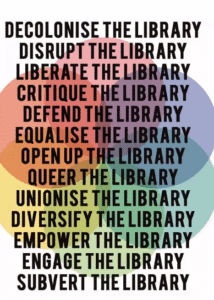
Critical Approaches to Libraries Conference poster
I attended the online CALC25 [Critical Approaches to Libraries] Conference from 13 – 15 May 2025. The programme, slides and recordings are available at https://sites.google.com/view/calcconference/calc2025 It was great to see Alice our Strathclyde placement student there too.
As you would expect from a conference on critical librarianship the programme topics were wide-ranging and diverse. Topics included professional identity, slow librarianship, supporting neurodivergent colleagues, information imperialism, and justice-orientated librarianship. I would highly recommend this affordable conference. It is £15 for 3 days and you can choose to donate a £15 entrance fee for another participant who can then attend for free. Most of the sessions were recorded and are on Youtube or the above website.
University of Edinburgh Law Library Senate Room to Mezzanine View with Students
This year, I was lucky enough to attend the British and Irish Association of Law Librarians (BIALL) conference for the very first time—and I hope it won’t be my last! From the moment I arrived, I was struck by how welcoming and friendly the event was. Thanks to the buddy scheme, I connected with librarians from across the profession, opening doors to future opportunities for sharing knowledge and ideas.
One of the big themes at all library conferences this year is Artificial Intelligence (AI), and BIALL was no different. As one of the AI leads in our team, I was keen to learn how AI tools are being used in legal practice and library-led support. The sessions didn’t disappoint.
I was delighted to be invited to Pittsburgh, Pennsylvania this year to speak at the Atla 2025 Annual meeting. It’s actually the second time I have been to a library conference in Pittsburgh “the steel city”, the first was to an ARLIS art librarians conference over 20 years ago. This time Pittsburgh was looking very green with cool damp weather, cooler than the June heatwave happening at home in the UK.
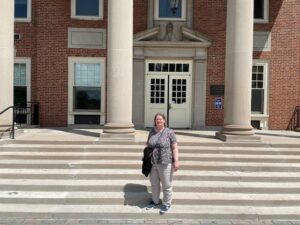
On the steps of Pittsburgh Theological Seminary
My conference experience began with a visit to Pittsburgh Theological Seminary (PTS)’s Clifford E. Barbour Library. Having just shown a group of PTS Doctor of Ministry students around my library, New College Library, the previous week, I was keen to visit the library of this partner institution. Like New College Library back at the University of Edinburgh, this library had recently been completely decanted for a full refurbishment, with priorities including increased light, improved air conditioning and redeveloped learning and social spaces. This was not the only similarity between PTS’s Library and my own library, which both use Library of Congress classification and support training for Presbyterian ministry. ...continue reading "Challenges, Changes and Collaborations– American Theological Library Association conference, Pittsburgh June 18-21 2025"
Today, 8 May 2025, marks the 80th anniversary of VE Day (Victory in Europe Day) when people in Britain and Allied nations across the world celebrated the unconditional surrender of Germany in the Second World War. While it was not the end of the conflict (it was August 1945 before the war against Japan ended) the sense of relief for people who had been living under total war for 6 years was huge. In Britain VE Day was declared a national holiday and people took to the streets to celebrate and commemorate in a huge release of collective tension. This blog posts pulls together just a small selection of our digital library resources that will help you find out more about VE Day, the events leading up to it and the aftermath.
What did the papers say?
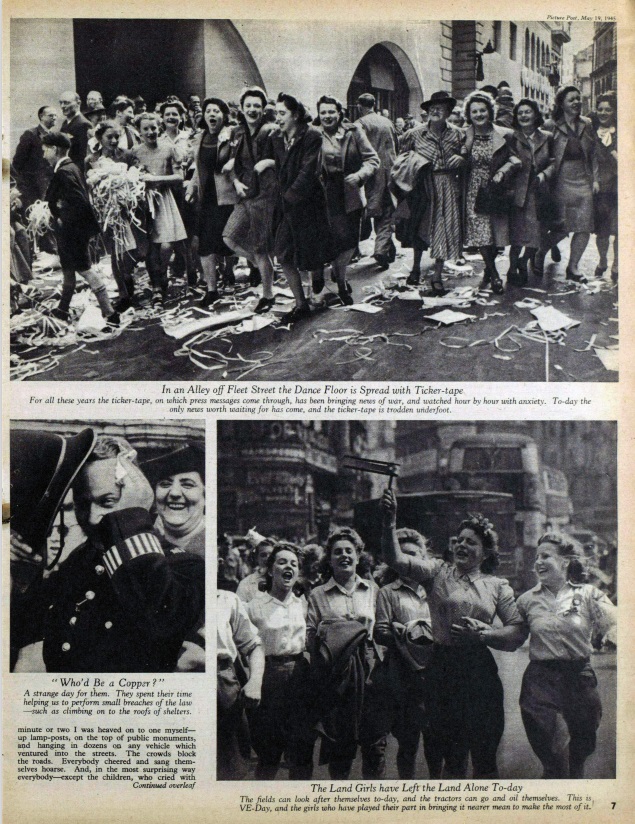
Mentions of VE Day or Victory in Europe Day start before the 8th May, as people were aware of and anticipating the likely German surrender. So some preparations were already underway and some people began to celebrate early, on the 7th, when in Britain it was announced on the radio that the war in Europe was over.
From "This was VE-Day in London." issue of Picture Post, May 19, 1945. Picture Post Historical Archive, 1938-1957.
Have you ever had that frustrating experience of searching on the web and finding a useful resource, but not sure whether the Library has access to it? Searching for academic content online can sometimes feel like a complicated process, but luckily the Library now has LibKey Nomad, an easy-to-use free browser extension that will link to academic articles, e-books and other materials which are available open access or though Library subscriptions.
LibKey Nomad works with many scholarly publishers' websites and also works with sites like PubMed and Wikipedia.
At the University Library you have access to a huge range of material for your research and learning including over 2 million books, archives, instruments and artworks, over 2 million e-books and 330,000 e-journals, as well as 1000s of streaming videos, digital scans, databases, and more.
In February we celebrate LGBT+ History Month 2025 in the UK and this year the theme is 'Activism and Social Change'. Throughout history and across the globe LGBT+ activists have fueled social change, advancing society for the benefit of all.
To help you discover more we’ve pulled together just a small selection of Library resources that will allow you to start to find out more about activism and social change in LGBT+ history, herstory, theirstory.
The International Gay and Lesbian Human Rights Commission (IGLHRC) was founded in 1990 as the first NGO devoted to advancing LGBT human rights worldwide. Transnational LGBT Activism : Working for Sexual Rights Worldwide asks how is that mission translated into practice? And what do transnational LGBT human rights advocates do on a day-to-day basis and for whom? Arguing that the idea of LGBT human rights is not predetermined but instead is defined by international activists who establish what and who qualifies for protection. ...continue reading "Activism and Social Change in LGBT+ History"
Are you developing a search strategy for a systematic review or other evidence synthesis? Here we have collated a list of useful training and guidance resources to help you.
The Learn course LibSmart II: Advance Your Library Research has a whole module on Literature Searching for Systematic Reviews. LibSmart II can be found in Essentials in Learn. If you don’t see it there, contact your Academic Support Librarian and we’ll get you enrolled. You can work through LibSmart at your own pace, and return whenever you need.
For self-paced training on the whole process of conducting a systematic review, Cochrane Interactive Learning has modules created by methods experts so you build your knowledge one step at a time.
If you are a student conducting a systematic review, we can highly recommend the book Doing a Systematic Review (2023). With a friendly, accessible style, the book covers every step of the systematic review process, from planning to dissemination.
According to the Cochrane Collaboration, a leading group in the production of evidence synthesis and systematic reviews;
systematic reviews are large syntheses of evidence, which use rigorous and reproducible methods, with a view to minimise bias, to identify all known data on a specific research question.1
This is done by a large, complex literature search in databases and other sources, using multiple search terms and search techniques. This might include Boolean operators, truncation, phrase searches, and database subject headings. Find out more about these search techniques on the Library subject guide to Literature Searching.
Traditional literature reviews, such as the literature review chapter in a dissertation, don’t usually apply the same rigour in their methods because, unlike systematic reviews, they don't aim to synthesise all known data on a topic. Literature reviews can provide context or background information for a new piece of research, or can stand alone as a general guide to what is already known about a particular topic2.
-----
You can contact your Academic Support Librarian for advice on literature searching, using databases, and managing the literature you find.
-----
References
Higgins, J., et al., Cochrane Handbook for Systematic Reviews of Interventions version 6.4 (updated August 2023). 2023, Cochrane.
Thanks to a request from staff in History, the Library currently has trial access to the newly launched extension years for The Scotsman Historical Archive from ProQuest Historical Newspapers. While the Library already has access to The Scotsman Archive covering the years 1817-1950, the new extension module increases coverage up to 2002.



 In February we celebrate