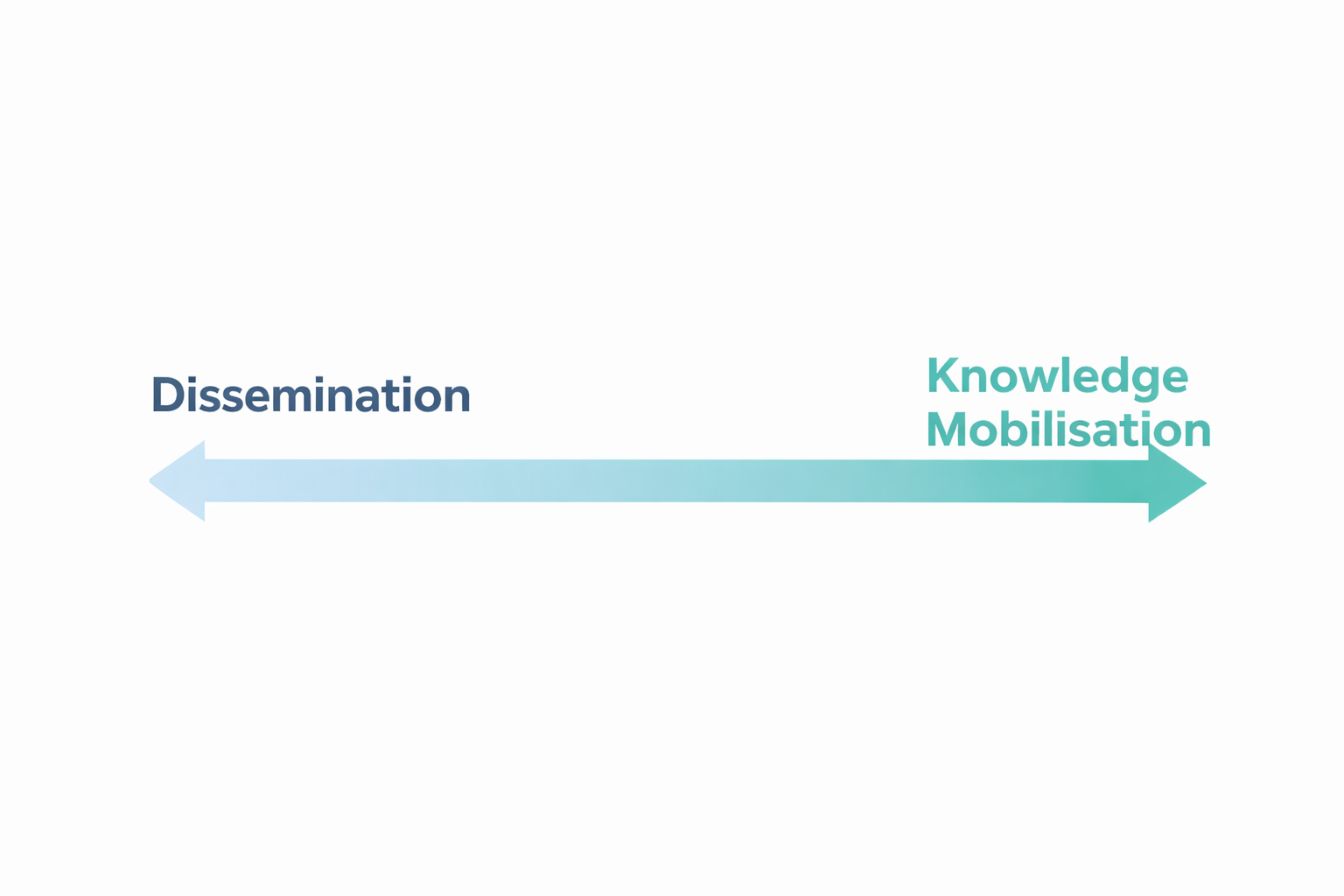
Research ‘dissemination’ has long been the default route to enable impact. But it is increasingly criticised as too passive, one-directional and researcher-led. Instead, ‘knowledge mobilisation’ is gaining traction, appearing in funding applications and offered as researcher development training (for example here). Knowledge mobilisation offers a more dynamic, relational approach to getting research used.
In a Nutshell: Dissemination vs Knowledge Mobilisation
Dissemination: linear, researcher-driven, focused on “pushing out” findings.
Knowledge Mobilisation: iterative and two-way, early engagement with knowledge users. Audiences, timing and outputs are strategically aligned to maximise relevance, use and uptake. Reframing information and generating discussion are part of the process.
Check out the blog post “What is Knowledge Mobilisation” for a more detailed outline.
A spectrum of engagement activities?
Rather than a binary distinction, I like to think of a spectrum of engagement activities, with dissemination at one end and knowledge mobilisation at the other.
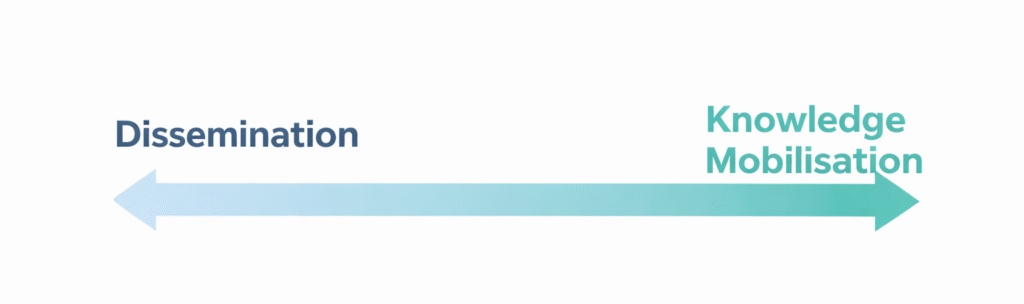
Of course, this is a very simplified way to view things. In fact, in some definitions of knowledge mobilisation, dissemination is seen as part of the process, rather than a competing / less effective process. However, for the purposes of this blog post, and the wider aim to shift focus from dissemination to knowledge mobilisation, I will stick to this spectrum idea.
How to make a webinar more ‘knowledge mobilisation’ and less ‘dissemination’
I recently shared findings from a PHIRST evaluation of an exercise referral scheme (more info here).
I worked with two other research teams who conducted similar evaluations (here and here) to jointly present at a webinar.
We designed the webinar to move away from dissemination, hoping to move towards the knowledge mobilisation end of the spectrum.
Here is how we did it:
1. Team up
Rather than presenting a single study, we brought together three related evaluations. For a time-pressured audience, this offered greater value and enabled comparison across settings.
2. Identify a target audience
We focused on people who could realistically act on the findings: commissioners and delivery managers in exercise referral services, across local government and third-sector providers. Delivering the webinar with Community Leisure UK gave access to this audience.
3. Engage early with the audience
At the start of the webinar, we asked participants to share their roles and webinar expectations via the chat. This gave us immediate insight into who we were speaking to and helped shift the tone from “researchers presenting” to a more collaborative exchange.
4. Recognise the importance of timing
Ideally, we would have engaged with the target audience just as they were making decisions about their exercise referral scheme(s) – but audience timelines are rarely aligned. Instead, we asked where people were in the (re)commissioning cycle. This recognised the importance of timing and allowed us to pitch the discussion at the right level.
5. Reduce, reframe, make it relevant
Focus on what is important to the audience, and skip the rest. We knew our audience was likely interested in what an intervention could look like, and how it should then be adapted based on our evaluation findings. We didn’t go into methods, strengths and limitations or literature reviews.
6. Keep the format simple
With multiple evaluations to showcase, consistency matters. We used the same three-slide structure for each evaluation: What is the intervention? What did we find? What does this mean for you? This reduced cognitive load and supported comparison.
7. Use a chair or facilitator
An experienced chair/facilitator can contextualise findings, connect research to practice, and enable discussions. Ideally this person is someone credible from the field of practice, rather than an academic colleague. We were lucky to have a chair from Community Leisure UK to help bridge the gap between researchers and the audience.
8. Prioritise discussion and question time
We kept presentations short (3 presentations at 7 minutes each) and protected time for questions after each talk and at the end. In hindsight, the presentations could have been even shorter, perhaps 5 minutes.
9. Send in questions in advance
Sending in questions in advance is a great way to avoid any awkward silences when it comes to the questions/discussion section. We prepared questions for the chair to use if needed. Often, one prompt was enough to open up discussion.
10. Extend the life of the event
Sharing slides and the recording allowed the content to reach beyond the live audience and increased accessibility.
11. Continue the conversation
Were there interesting discussions during the webinar? Did someone make a good point in the chat? Follow-up with them after the webinar (e.g. via email, LinkedIn, Teams) and keep the conversation going.
12. Try to assess impact (where possible)
We tried to understand how likely people were to use insights from the webinar by encouraging people to post in the chat. Whatever method you choose (e.g. surveys, one-to-one conversations), try to capture any potential impact. This is challenging and often limited by factors such as survey fatigue, but even partial feedback can be informative.
Thank you to Prof Susie Sykes, Emma Doohan and Dr Neil Howlett for helping to put together the webinar and for reviewing this blog post.
I am always interested in hearing more ways to pivot from dissemination to knowledge mobilisation. Do you have any more practical tips relating to webinars or other engagement activities?