

Unica of the Dolmetsch Lute Book
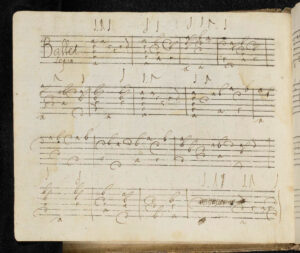
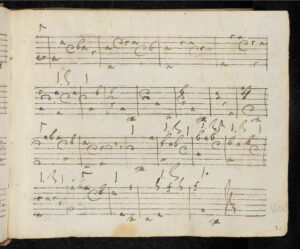
Ballet Lepin, GB-Eu Coll-2073, f.31v-f.32r, Composition by Charles de L’Espine (c.1580–c.1627), A unica from the Dolmetsch Lute Book
The following section is devoted to the 89 unica of the Dolmetsch lute book, presenting a ‘digitised’ edition of these compositions.1 Each piece has a separate page which contains a facsimile of the French or Italian lute tablature from the manuscript, a transcription in common music notation, and a video performance . The facsimile and the transcription can be viewed online and downloaded as a PDF file.
The compositions themselves cover a wide variety of popular contemporary genres of lute music, including courants, galliards, passamezzos, saltarellos, intradas, ballets, sarabands, allemandes, and intabulations (arrangements of vocal works). Of particular interest are compositions unique to this source by the composers Charles de L’Espine (c.1580–c.1627, Ballet Lepin, ff.31v-32v) and Michelangelo Galilei (1575–1631, Passomezo Galilei, ff.151v-152r and Intrada Galilei, ff.280v-281r Of composers whose pieces are unique to this source Michelangelo Galilei is the most famous; hailing from Florence he was the son of music theorist and lutenist Vincenzo Galilei and the brother of renowned scientist Galileo Galilei, and established himself in Munich working for the court of Duke Maximillian I.2 The Parisian Charles de Lespine was a lutenist, composer, poet, and dramatist, who travelled extensively throughout Europe, before publishing an account of his travels in Turin in 1627.3
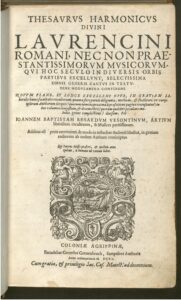
Title Page, Thesaurus Harmonicus, Cologne: Gerardus Greuenbruch, 1603
The rest of the unica are anonymous, either the work of amateurs who did not desire to associate their name with the act of composition, or otherwise having lost their attribution in the transmission process. The scribe’s encyclopaedic nature to the collection and ordering of the contents in the manuscript mirrors other substantial works, most notably Jean-Baptiste Besard’s Thesaurus Harmonicus (Cologne: Gerardus Greuenbruch, 1603), a substantial print itself a potential source for the manuscript’s scribe.4 This in particular can be seen in the central groupings of the galliards, voltes, ballets, intradas, and passomezzos and saltarellos, while the opening and concluding sections maintain the eclectic nature of a manuscript for personal use. The resulting collection of unica represent a significant addition to the lute repertory, and the digitised editions and performances make these accessible to a wider audience for the first time.
Note on the Transcriptions and Performances
All the pieces have been transcribed for a 10 course lute in G in viel ton tuning (C-D- E/E♭-F-G-c-f-a-d’-g’), except for the untitled piece on the final f.285v which is in a corde avalée, a tuning described in Besard’s Thesaurus Harmonicus (C-D-E♭-F-G-B♭-f-b♭-d’-g’).5 The decision to transcribe all the pieces for the lute in a nominal viel ton tuning in G was made to emphasise the placement of the tablature on the fingerboard. While it could be argued that pieces in more distant keys (for example F minor) were conceived mentally by their author in the key of G minor for a lute one tone higher in A (D-E-F/F♯-G-A-d-g-b-e’-a’), this would indirectly give the impression of the use of fewer keys on the instrument in the manuscript, particularly for those who cannot read the tablature facsimiles.
By the beginning of the seventeenth century the strict contrapuntal rules that governed both vocal and instrumental composition were starting to be subverted. I do not impose a polyphonic ideal in my transcriptions, but emphasise the actions represented by the tablature. The rhythms, barring, and meter are transcribed as they appear in the manuscript unless otherwise noted in the commentary below, and the note values are what is determined by placement on the fingerboard unless impractical (for example in sections with extensive arpeggiated sections).
The performances reflect what was notated in the tablature, with ornamentation not being added and repeats only undertaken when notated. However, it is highly likely that ornamentation was added in performance at the performer’s discretion, demonstrated by the images below of La Courant Sarabande from Nicolas Vallet’s Secretum Musarum (Amsterdam: 1615) and a concordance from the Dolmetsch lute book. The commas (‘) and crosses (x) indicate where ornamentation can be placed, in contrast to the lack of any ornamentation signs in the Dolmetsch Lute Book. Occasionally a star symbol (*) appears (for example Intrada, ff.142v-143r ) which I have interpreted as an ornamentation sign.
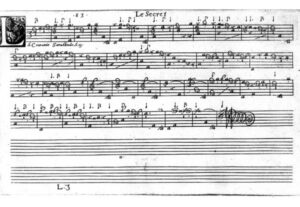
La Courant Sarabande, Nicolas Vallet, Secretum Musarum (Amsterdam: 1615), 83
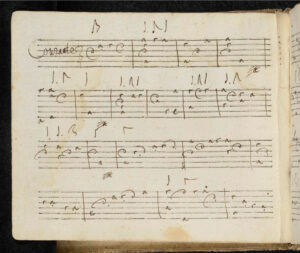
Courante, GB-Eu Coll-2073, f. 20v-f.21r
- A digitised edition replicates a print edition in a fixed format such as a PDF orJPEG file, while a digital edition is encoded and can be analysed and adapted in a digital paradigm. For further reading on the definition and implications of a scholarly digital edition see; Patrick Sahle, “What is a Scholarly Digital Edition?”, in Digital Scholarly Editing: Theories and Practices, ed. J. M. Driscoll and E. Pierazzo, Cambridge, Open Book Publishers, 2016, pp. 19–39,https://books.openedition.org/obp/3397?lang=fr. The scope of this project only allowed for a digitised edition.
- Claude Chauvel, Introduction to Il Libro Primo d’Intavolatura di Liuto by Michelagnolo Galilei, (Genève: Editions Minkoff, 1988), 6-8.
- David Ledbetter, “Lespine, Charles de” Grove Music Online, 2001; Accessed 15 Apr. 2026. https://wwwoxfordmusiconlinecom.nls.idm.oclc.org/grovemusic/view/10.1093/gmo/9781561592630.001.0001/omo-9781561592630-e-0000041021.
- Jean-Baptiste Besard’s Thesaurus Harmonicus shares many concordances with the Dolmetsch lute book, for a helpful database of concordances see https://mss.slweiss.de/index.php?id=1&type=ms&lang=deu&ms=GB-Eu_Coll2073&nm=350&st=0&instr=all&title=&comp=&msnam=&abcinc=&conc=&key=.
- Jean-Baptiste Besard, Thesaurus Harmonicus (Cologne: Gerardus Greuenbruch, 1603), 147.

Comments are closed
Comments to this thread have been closed by the post author or by an administrator.