

The Dolmetsch Lute Book
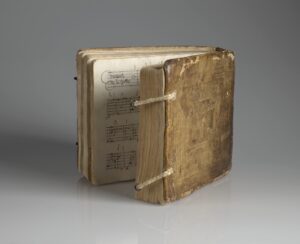
An Image of the exterior of the Dolmetsch Lute book, GB-Eu Coll-2073.
The Manuscript
At 285 folios, the Dolmetsch lute book is one of the largest lute manuscripts to have survived from the seventeenth century. Each page is 15×18.3cm and the manuscript is in an oblong 8vo format, with the watermark (a double headed eagle over a shield containing the initials MB underneath), split in half and visible in the centre of the top of the opening pages.1 The binding is of contemporary blind-stamped pigskin, possibly by the Federnelkenmeister binder of Cologne (c.1583-1619). The lines of the lute tablature have been typeset and a single scribe has consistently copied the 322 pieces. While one of the largest lute manuscripts to survive, it is likely that it could have originally been even longer, as the last piece of the collection (Untitled, f.285) abruptly halts seemingly in the middle of the composition. The care the scribe took to make the lute tablature performable, arranging the music to be played without a page turn or altering their spacing to fit a composition onto a single folio (Courante, f.250v). It is unlikely that the scribe would have chosen to copy this piece knowing that there is not space to complete the composition.
The Music
The Dolmetsch lute book spans the musical fashions of Europe at the beginning of the seventeenth century containing, as well as its unica, many of the most popular lute compositions of the period. These include versions of English compositions by composers such as John Dowland (1563–1626) and Robert Johnson (1583–1633), pieces by the French composers Charles Bocquet (c.1570–before 1615), Charles de L’Espine (c.1580s–c.1627), and Robert Ballard (c.1575–after 1649), and Italian compositions by Pietro Paolo Melii (1579–1623). It gathers compositions from some of the most popular prints of the period, with the most numerous coming from Nicolas Vallet’s Secretum Musarum (Amsterdam: 1615, 1616) and Jean-Baptiste Besard’s Thesaurus Harmonicus (Cologne: Gerardus Greuenbruch, 1603) and Novus Partus (Augsburg: Davidem Francum, 1617). The majority of the pieces are notated in French lute tablature, a system where alphabetic symbols indicate the frets of the lute and are then placed onto a six-line stave representing the strings, where the highest sounding is symbolised by the top line of the tablature. There are a small number of examples in Italian lute tablature (for example Courante, ff.273v-244r) where the numerals are placed onto the six-line stave that is reversed, with the lowest line representing the top string of the lute. The compositions begin to show a style of playing that later became termed the ‘style brisé’, a broken chordal style of performance in contrast to the highly polyphonic composition of earlier sixteenth-century lute music. It was this style of lute playing that led to lutenists experimenting with the tuning of their lutes early in the seventeenth century, as can be seen in the compositions at the end of the the manuscript in two alternative tunings (corde avalée).
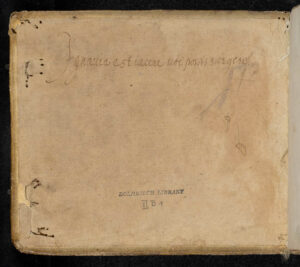
The back of the front cover of the Dolmetsch lute book (GB-Eu Coll-2073), with the text ‘Iganvia est iacere voi possis svergere’.
Context
It has been noted that the Dolmetsch lute book shares many similar pieces with lute manuscript MS G.IV.18, currently housed in Prague, Národní Muzeum, which was copied in Salzburg and owned by Joannes Aegidius Berner von Rettenwert (1603-1663). As well as many pieces in common, there are other similarities: the hand of the scribe appears to be the same; the notational sign for inserting missing music at the end of a piece is replicated; and they both share a similar humanistic leaning – a Latin loci commune opens the Dolmetsch lute book, ‘Iganvia est iacere voi possis svergere’ (Laziness is to lie; you should be able to rise) praising the work ethic clearly shown by the scribe, and this continued in the Prague manuscript with many loci communes interspersed amongst the compositions of the manuscript. This practice links these manuscripts to a tradition of German and Austrian humanists who played and copied lute music.2
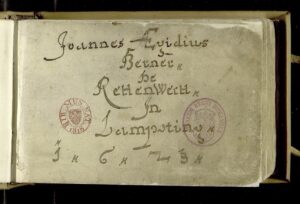
An image of the title page of CZ-Pnm IV.G.18.
Taking these points into consideration it is highly likely that the scribes of the manuscripts were the same person and that was Joannes Berner himself. Berner was born in Salzburg in 1603, he married Sophie von Pauernfeind in 1641 and they settled in the castle ‘Schloss Anif’ (coincidentally the castle featured in The Sound of Music) in 1643 before his death in 1663.3 The title page of manuscript MS G.IV.18 states that it was compiled starting in 1623, when Berner would have been in his early twenties. The manuscript shows a wealth of compositions in Italian and French lute tablature, both in viel ton (the standard tuning of a renaissance lute in the sixteenth and early seventeenth centuries) and corde avalée (alternative tunings that lutenists were starting to experiment with at the beginning of the seventeenth century), that could only be performed by a technically accomplished performer. He also displays his learning through a number of common places written throughout the manuscript in a wide variety of languages.
In contrast, the Dolmetsch lute book contains pieces that are almost all in French lute tablature, some of the pieces have been simplified, and compositions in corde avalée only appear in the final folios of the manuscript (such as Untitled, f.285v). This points to an earlier compilation of the Dolmetsch lute book (c.1620) compared to the Prague manuscript, suggesting that during its compilation Berner was at the beginning of his lute studies and only comfortable with one form of notation, French lute tablature, and one tuning, viel ton. The passamezzos that appear throughout the manuscript demonstrate his progression has a lutenist. The first passamezzos are exercise like compositions, displaying the ground bass that the passamezzo is based on first in a chordal figuration (Passomezo, ff.27v-28r), and then intergrated with a melodic motif (Passomezo, ff.28v-29r). On the other hand, later passamezzos are mature compositions that require skill to play (Passomezo, ff.175v-176r) showing his development as a lutenist.
Provenance
In the nineteenth century the manuscript was first mentioned in the 1890s by Romain Rolland describing it’s presence in a Zürich bookshop, and was subsequently owned by Brahms scholar Max Kalbeck (d. 1921). Early music pioneer Arnold Dolmetsch (1858–1940) then purchased the manuscript and it was owned by his family until the purchase by the University of Edinburgh in 2022.
- A drawing of the watermark can be seen in Diana Poulton, “The Dolmetsch Library, Haslemere, MS II B.1: a preliminary study”, The Consort, no.35 (1979), 327-341.
- For further reading see, Kateryna Schönig, “Italian practices in German lute tablature manuscripts, c.1500: practical script appearance”, Early Music, Vol. 1, no.3 (2022), 275-295.
- See Josef Klima, Die Lautenhandschrift des Joannes Aegidius Berner von Rettenwert (1603-1663) in der Musikabteilung des Nationalmuseums Prag, Sig. IV. G.18 : Themenverzeichnis, (Verl. Wiener Lautenarchiv, Josef Klima, Maria Enzersdorf bei Wien, 1975) and Paul Buberl, Die Denkmale des Gerichtsbezirkes Salzburg Österreichische Kunsttopographie (Wien: A. Schroll, 1916), 36.

Comments are closed
Comments to this thread have been closed by the post author or by an administrator.