

Navigating “hard fun” while studying online – an enjoyable challenge
By Jolina, from the Philippines, studying MSc Science Communication and Public Engagement (Online Learning)
Choose life. Choose a job. Choose a career. Choose your future. Choose to study a postgraduate online degree at the University of Edinburgh. Choose hard fun. With a family of two young children, a golden retriever, and a job, why would I want to do a thing like that?
The concept of “hard fun” in the pursuit of an online masters
Inspired by the famous lines of Irvine Welsh, one of Scotland’s literary icons, I found myself choosing a MSc in Science Communication and Public Engagement, where we explored the concept of hard fun: the deep satisfaction people feel when tackling demanding, meaningful work (McCrory, 2021). Hard fun is what drove former University of Edinburgh student Charles Darwin to travel to the Galapagos and write about evolution. Hard fun is why scientists at the Roslin Institute created Dolly, the first mammal cloned from an adult cell. Hard fun is why the UK’s most powerful supercomputer now resides at the EPCC at the University. Hard fun is what we’re hardwired for; hard fun is what we humans choose to do.
Hard fun is all about the satisfaction that comes from activities that are enjoyable precisely because they are challenging. And that’s the kind of hard fun you can experience by studying at the University of Edinburgh. Wherever you are in the world, their online part-time postgraduate programmes let you create your own version of hard fun, making space for the realities of juggling childcare, household chaos, and work, all whilst earning a degree from one of the world’s top universities.
The benefits of studying online
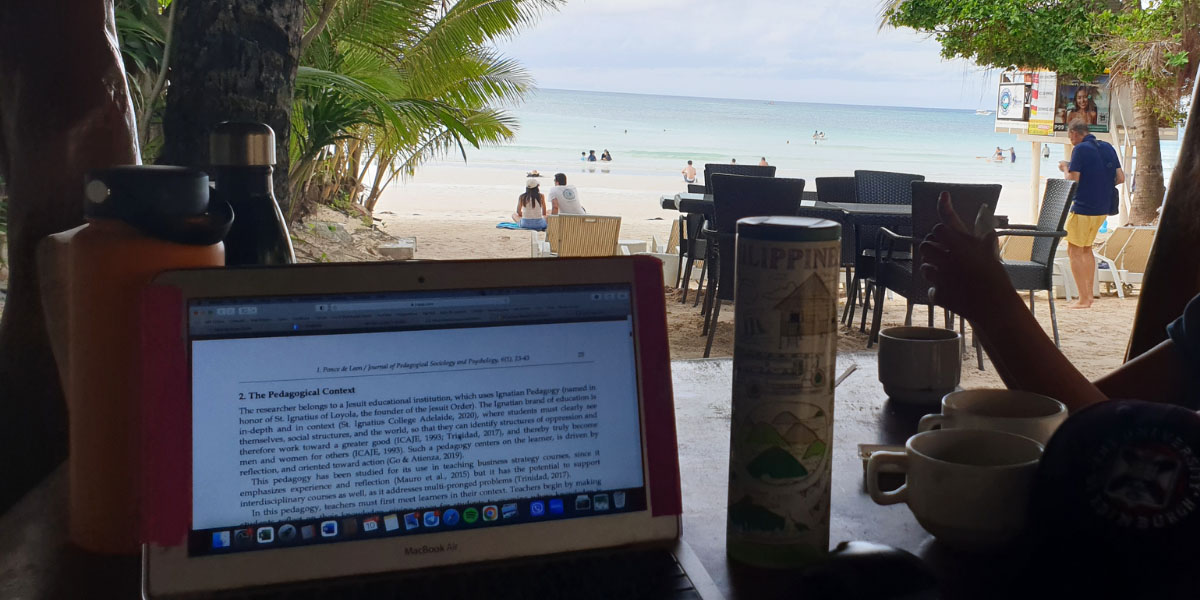
In fact, embracing the hard fun of doing my masters online has strengthened my flexibility and resilience through challenging readings, weekly tasks, and major assignments—sharpening my critical thinking skills, knowledge, and understanding of the field. At the same time, it has opened doors to opportunities and once-in-a-lifetime experiences I might have missed with a full-time program—like traveling to the Philippines during term time for my brother’s wedding or spending nearly a month by the beach with my family, all whilst keeping up with my course.
So, how can you navigate this kind of hard fun? Here’s a few practical tips (Rucker, 2024):
Set realistic goals
Breaking big challenges into manageable pieces is essential. Focusing on major assignments and weekly tasks keeps me moving without feeling overwhelmed.
Commit to regular practice
Hard fun thrives on consistency. My programme’s three-year structure creates a rhythm that supports steady growth and development.
Reflect on experiences
I love thinking back on discussions, readings, and the ordinary magic of daily life. Taking time to savour what I’ve learned through reminiscing, reflecting, and noticing how I’ve grown reinforces the value of the effort and builds motivation.

Seek community support
My husband’s encouragement has been a lifeline. So has connecting with others who thrive on hard fun — my cohort, academic staff, and the wider University of Edinburgh community. Skills trainings like Speed Reading, Find Your Masters Dissertation Genius, and Being Critical for Assignments, plus the ever-helpful online library staff, have not only strengthened my abilities but also created a shared sense of purpose that kept me motivated, inspired, and moving forward, even when the work felt toughest.
Skills training sessions from the Institute of Academic Development
Whether online or in person, having a supportive community makes postgraduate study even more rewarding, especially when life is full.
Let go of perfection
And lastly, perhaps the biggest lesson I’ve learned is choosing to let go of perfection. Because when you stop chasing perfection and lean into the rewards of hard fun, you open the door to the extraordinary.
Got questions about student life at Edinburgh?
References:
Lucardie, D. (2014). The impact of fun and enjoyment on adult’s learning. Procedia-Social and behavioral sciences, 142, 439-446.