
A golden age for biomedicine
Professor David Hay, Director of ZJE Translational Hub, reflects on the Beacon of Excellence seminar in Guangzhou and Shenzhen last week and reflects on the coming of a golden age for biomedicine.
We talk lot about the role ZJE has in nurturing the next generation of innovators and leaders in biomedical science to address the challenges facing society. The Beacon of Excellence seminar this week in Guangzhou and Shenzhen gave us the chance for a delegation of translational scientist from ZJE to set out our stall before venture capitalists and leading players in the healthcare sector.
In this blog I will share what we said, in the next one I will reflect on what we can take away.
Shenzhen: scale, speed and ambition
Shenzhen was an excellent choice of location in the bustling Greater Bay Area. In 1950, the population of Shenzhen was officially recorded as 3,148; current estimates vary but fall between 13–17 million. The growth in GDP has been equally striking, now outstripping the so-called Tiger Economies of Singapore and its’ close neighbour Hong Kong.
Bio Island: where research meets commercialisation
The seminar began with a tour of Guangzhou International Bio Island. This biotech one-stop shop brings together biotech firms, research, and investment. With a focus on linking China with global partners and turning research into real-world impact, it was a fitting place to start exchanging ideas on how to commercialise the biomedical innovations emerging from ZJE. Our delegation was joined by colleagues from The National University Biomedical Regional Technology Transfer and Transformation Center (Guangdong-Hong Kong-Macao Greater Bay Area).
Showcasing ZJE research excellence
During the visit, our executive dean, Prof Sue Welburn introduced ZJE, and then invited colleagues from three of our five research centres to share their work:
- Wenwen Huang and Yishan Chen, ZJE Centre for Regeneration and Cell Therapy
- Chaochen Wang, ZJE Centre for Biomedical Systems and Informatics
- Jian Liu, ZJE Centre for Infection, Immunity and Cancer
In lofty footprints
With the presentations complete, we moved on to a guided tour of Medcaptain Medical Technology, a company specialising in infusion pumps, syringe pumps, anaesthesia and respiratory products, and wearable medical devices. Our visit was delightfully hosted by Michael Zhong, co-founder, vice chairman and vice president of Medcaptain. We were following in the footsteps of the UK Minister for Investment, Lord Stockwood, who had visited in December. On its website, Medcaptain noted that the ministerial visit “highlights the UK’s positive attitude towards deepening cooperation with leading Chinese technology companies, while also boosting the confidence of globalising Chinese enterprises like Medcaptain—foreshadowing more pragmatic achievements in China–UK economic and trade cooperation through complementary strengths.”
Following our tour, we began the “Medcaptain China UK Frontier Academic Exchange Conference”. I gave a seminar, “Engineering functional liver tissue from pluripotent stem cells” highlighting the key role stem cells have to play in modern medicine, with a focus on treating regenerative diseases in humans. This was followed by a vibrant panel discussion focusing on translational science featuring our ZJE scientists Wenwen, Yishan, Chaochen, Jian and Di.
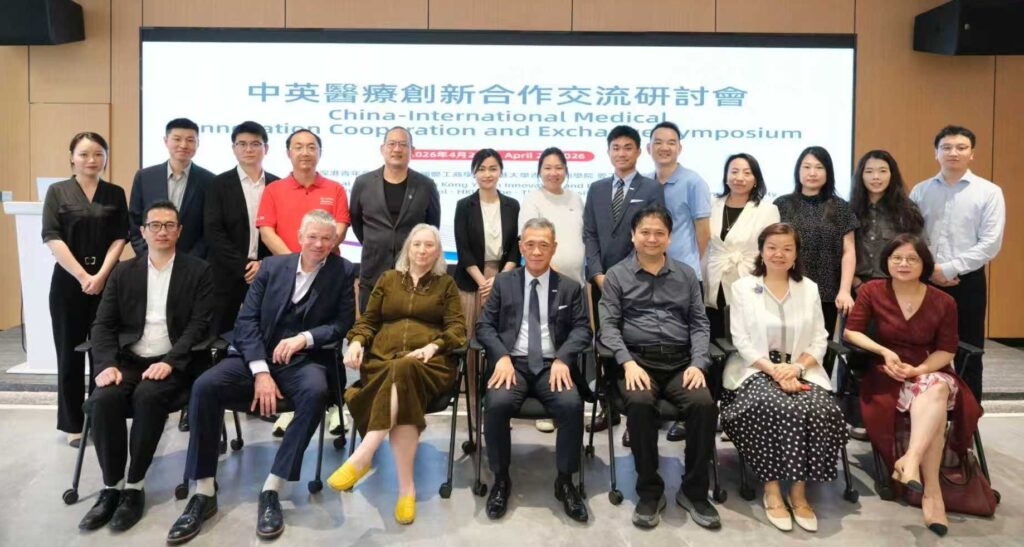
The following day we visited Qianhai Shenzhen-Hong Kong Youth Innovation and Entrepreneur Hub. This was hosted by Peter Mok and Joseph Ho. We were hugely impressed by the incubator’s philosophy, range of technologies, and successful track record in commercialising research from Hong Kong University.
In the afternoon we moved on to our main event the Beacon of Excellence seminar. Sue Welburn gave an overview of the UK China Biomedicine landscape, shaped from her experience of being Co-Chair of the UK China Health Research Alliance UKCHRA and leading Zhejiang University-University of Edinburgh Joint Institute for the past 8 years. This was followed by my presentation on “Commercialisation of Stem Cell Research and New Product Development” featuring Stimuliver’s work on implantable liver tissue for the clinic and Di Chen’s on “The Building of The Research and Translational Ecosystem of Zhejiang University International Campus”.
UK strengths: precision and translation
Sue highlighted our complementary strengths, and I would like to take a moment to reflect on a few key points.
The UK strength comes from precision: strong science, clear regulatory pathways, and a proven ability to translate discovery into globally relevant therapies. Institutions such as UK Biobank and Genomics England underpin a research environment that is globally respected, particularly in early-stage discovery and translational science. The integration of the UK National Health Service into the research ecosystem remains a distinctive advantage, offering a route from laboratory to patient that few countries can replicate at scale.
UK Government policy is broadly supportive. Between now and 2035 the Life Sciences sector Plan commits investment of over £2 billion. Alongside this there are efforts to streamline clinical trials, with ambitions to reduce approval timelines to under 150 days.
Public R&D investment remains substantial, with £13.9 billion distributed through the Department for Science, Innovation and Technology (2025/26), including £602 million for the Medical Research Council.
Venture capital activity delivered £1.23 billion in the first half of 2025. But the mature ecosystem of global firms such as AstraZeneca and GSK anchors the UK’s position in high-value research and development.
The UK continues to generate high-quality, science-led ventures. Companies such as Verdiva Bio (focused on obesity), Orchard Therapeutics (gene therapy), and Kymab (antibody discovery) evidence the strength of the pipeline from research to commercialisation.
China’s strengths: scale and acceleration
The significant difference between the UK and China is the scale of investment, of data, of clinical trials, and increasingly, the scale of ambition.
Biotechnology is a priority for the Chinese government, with regulatory reforms accelerating innovation. In 2025 total R&D investment reached a record $569 billion (around 2.8% of GDP) with sustained annual growth projected at 7%.
China’s ecosystem is broader and increasingly global in outlook. Firms such as BGI Genomics and Fosun Pharma run at significant scale, while the country’s growing share of advanced therapeutic platforms – points to a system moving rapidly up the value chain.
This level of commitment is reshaping the global landscape. China’s ability to move quickly from concept to clinical application, supported by large patient cohorts and integrated industrial policy, creates a powerful engine for growth – particularly in genomics, AI-driven drug discovery, and precision medicine.
Sue’s talk showed how the UK punches above its weight on a per capita measure, but China dominates though absolute scale. As she said, “Put another way where the UK optimises – China amplifies”. No wonder the governments in the UK and China see value in the synergies from these respective strengths.

Building the talent pipeline
This better together logic led to the establishment of ZJE, the first Biomedical Joint Institute in China, for which I am translational director. Ten years ago, Edinburgh and Zhejiang started delivering the first biomedical undergraduate programme in China, University of Edinburgh has more than 800 biomedical science related students now studying at our Joint Institute in China – representing around 3% of the UoE student body.
There are two undergraduate programmes with a third in Intelligent Healthcare in the pipeline. We also have five post graduate programmes are the Institute with these young talents supported by more than 100 academic staff from UK and China.
Our ZJE staff are selected by us for their potential as educators and researchers. But research must be more than a paper trail of publications. A significant amount of the research at ZJE must have translational potential for uptake by industry. Some of this work will align to the UK priorities including healthy aging, regenerative medicine, and the effective management of infectious diseases. These diseases can decimate productivity and dislodge the UK governments’ commitment to economic growth within a fair and equitable society.
The young people at JZE are exceptionally well placed to enter the evolving biomedical healthcare landscape in China and globally. Close to 90% of our students want to carry on in research by taking master’s or PhD. This is much higher than equivalent students in Europe.
A golden age for biomedicine
Perhaps everything I am trying to say can be summed up by Sue’s rallying cry. “This is a golden age for investment and opportunity in biomedicine that can change the health and wealth and therefore future of global society, equitably”. We must embrace this, nurture innovation and talent and build partnerships between academia and industry that can marry rigour and scale.
That is why The Beacon of Excellence and Medcaptain “Frontier” seminars were both timely and important.
Beacon of Excellence was organised by Sharon Cheng, Jiang Si and me as Director of Translation at ZJE, and was kindly sponsored by the China Europe International Business School (CEIBS) in Shenzhen. CEIBS, like ZJE, it is a leading proponent of transnational education, with campuses in China, Ghana and Switzerland.