
From Dr Wong Fun to future leaders
Welcoming our students to Edinburgh, we reflect on a visit that connects their journey with a legacy stretching back over 170 years.
When a group of our undergraduate students from ZJE visited Edinburgh in January, I was keen that they visit the gardens of the Confucius Institute. Peering over their shoulders at the back of the photo below, you can see the statue of Huang Kuan, known as Dr Wong Fun.
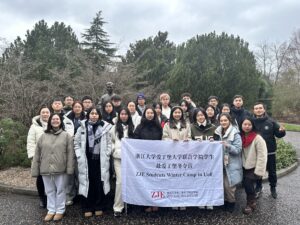
An image of the the ZJE Undergraduate students next to the statue of Dr Wong Fun.
In addition to the statue, there is a plaque which commemorates Wong Fun becoming the first Chinese student to graduate from a European university and the first doctor to be trained in a Western school in 1855. Wong Fun may have been student zero, but over 170 years later many others have followed in his path. Currently around 30% of Edinburgh undergraduates and over 40% of postgraduate students are from Asia.
The first – and far ahead of his time
Wong Fun was a polymath. Before coming to Scotland he had graduated with a degree in literature from the Monson Academy in Massachusetts. His switch to Edinburgh University was at the behest of his patron, a Scot called Andrew Shortrede, but from 1852 he was financially supported by the Edinburgh Medical Missionary Society (EMMS).
He seemed to have made the transition from literature to medicine with some distinction. He garnered a number of prizes in the medical botany classes taught by Professor John Balfour. He wrote his thesis, ‘On Functional Disorders of the Stomach’. In the graduation address he was described in glowing terms:
‘The high station which Dr Wong Fun has won for himself among you as a most meritorious and modest student, and the high prizes and honours which he has carried off, when he descended with you into the arena of competition in the classroom, afford us every hope that he, the first Chinese, I believe, who has ever graduated at a European University, will form, among his countrymen, a most able representative of the medical arts and sciences of the Western World.’
From Edinburgh to the operating theatre
In 1857 the London Missionary Society (LMS) sent him to Kum-Lee-Fow, but he moved on to the American Canton Hospital. In China Wong Fun performed a wide variety of surgeries. He was described as “one of the ablest surgeons east of the Cape of Good Hope”. But he is also credited with educating a generation of Chinese doctors, both as a teacher and by translating medical textbooks into Chinese.
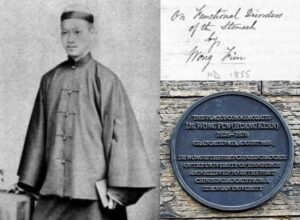
An image of Dr Wong Fun and the commemorative plaque at 8 Buccleuch Place in Edinburgh.
More than history – a blueprint
The reason I wanted the students to be aware of Wong Fun was partly to show how they fit in a timeline that goes back over 170 years. But more importantly, I think Wong Fun exemplifies the implicit and explicit skill sets that we want to instil in our students. He was a good communicator, and he was a leader in the field of Western medicine in China, and he built a legacy.
When I talk about the importance of the teaching at ZJE Institute, I talk about the value of our work in research-led biomedical teaching. But in the same breath I talk about the importance of cultivating a cohort of leaders. Zhejiang University and Edinburgh bring different qualities – but there is a synergy in our commitment to excellence in pedagogy and research.
Finding their own path
Returning to the students in the photo, my colleagues did a workshop with them to work out what they valued about their engagement with ZJE. The students took turns to tell each other stories about significant milestones on their journey with us so far.
The first story shared was from a student who talked about the way that she felt empowered to take advantage of a range of opportunities. She felt that many of her peers in other institutions were more likely to be following a clearly established plan. She had learned to be comfortable with uncertainty and to evaluate and take advantage of opportunities as they came along. Another student picked up this theme, explaining how he had started to pick up chores in the lab and made himself useful and then invaluable. This ability to see what needs doing, take the initiative, and add value will help him go far.
The final two students talked about how their journey through the institute had seen their confidence grow. One had really struggled to share ideas, and fear of failure made them sabotage their chance of success. They now contribute to discussions and take on board feedback. What they saw as uncomfortable is now embraced as a chance to grow and learn.
The final student had chosen his pathway in biomedical sciences because he was discouraged from the visual arts. He then found that his research required him to produce illustrations and protested that he couldn’t do it. Gentle cajoling from his tutor saw him overcome his fear of failure. He is now proficient at drawing, but more importantly he is more open to trying new things.
Growth, grit, and momentum
I like these stories – they show growth and character. The stories also show the first steps on their pathway to leadership that will help them stand out from their peers. No wonder our graduates are so successful in moving into postgraduate programmes. All 85% of the last cohort who wanted to pursue postgraduate study are now doing so. More than half are now undertaking doctoral degrees at global top 30 universities.
The next generation steps forward
When I prepare my address to the 150 students graduating in June, I will talk about the graduates in similar ways to the description of Dr Wong Fun. These young men and women have been shaped by rigorous scholarship and the best principles of transnational education. As ZJE graduates, they step forward as the next generation of leaders and innovators in biomedical sciences, ready to advance research in service of society.