
Expanding UK – China Educational Partnerships
The UK government continues to regard educational engagement with China as a strategic bridge – one that advances scientific collaboration, strengthens academic exchange, and contributes meaningfully to the UK’s services economy. The recent UK meeting of the UK – China Joint Institute Alliance hosted by University of Sussex provided a timely opportunity to reflect on the significant progress the university sector has made in translating this ambition into tangible outcomes.
As of April 2026, there are 68 UK–China Joint Institutes operating across more than 20 provinces and municipalities, with clear momentum in their expansion. Since October 2025 alone, 24 new Joint Institutes have been established, demonstrating both sustained growth and increasing diversification within UK – China higher education partnerships. While East China, particularly Jiangsu and the wider Yangtze River Delta remains a focal point, new collaborations are extending into central and western regions. Notably, Hainan is emerging as a significant hub for transnational education (TNE).
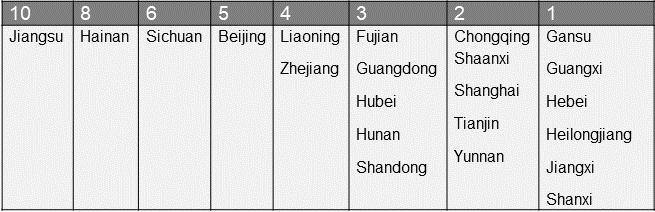
Number of Joint Institutes in each province and municipality
The disciplinary landscape of these Joint Institutes is also evolving in ways that reflect shared strategic priorities. While engineering, artificial intelligence, and advanced manufacturing remain prominent, there is growing activity in business and management, creative industries, digital technologies, and health and biomedical sciences. This diversification enhances the network’s contribution to regional and national priorities on both sides, and it is particularly encouraging to see increased engagement in the arts and humanities.
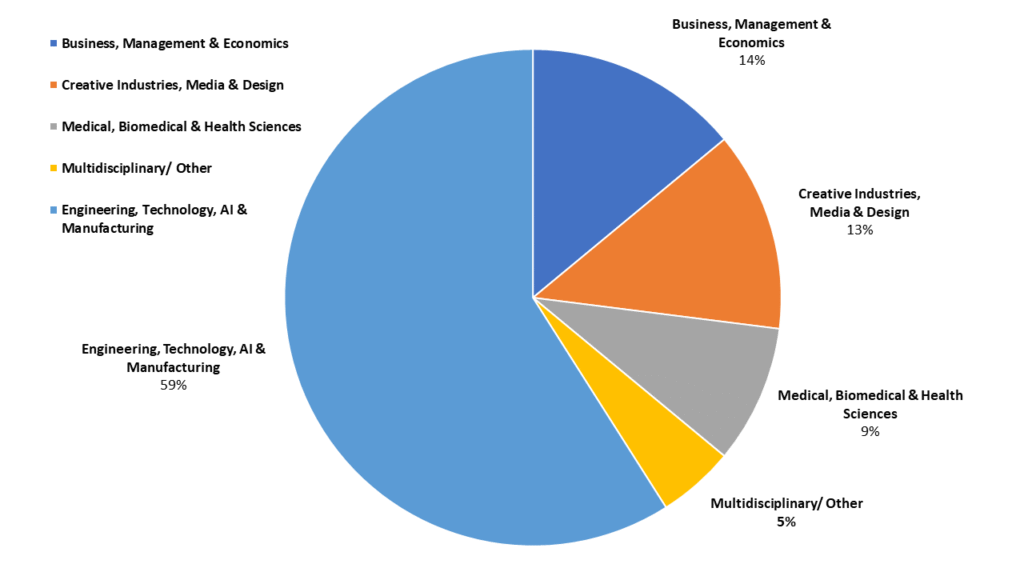
A pie chart showing the shared strategic disciplinary priorities of the 68 UK-China Joint Institutes.
Celebrating What Works
A particularly valuable aspect of the meeting was the opportunity to focus on effective practice. Institutional discussions often centre on challenges; however, there is equal importance in identifying success and understanding how it can be replicated.
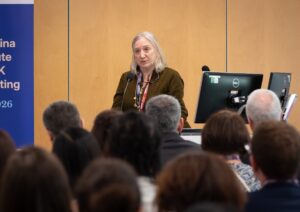
Prof Sue Welburn speaking at the UK – China Joint Institute Alliance meeting in Brighton, May 2026
One notable example is the Alliance Network for Senior Managers and Professionals. Colleagues at the University of Glasgow and the University of Birmingham are facilitating practical knowledge exchange across key operational areas, including admissions, quality assurance, finance, compliance, and institutional administration. This initiative is enabling many Joint Institutes to achieve a high level of organisational maturity within a relatively short timeframe.
The Alliance also plays a critical role in supporting members as they navigate evolving geopolitical and policy environments. This support is essential for building resilience and long-term sustainability, underpinned by robust governance, effective staffing models, and strong compliance frameworks.
In parallel, Dr John Menzies at the University of Edinburgh continues to advance work on student engagement in UK – China Joint Institutes, particularly focusing on concepts of mattering and belonging. Ensuring that students feel recognised, valued, and meaningfully connected to their academic environment is fundamental. Institutes must remain attentive to how students experience research and practice led TNE education and the extent to which this enhances their academic and personal development.
Strengthening Collaboration Through eCADRE
Another significant initiative within the Alliance is eCADRE (Enabling Collaborative Academic Development, Research and Entrepreneurship). Six collaborative projects are currently underway, spanning academic development, research engagement, entrepreneurship, leadership, and communication across UK–China TNE partnerships. Collectively, these efforts are strengthening research capacity, supporting staff development, and deepening institutional collaboration.
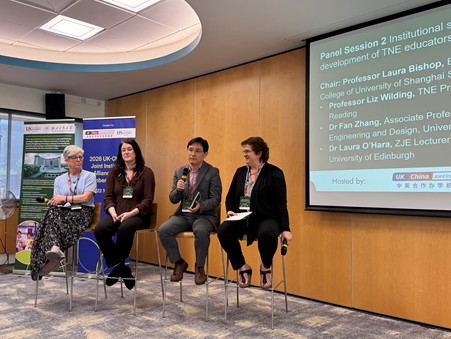
Panel members in discussion at the UK – China Joint Institute Alliance meeting in Brighton, May 2026. (Left to right: Prof Laura Bishop, Dr Laura O’Hara, Dr Fan Zhang and Prof Liz Wilding)
Several shared priorities are emerging. These include the need to enhance research engagement and career development for educators and researchers; a stronger focus on employability, entrepreneurship, and leadership; and more innovative approaches to communication, language support, disciplinary integration, and academic skills development.
The second day of the meeting was particularly valuable for its emphasis on leadership and on supporting academics working across institutions, systems, and cultures. These discussions reinforced an important principle: successful transnational education depends not only on effective structures and systems, but also on sustained investment in the people who lead, teach, and sustain these partnerships. They are our most valuable assets.
A further key theme was the value of co-creation. At its most effective, co-creation brings together the complementary strengths of partner institutions to develop a genuinely distinctive educational offer and enables a truly collaborative “East–West” approach – grounded in shared expertise, mutual learning, and joint design.
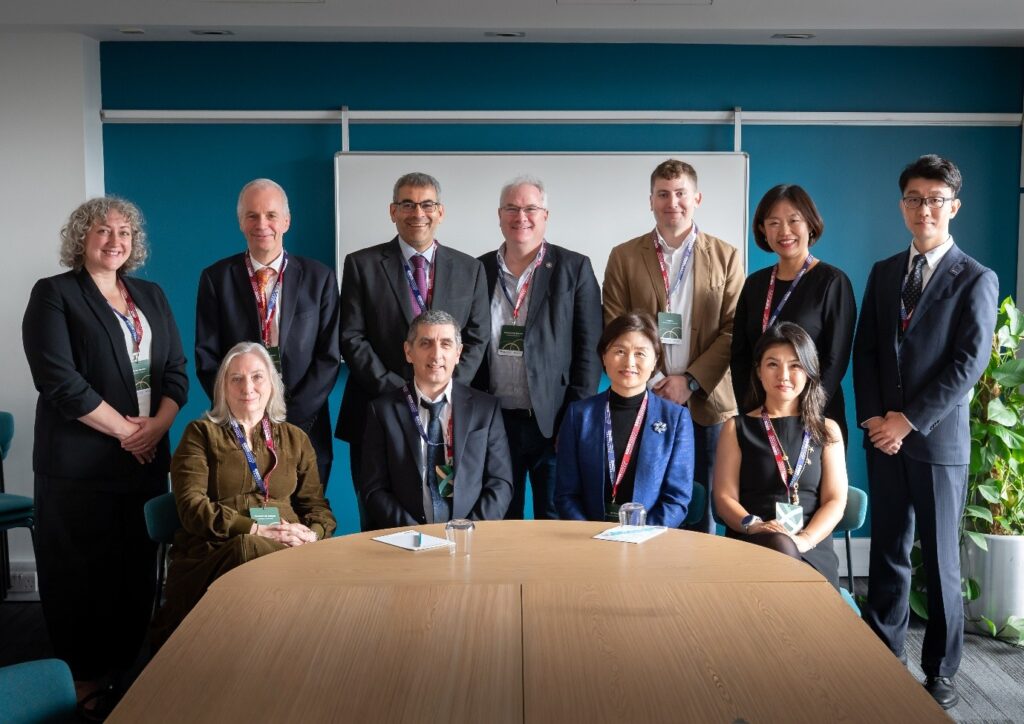
Left to right back row: Gemma Proudley, Prof Luc Moreau, Prof Robin Banerjee, Prof Mike Shipston, Mr Griff Ryan, Ms Lengxin Liu, Mr Chen Zhao. Left to right front row: Prof Sue Welburn, Prof Michael Luck, Minister Counsellor Ms Wei Zhou, Ms Leina Shi.
Looking Ahead
The Alliance will continue to prioritise strengthening institutional connectivity and fostering collaborative innovation. Central to this will be the sharing of practical approaches to sustainable UK – China TNE delivery, including many of the examples highlighted during the meeting. Progress will depend on clearly defined agendas, enhanced knowledge-sharing mechanisms, and the continued development of thematic collaboration across the network.
Thanks
Hats off to the University of Sussex for hosting the meeting, particularly Professor Robin Banerjee, Professor Michael Luck, Professor Luc Moreau, and Professor Simon Thompson. We are so appreciative of the invaluable contributions of the British Council, including Ms Leina Shi and Mr Chen Zhao; Universities UK International, particularly, Mr Griff Ryan; and all Alliance member institutions.
We remain grateful for the continued engagement of the Chinese Ministry of Education, notably Minister Counsellor Ms Zhou Wei of the Chinese Embassy in the UK, and the China Education Association for International Exchange. Their ongoing support reflects a shared recognition of the Alliance’s vital role in advancing high-quality, sustainable UK–China transnational education partnerships.

Photo credit: Prof Laura Bishop (Executive Dean British Sino College)
Finally, a nod to Brighton, what a superb place, the sun was shining and I am struggling to think of a better way to spend a summer evening than having dinner on Brighton pier with all the wonderful colleagues in our TNE community.
See you all in Guangzhou!
Blog written by Professor Sue Welburn, Dean Executive of the Zhejiang – University of Edinburgh Institute (ZJE)