

Launching a new UK–China health partnership
The 10 March 2026 found me in Wuhan, with colleagues at our inaugural workshop of the UK–China Health Research Alliance (UKCHRA). The alliance brought together over 20 leading universities and research institutes from the UK and China, along with other key stakeholders, to set up a platform for engagement of academic researchers, industry professionals, and government representatives.
Deep roots, renewed collaboration
The historic roots of UK–China cooperation in medicine and education in the locality were highlighted: back in the 1860s, Griffith John, a Welsh missionary, arrived in what is now Wuhan and went on to establish schools and hospitals. In 1889, the University of Edinburgh conferred on him the degree of Doctor of Divinity in recognition of his service in China. I am pleased to say that Edinburgh University remains an active partner in terms of scientific development in China, not least through the ZJE Institute where I am Executive Dean.
Aligning strengths for greater impact
Like all platforms that aim to extend collaboration, it is important that the UKCHRA builds on existing programmes. A critical first step is to map institutional competencies and ambitions so that we can identify and agree synergies for enhanced joint research. UKCHRA has been growing an alliance of British and Chinese research partners since July 2024.
From the UK perspective, alignment with our strategic priorities in biomedicine and UKRI agendas is essential. Chinese partners similarly aligned with the National Natural Science Foundation of China (NSFC). This preparatory work strengthened governance and deepened networks across institutions with a strong record of accomplishment in biomedical science.
Trust, governance, and shared standards
If that is the ‘what,’ the ‘how’ is equally important. Any collaborative work must be built on a foundation of trust. Having a face-to-face inaugural meeting was therefore essential, even in an age of virtual connection. Alongside trust, we also put in place the checks and balances of good governance.
In his opening remarks, Matt Moody, Minister Counsellor (Innovation) at the British Embassy in Beijing, referenced prime minister Sir Keir Starmer’s recent visit to China. He highlighted the UK’s strengths in life sciences and the importance of collaboration grounded in trust and high standards to address shared health challenges.
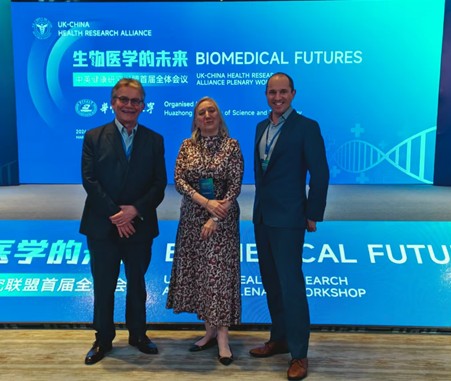
Professor Jon Frampton, University of Birmingham (Chair UKCHRA), myself (co-Chair) and Ross Towers Informed Engagement & Research Security Senior Policy Officer, Science & Technology, British Embassy Beijing, China
From shared priorities to future impact
In the run-up to the meeting, five shared health challenges were agreed:• Healthy ageing
• Obesity & diabetes
• Cancer
• Antimicrobial resistance
• Pandemic preparedness
These priorities build on £28m of investment across two programmes, including the UK–China Flagship Challenge on Healthy Ageing and a second programme on One Health. Together, they provide a solid foundation of evidence, innovation, and collaboration—from dementia and primary care to wearable technologies and epidemic preparedness.
As you would expect from 200 sharp minds, the meeting created a powerful foundation of shared strategic intent and long-term partnership. We also considered how this collaboration can support early career researchers, who will be central to its future.
Clear next steps are now in place, including policy dialogues, stakeholder engagement, and the development of FAIR data protocols aligned to regulatory frameworks. From the UK perspective, we look forward to working closely with the Department for Business and Trade and the embassy to take this forward.
I am confident we have an alliance that can move quickly from collaborative research to policy recommendation and improvements in treatment and care at scale – contributing to health security and greater health equity. More than that, I believe this partnership will evolve in ways none of us can yet fully imagine – and, if we succeed, it may even contribute to my own healthy ageing.
Blog written by Professor Sue Welburn, Dean Executive of the Zhejiang – University of Edinburgh Institute (ZJE)