17:00 Edinburgh local time – Zoom Webinar (Register via Eventbrite here)
Rebuilding (in) History
Historic Antwerp Houses moved to the Bokrijk Open-air Museum
PROF. EM. DR. LUC VERPOEST
KU LEUVEN, BELGIUM
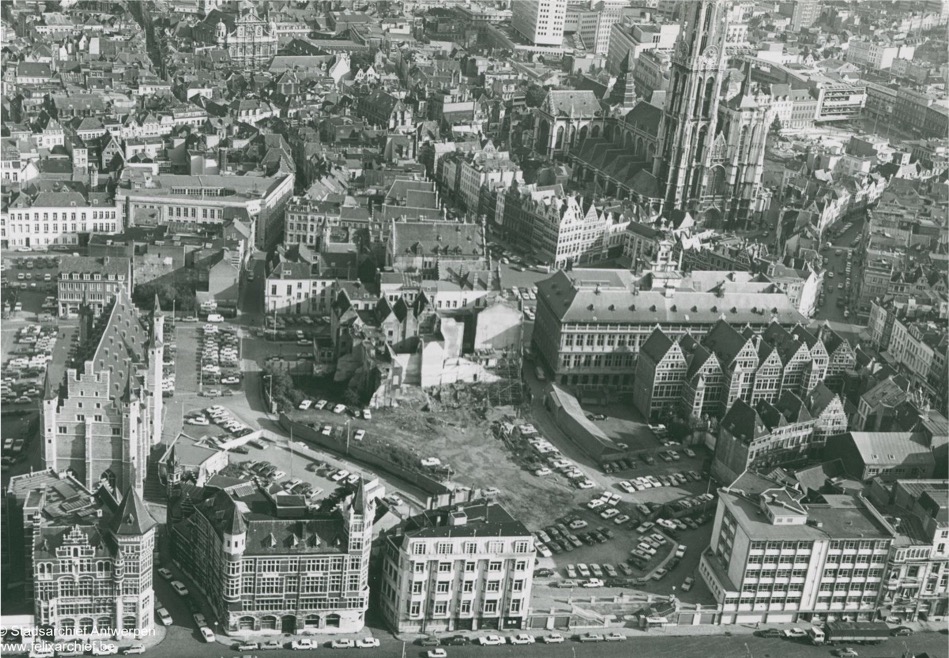
Starting in 1959, the historic district around the Vleeshuis (Butchers’ Hall) in Antwerp’s city centre was largely demolished due to its general dilapidation. Partial wartime destruction in 1944 led to a series of plans in the 1950s and 1960s for preservation and restoration, or complete replacement with new construction, primarily social housing and local shops. A final “Special Development Plan” (BPA/Bijzonder Plan van Aanleg) was approved in 1969. The decision was made to demolish the historic houses but preserving the historic street pattern, and to build new, typologically and morphologically modelled on the historic buildings and urban lay out. The project included 162 residential units, 11 shops, and an underground parking garage, accessible from the Scheldt Quays and on the side of the Grote Markt and City Hall. The architecture, designed by architect Groothaert (1928-2007), in brick with a visible concrete skeleton and sloping roofs, is a “modern” interpretation of traditional Antwerp townhouses. The late-Gothic Vleeshuis (Butchers’ Hall) from the early 16th century has been preserved as the historic centre of the neighbourhood. It was already restored in the early 20th century and used as a museum of applied arts, since 2006 the Music Museum Sound of the City.
When the neighbourhood was demolished in 1959, several 15th- and 16th-century historic houses in the area were carefully dismantled with the intention of rebuilding them in the Bokrijk Open-Air Museum (near Genk, province of Limburg), which had opened the previous year. Conceived as a museum for traditional, rural architecture in Flanders, the creation of “De Oude Stad”, an urban neighbourhood, with possibly buildings from various Flemish cities, was anything but self-evident. Between 1960 and 1973, Bokrijk acquired several houses, which were rebuilt between 1972 and 1989. The project sparked heated debate, in accordance with internationally advocated views (ICOMOS, CIAV, etc.) to preserve historical buildings in situ and not to relocate them elsewhere or move to an open-air museum. In the end the project was never completed and only partially put into use.
Luc Verpoest
Prof. em. Luc Verpoest has been teaching history of architecture (19th and 20th century) and history and theory of architectural preservation. Research was focused on the 19th century Gothic Revival in Belgium, Modern Architecture and architectural preservation.
Luc Verpoest is Honorary Chairman of Monumentenwacht Vlaanderen (Monuments Watch Flanders), of which he is now chair of the Advisory Board; member of DOCOMOMO (International working party for Documentation and Conservation of buildings, sites and neighbourhoods of the Modern Movement) and former coordinator of DOCOMOMO Belgium (and now its Honorary Chairman); member of ICOMOS; former member of the Koninklijke Commissie voor Monumcnten en Landschappen Vlaanderen (Royal Commission of Monuments and Sites Flanders); board member of the Fonds Henry van de Velde / La Cambre, Brussels.