

Week 7: Building a Village & Workshops
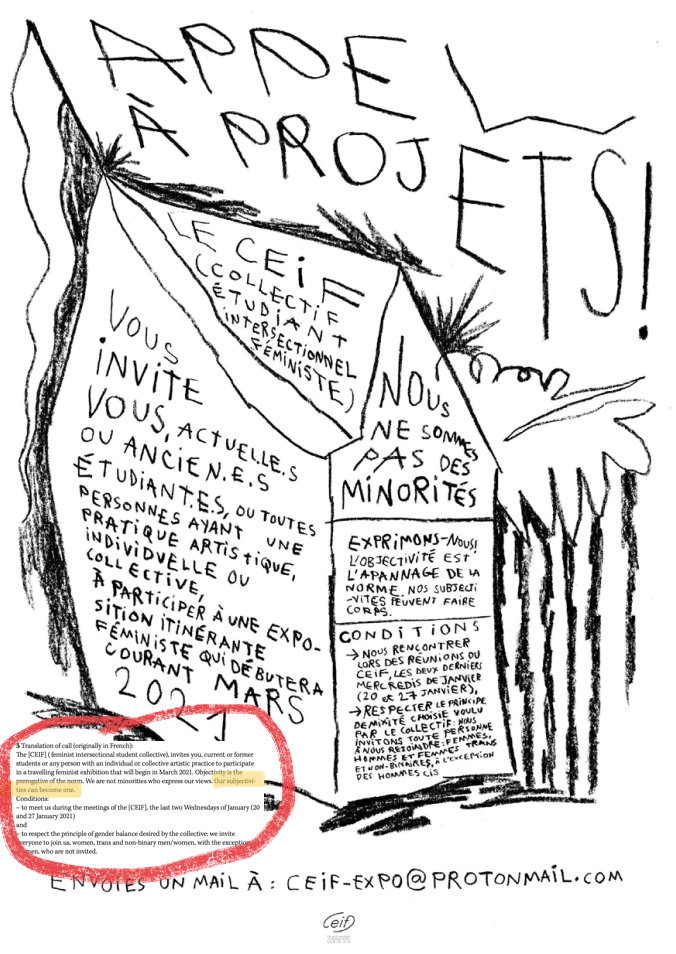


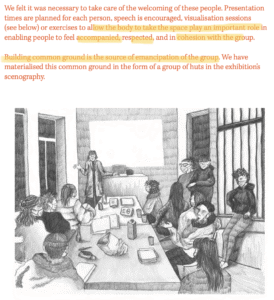
Screenshot of Bernard, Romane, et. al. “Now Imagine That We Are a Village” in Reckitt, Helena and Richter, Dorothee. eds. ‘Instituting Feminism.’ On Curating 52 (2021), pp 143. Drawing by Rose Moreau.
Call drawing by Marie Béney, from Bernard, Romane, et. al. “Now Imagine That We Are a Village” in Reckitt, Helena and Richter, Dorothee. eds. ‘Instituting Feminism.’ On Curating 52 (2021), pp 141-145.
This week, I have been thinking about the emphasis on dialogue and community that is so central to the project — and how to intertwine this in all facets of the project, before/after the exhibition itself.
Building a ‘village’
I have been greatly inspired by the text written by members of the “collectif étudiant intersectionnel féministe” (CEIF), a feminist intersectional travelling exhibition, in “On Curating 52”. They utilize the village as a metaphor and framework to underscore the necessity of collective action and community central to the project.
Incorporating workshops in the development of the exhibitions, CEIF leads with care: ensuring the empowerment and connection of participants in the exhibition.
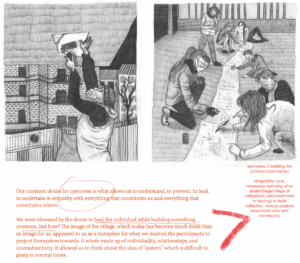
Screenshot of Bernard, Romane, et. al. “Now Imagine That We Are a Village” in Reckitt, Helena and Richter, Dorothee. eds. ‘Instituting Feminism.’ On Curating 52 (2021), pp 144. Drawing by Rose Moreau.
I am currently participating as an artist in off-page 26, a workshop/development programme in Glasgow, and have been thinking about this model of workshops/crits/dialogues leading to exhibition. Whilst the curators/organizers select artists involved, the curatorial project becomes expanded and guided by the diverse interests/practices of the collective and the (actual) dialogues of the artists.
Given the nature of my project, incorporating an artist workshop prior to the exhibition is essential. Perhaps I have been too focused on dialogues amongst publics/project, but a programme for participating artists would foster empowering dialogues and collective gathering.
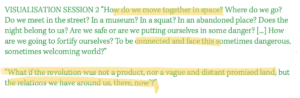
Screenshot of Bernard, Romane, et. al. “Now Imagine That We Are a Village” in Reckitt, Helena and Richter, Dorothee. eds. ‘Instituting Feminism.’ On Curating 52 (2021), pp 145.
Myvillages & Situated Practice
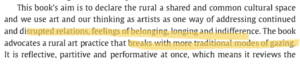
MyVillages, “Introduction” in MyVillages (eds.), The Rural (Whitechapel Gallery, 2019), pp. 12.
The discussion of the ‘village’ goes hand in hand with this week’s focus on situated practices and reading on the rural; revisiting this text cemented key tenets underpinning community and access in my project, and the resonances with my own upbringing in the rural.
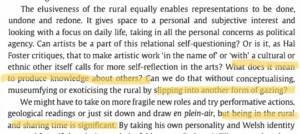
MyVillages, “Introduction” in MyVillages (eds.), The Rural (Whitechapel Gallery, 2019), pp. 17.
I recognize (and am critical of) my own situatedness in relation to the project themes, and as such this emphasis on “[breaking] with more traditional modes of gazing” is crucial for the success of the project. I am not seeking to “produce knowledge about others”, rather, I am devoted to the project offering opportunities for “sharing time” and dialogue, crucial for building an understanding and empathetic public/community.
Extending Dialogues
In conducting further research for the project publication, I came across Out of the Blueprint, an eco print studio actually located within Out of the Blue Drill Hall, the proposed site for the exhibition. They focus on supporting young people within the community through residencies, workshops, and training opportunities, and their printing services support these efforts. As such, they are a perfect partner to work with to print the publication, flyers, and other project ephemera.
I would be very interested in proposing workshops through Out of the Blueprint as part of the programming to involve young artists from the local community, and will investigate this further in the coming weeks.
References
Bernard, Romane, et. al. “Now Imagine That We Are a Village” in Reckitt, Helena and Richter, Dorothee. eds. ‘Instituting Feminism.’ On Curating 52 (2021), pp 141-145. https://www.on-curating.org/files/oc/dateiverwaltung/issue52/PDF_to_Download/OnCurating_Issue52_WEB.pdf
MyVillages, “Introduction” in MyVillages (eds.), The Rural (Whitechapel Gallery, 2019), pp. 12-19.


1 replies to “Week 7: Building a Village & Workshops”
Leave a reply

Hi Preston, there is some excellent research appearing across your posts, both independent (including engagement in curatorial activities externally) and course-related, very well done. There are some really strong visuals also, enhancing the feel of a portfolio.
Week 4, frame the dynamics of working collectively in a research context, quoting from those working in artist-led culture, or from sociology/politics/arts management sources, for eg.
Week 5 “Does this conveniently instrumentalize the diversity of a neighborhood”, link gentrification to globalisation (Week 1) ideas of care (Grant Kester, Nato Thompson writing on public space and public art may be of interest). Denmark and Russia are discussed, consider cultural context of Scotland in comparison? A bit of history on Dalmeny Park? Frame questions as conceptual, practical, or? Link the question on White Cubes to course readings (anything from Week 2, or Week 3 on ethics of engagement?)
Curatorial Pitch: work-in-progress (wip). “My proposed curatorial project will involve” because…be explicitly how this multi-arts or cross-medium curatorial methodology (examples of this approach in Edinburgh, Glasgow…perhaps things curated by artist-led centres?). Very evocative use of poem for title, written when? (think extra pithy info to enrich always, in your own style). You mention “migration and the refugee experience” re: the poem and “diaspora”: more is needed on the Edinburgh context/Dalmeny park if you are using this source/this focus. (for example The Trembling Museum is named after a concept from Edouard Glissant’s work and was integral to the show’s curation https://glasgowguardian.co.uk/2023/12/19/the-trembling-museum-curators-on-modernism-glissant-and-the-problem-with-museums/) Strong selection of indicative artists, sourced how?
Week 6: “a key focus of mine” or SICP project title ? Clear and substantial investigation of course lecture on publishing, good. Week 7, great to read about off-page (good to add hyperlinks, do this elsewhere, eg artist/theorist/educator sites/profiles?). More criticality on what “dialogue and community” are?
Presentation (supporting micro-edits):
Use Figure/Image for inserts of all sorts. Footnote 1: too long, it is main blog discourse. Add basic bio for references, eg curator, eductor Mary Jane Jacob, maybe https://www.saic.edu/profiles/faculty/mary-jane-jacob eg Copenhagen-based collective Superflex. Give full names Alvi X, Kato Y. Use subheadings when shifting focus in a weekly post to eg Curating MA CAP/MA CAT workshop (more criticality on this experience). Clear signposts, eg Week 7 Situated Practices. Be sure to summarise all references/sources used in posts at the end including exhibitions etc.