

Critical Reflection Text


Introduction
Mending the Mutilated World is an exhibition exploring the relationship between diasporic identity and the physical and conceptual landscapes of artists’ adopted countries. Employing an exhibition, publication, and public programme which includes a music performance and poetry reading, the project seeks to offer intercultural dialogues as an alternative to division resulting from rising anti-immigration and racist sentiments across the country. In this text I will reflect upon the influence of the research, practice, and theory developed throughout the course on my SICP, focusing on key moments that influenced the project’s development, the formation and development of the Jí Jū Collective, highlights from the Summerhall project space, and a final analysis of the impact of my SICP.
Becoming Jí Jū Collective
A key moment in the formation of our collective was deciding upon our name: Jí Jū Collective. Inspired by the Mandarin word for hermit crab (Jìjū xiè), the name reflects the fact that no one in the collective is from Scotland, and as such, is living in an occupied home or ‘shell.’ Being the only native English speaker, navigating early weeks in the collective was difficult as I found myself often taking on an Informal Leadership1 role due to the ‘personal power’ I carried due to the rest of the collective’s speaking English as a second language. Whilst I am comfortable in and often assume leadership roles in group settings, I found it difficult to delegate tasks to peers, and when met with less participation and engagement I would often assume the work of these tasks myself (ex: drafting the initial Collective Ethics Manifesto myself). As I did not leave space for other members to take on leadership roles in these early weeks, I often felt isolated in the imbalance of contributions and effort between myself and other members. The collective’s working dynamic began to positively shift throughout the term as I adapted and reflected upon my leadership role.
Initial Project Conception + Ethics
From the outset of my project, I was interested in presenting an exhibition that could challenge rising anti-immigration sentiments and the growing difficulty of migration across the globe through a rooting in the negotiations of artists based in the UK. Given the political and social nature of this topic, a consideration of curatorial ethics was paramount to the project’s success throughout development; Maura Reilly’s text heavily informed my ethics in regards to the necessity to enact change and actively seek solutions to systemic inequalities. I remain highly critical of my own positionality as a white male within an art world where the “legacy of authority and privilege has not been laid to rest.”2 The curatorial practices Reilly discusses that move from “affirmative-action curating” to “smart curating” informed my own curatorial strategies which center upon amplification of marginalized voices and letting the exhibition themes be developed and guided by artists’ practices. Later curatorial decisions reflect these strategies, removing aspects of programming to allow for more of the budget being allocated to the commissioning of new work from Nidhi Bodana and to support the publishing and performances of work from members of the Scottish BPOC Writers Network.
Shifting Project Locations
Following feedback from the Formative Curatorial Pitch, it became clear that the concerns over my selection of Dalmeny Street Park outweighed the positive aspects of the outdoor site. The location was critical to my initial conception of the project, as Chiang Mai Social Installation festivals3 and APTART’s “Anti-Shows”4 greatly influenced my desire to embed the exhibition within the urban landscape. This choice stemmed from a desire for wide accessibility and a rejection of how “institutions… make use of their symbolic power and their material infrastructures to endow the interests of big capital and individual wealth with a healthier glow or to engage in forms of fashionable ethics”5 which has remained foundational to my curatorial ethics and methodologies used in my SICP. Whilst this choice felt like sacrificing a key aspect of my project, this shift offered greater accessibility and connection with the local community, given Out of the Blue Drill Hall’s existing infrastructure and community-oriented programming. Rather than see this as a fundamental loss to the DIY/guerrilla nature of my project, it marked my shifting recognition of the power of a multi-arts curatorial methodology to effectively and accessibly serve a wide range of publics.
artists who read Workshop
When the ‘artists who read’ student group asked me to lead an art writing workshop, I saw it as a perfect opportunity to explore workshops as public programming in the Summerhall Collective Space. The ekphrastic writing workshop generated meaningful exchange and open dialogues, demonstrating the impact workshops have in building and engaging communities. As part of documenta fifteen, curators Tanya Abraham and Maayan Sheleff led a workshop inviting participants to respond to individual works, creating new routes and responses to artworks that demonstrate how curatorial practices can “adopt a wider and a more far-reaching method of interpretations and perceptions.”6 Sparking a dialogue between artists and writers in my workshop demonstrated the diversity of interpretations and responses to an individual work of art, and a similar workshop could not only be used to engage audiences within an exhibition, but as a democratized curatorial methodology in which the response and engagement of publics inform the curation of an exhibition.
Whilst I had initially considered inviting participating artists to lead workshops as part of the public programming of my SICP, the process of planning, arranging, and leading the workshop demonstrated how much effort goes into running a successful workshop, and that it cannot be approached as merely an addition to an exhibition to foster community engagement.
A trimmed tree is no place for song birds
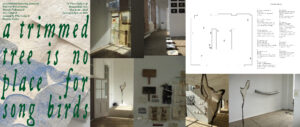
Collage including exhibition flyer, installation views, and floor plan of the exhibition a trimmed tree is no place for song birds. All images and designs are my own.
A highlight of the course was curating an exhibition of MA Contemporary Art Practice students alongside Ellie Lodge, which was installed over a weekend in the collective space at Summerhall. When planning the layout of the exhibition, we quickly arrived at a structural approach that eschewed a linear narrative; rather than subdividing the space into three spaces for each artist (an easy choice given the space), we created a plan that moved seamlessly between works and reflected our intention to present the material relationships between their works. I was greatly inspired by Mary Louise Pratt’s notion of “contact zones” as “social spaces where disparate cultures meet, clash, and grapple with each other, often in highly asymmetrical relations of domination and subordination.”7 These asymmetrical relations are replicated through the aesthetic and social sphere of the white cube, where “the work is isolated from everything that would detract from its own evaluation of itself,”8 isolating artworks from the culture and context in which they were created. By incorporating two speakers that looped Mitsuki Nakatani’s field recordings of chanting monks and cicadas in Japan, Alvi Östgård’s retelling of a Scottish folktale, and Kato’one Koloamatangi’s grandfather playing lap steel guitar, the exhibition cultivated and presented “contact zones” between the artists’ diverse cultural backgrounds and the works they informed.
In Week 3’s Blog I questioned James Clegg’s notion that all exhibitions must “hold the room”, that spatial concerns are equally as important as the theoretical and conceptual rigor of a project. Throughout the process of curating this exhibition, this reality became painfully clear: the aura of certain works necessitated varying amounts of ‘room to breathe’ (Nakatani’s tapestry), or were strengthened through a direct dialogue with other works (the ephemera wall). As I later developed the layout of my SICP, this practice supported how I navigated the physical and conceptual, altering my selection of ihsan saad ihsan tahir’s work for one that would be more responsive to the space. The inclusion of an ephemera wall presenting artistic research including material studies, notes, and drawings from Koloamatangi, Nakatani, and Östgård was crucial to the project, and provided me with communication skills throughout the process of asking these artists to contribute to a collaborative, co-authored installation of ‘private’ aspects of their practice. Rooting curatorial decisions in the underlying themes explored in artists’ practices was crucial in justifying decisions and ultimately curating an exhibition that fostered connection and intercultural dialogue between these three artists, informing how I communicate with artists in future curatorial projects.
Jí Jū Exhibition: “Our Shell”
In the week following the MA CAP exhibition, my collective self-curated an exhibition exploring how we find and create inhabited “shells” while living abroad. This exhibition included artworks from members and an installation we created together, bringing together images of home with images of Edinburgh to create a ‘shell’ in the gallery space.
Reflecting on how my role within the Collective shifted throughout the term, I admittedly was less involved in the process of developing “Our Shell” than in earlier moments throughout the course, such as the improvisational curation workshop I organized in the collective space in Week 6. While I introduced an original concept for the exhibition centered upon the objects we use to fill our “shells,” the concept and themes shifted through other members’ contributions as I took more of a situational leadership approach.9 Through this I actively balanced participation and delegation: physically installing artworks and translating written materials to English while others handled macro-level decisions and last minute printing. This experience demonstrated the role that my leadership style can have in limiting space for open dialogues; when I stepped back in the collective and allowed others to assume leadership positions, the emergence of quieter voices contributed to a stronger team dynamic and ultimately a more effective exhibition that reflected the diverse interests and voices within the collective.
Curation as Sculpture
As demonstrated throughout my blog, I have considered many different forms of programming for my project. Upon developing a budget, I quickly realized I could not feasibly incorporate all of these aspects with a high level of criticality and fair compensation for all involved parties. Though I initially wanted to avoid the traditional form of the exhibition, the process of curating a trimmed tree is no place for song birds helped me realize how “the potential of art lies in putting before us a manifestation concretized as a cultural formation,”10 cementing my interest in exploring the limits and possibilities of curating artworks as a methodology to foster spaces for the open exchange and circulation of ideas.
Whilst navigating this uncertainty regarding what methods and forms for my project to take, visiting the Talbot Rice exhibition The dead don’t go until we do11 cemented my choice to include a reading room, moving the exhibition into a space for education and sharing of knowledge. Despite discovering it early in the course, the 2023 Taipei Biennial’s curation of a music room was foundational in my consideration of live music performance as a curatorial format that shifts the role of spectatorship to active participation through listening.12 Leading to research into musicians and discovery of the band Kinaara, this was crucial in cementing the format of my public programme. Ultimately, I have learned that the curatorial process is akin to sculpture: whilst research contributes to an ever-growing mass, I had to continually remove and refine aspects in order to arrive at a curatorial methodology that best suited the underlying ‘goals’ of the exhibition.
Shortcomings and Successes in Mending the Mutilated World
My underlying methodological approach to curation I outlined in Week 4’s blog of pairing the mission of ‘the rural’13 with the project of ‘the minor’14 underpinned my efforts throughout the development of my project. I have been highly critical of an instrumentalization of the artworks to demonstrate the exhibition themes, rather than employing these works to complicate, support, and offer different meditations on diasporic identity and how it is enmeshed within adopted culture. Proposing a conversation rather than a lecture, my eschewing of didactic curation in the project raises potential concerns over the lack of direct education of important topics.
Given the project’s engagement with themes of immigration, a decolonial and anti-imperialist methodology is crucial and requires further reflection. The Changemakers’ Museum Test,15 whilst targeted towards museums, is a tool to analyze how topics of imperialism, colonialism, and the transatlantic slave trade are discussed and treated within an exhibition. Whilst my project would pass as ‘good’, it still raises concerns over the lack of direct discussion of themes such as immigration and the impact of imperialism, particularly relevant given a number of participating artists come from former British colonies. The inclusion of Scottish BPOC Writers Network in the programme ensures diverse perspectives are incorporated in the project, though this partnership could be incorporated at an earlier point in the project development — this is particularly relevant in regards to how I incorporate workshops as curatorial methodology in future projects. In his seminal essay “Museums as Context Zones,”16 James Clifford outlines this in practice when discussing the inclusion of indigenous Tlingit elders in planning discussions over the reinstallation of the collection at the Portland Museum of Art. By borrowing the idea of “contact zones,”17 he posits that the museum can (and should) function as a space for exchange and dialogue, offering a symbiotic relationship benefiting both the museum and cultures represented by objects on display, rather than a reflection of colonial and imperial extraction. Whilst my exhibition successfully supports notions of exchange and challenges colonial and imperial histories, the inclusion of only one socially-engaged practice (Nidhi Bodana) and lack of structured workshops for education and early inclusion of diverse perspectives are shortfalls that hinder the project’s effectiveness in engaging publics.
Conclusion
Throughout the process of researching and developing my SICP alongside curating exhibitions and leading workshops in the collective space, I have come to better understand the negotiations between concept, impact, and feasibility enmeshed in contemporary curation. Central to my curatorial practice is a rejection of the “mega-exhibition”18 as a format for meaningful engagement with communities and the impactful circulation and exchange of ideas. The development of my SICP has exposed how ‘usefulness’ remains central to my practice, informing my goals for future curatorial projects to be “created by and through [their] usership.”19 As such, in the future I am interested in producing community-centered public programming (art walks, workshops, classes, symposiums, listening rooms), as these curatorial methodologies oppose the structure of institutional exhibitionary models and meaningfully engage public participation. In my curatorial practice moving forward, the role of curation is to elevate marginalized voices and re-orient audience spectatorship towards active engagement, using curation as a methodology to foster discourse and challenge fragmentation across communities.
Notes
- See Byrnes, William J. “Chapter 8: Leadership in the Arts” in Management and the Arts. 5th ed. Burlington, Massachusetts ; Focal Press, 2016.
- See Reilly, Maura. Curatorial Activism: Towards an Ethics of Curating. London: Thames & Hudson, 2018, pp 214-225.
- See Teh, David. Artist-to-Artist : Independent Art Festivals in Chiang Mai 1992-98. London: Afterall Books, 2019.
- See Tupitsyn, Margarita, Viktor Agamov-Tupit͡syn, David Morris, and sponsoring body Bard College. Center for Curatorial Studies. Anti-Shows : APTART 1982-84. Edited by Margarita Tupitsyn, Viktor Agamov-Tupit͡syn, and David Morris. London: Afterall, 2018.
- See Krasny, Elke and Perry, Lara. eds. Curating with Care. Routledge, 2023, p2.
- See Sheleff, Maayan and Abraham, Tanya. “Reflections on the Workshop “Untitled (Re-curating documenta fifteen)”” in Ronald Kolb, Dorothee Richter (Eds.), OnCurating Issue 54 / November 2022 eds. https://www.on-curating.org/issue-54.html
- See Pratt, Mary Louise. Imperial Eyes : Travel Writing and Transculturation. Second edition. London: Routledge, 2008, p7.
- See O’Doherty, Brian. Inside the White Cube : The Ideology of the Gallery Space. First book edition. Santa Monica: Lapis Press, 1986, p14.
- See Byrnes, William J. “Chapter 8: Leadership in the Arts” in Management and the Arts. 5th ed. Burlington, Massachusetts ; Focal Press, 2016.
- See Kosuth, “The Play of the Unsayable: Preface and Ten Remarks on Art and Ludwig Wittgenstein,” 1989, in Art After Philosophy and After: Collected Writings. Cambridge, Massachusetts: MIT Press, 1991, 250, quoted in Smith, Terry, and Independent Curators International. Thinking Contemporary Curating. New York: Independent Curators International, 2013, p116.
- See the exhibition The dead don’t go until we do, an exhibition at the Talbot Rice Gallery in Edinburgh, Scotland from 07 Mar – 30 May 2026. https://www.trg.ed.ac.uk/exhibition/dead-dont-go-until-we-do
- See the 2023 Taipei Biennial, “Small World,” which ran from November 18, 2023, to March 24, 2024, at the Taipei Fine Arts Museum. https://www.taipeibiennial.org/2023/list/musicroom
- See MyVillages, “Introduction” in MyVillages (eds.), The Rural (Whitechapel Gallery, 2019), pp. 12-19.
- See Chris Sharp, “Theory of the Minor” in Mousse 57 (February 2017), pp. 224-231.
- See The Changemakers, “The Museum Test”, Museums Galleries Scotland, June 7th 2023. https://www.museumsgalleriesscotland.org.uk/advice-article/the-museum-test/
- See Clifford, James. “Museums as Contact Zones” in Routes : Travel and Translation in the Late Twentieth Century. Cambridge, Mass. ; Harvard University Press, 1997, pp. 188-219.
- See Pratt, Mary Louise. Imperial Eyes : Travel Writing and Transculturation.
- See Thea, Carolee, and Thomas Micchelli. “Introduction” in On Curating : Interviews with Ten International Curators. First edition. New York, N.Y: D.A.P./Distributed Art Publishers, 2009, pp. 7-19.
- See Hudson, A. (2017) ‘Building a user-generated museum: a conversation with Alistair Hudson’, OpenDemocracy, 5 May. Available at: https://www.opendemocracy.net/en/building-user-generated-museum-conversation-with-alistair-hudson